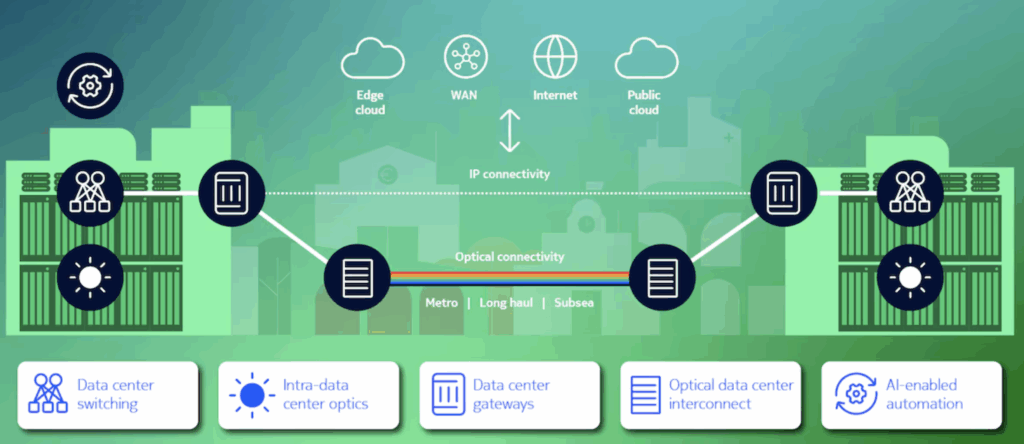
00:00 [music] 00:03 for RCR Techch. I'm Sean Kenny and 00:05 welcome to Signal and Noise, where we 00:06 host conversations from the edge of AI 00:09 with a wide variety of industry experts 00:11 and thought leaders. It's a pleasure to 00:13 introduce Mike Buchong, vice president 00:15 of data center at Nokia. So, Mike, 00:17 thanks for joining me. 00:18 >> Happy to be here. 00:19 >> Before we kind of dive in here, can you 00:21 maybe give us just a general overview of 00:24 uh Nokia's data center business and just 00:26 give us some details of your particular 00:28 remitt? Sure. So I mean I own data 00:30 center globally which means you know 00:32 everything from strategy to figuring out 00:34 you know how we go to market all of the 00:36 ancillary things that come along with 00:38 that you know figuring out support 00:39 services and and whatever from a Nokia 00:42 product perspective you know we build 00:44 hardware so we build routers and 00:46 switches think of it as like the gateway 00:48 all the way to the fabric within that 00:50 you we've got uh a particular emphasis 00:52 on merchant silicon so you know a lot of 00:55 familiar you know Broadcom parts which 00:57 will kind of drive the form factors 00:59 That hardware runs software that we call 01:02 SR Linux. That's our flagship operating 01:04 system, you know, based in Linux as the 01:06 name would suggest, but really kind of 01:08 telemetry and automation forward is is 01:10 kind of the way to think about that. And 01:12 then in some cases, depending on, you 01:14 know, which segment we're after, we've 01:15 got management software. We call it EDA. 01:17 EDA is multi- vendor intentbased 01:20 management. So, think of this as kind of 01:22 a top- down approach to multi- vendor 01:24 management in data centers. 01:26 >> Yeah. And I know with the uh huge amount 01:28 of commercial activity around AI and the 01:31 underlying infrastructure, you've been 01:32 staying busy. But yeah, that's what I 01:34 kind of wanted to get into today is the 01:36 the role that networking plays in making 01:38 all this possible. If I kind of look at 01:40 our own coverage, we're covering point 01:43 solutions. We're not covering systems. 01:45 we're writing about GPUs or rack level 01:47 energy consumption or liquid cooling or 01:49 whatever one kind of aspect but maybe 01:53 help us understand how data center 01:56 networking is that sort of fabric that 01:58 makes all of these point solutions work 02:00 as a system. Yeah, I mean ultimately 02:03 people think about the either the 02:05 outcomes if you're you know sort of a 02:06 business level buzzword strategist 02:09 really you've got like jobs that have to 02:10 run you've got collections or clusters 02:12 of you know GPUs or compute resources at 02:16 some point they have to talk to each 02:17 other so the network really is the 02:18 connective tissue that brings it all 02:20 together in the networking space that 02:22 leads to you know some operational 02:24 considerations and then there's a set of 02:26 you know kind of connectivity 02:27 considerations and then I would say in 02:29 probably you know what we'll get into 02:31 today there's a bunch of strategic 02:33 things that happen both inside the 02:35 network but also outside the network you 02:37 know things like procurement practices I 02:39 mean there's like I would say there's 02:40 industry competitive dynamics that are 02:42 at play and so a lot of it comes 02:44 together so when we think about AI in 02:46 the data center I would just encourage 02:48 people to think it's not only about the 02:50 bits and bites I mean there's like big 02:52 moving pieces here and I think you know 02:54 decisions are far more these days than 02:57 just you know can I connect this to that 02:59 you got to think through you know things 03:01 like workforce implications. You got to 03:03 think through things like, you know, 03:04 long-term budget and, you know, what 03:06 kind of dynamics do you have with vendor 03:08 management, supply chain, I know it 03:10 feels like it was years ago when supply 03:12 chain was like a hot thing. Supply chain 03:14 is still like front and center and 03:16 whether that's supply chain resiliency 03:18 or whether it's even things like lead 03:20 times to hit, you know, some of these 03:21 like early or aggressive timelines. And 03:24 then you there's there are broader 03:25 dynamics, you know, I'll say it out 03:27 loud. I mean, like Broadcom and Nvidia 03:28 are titans of industry. And so there's 03:31 things that have to happen there that 03:33 probably influence decisions that folks 03:35 make depending on the scale that they're 03:36 building at. 03:37 >> So I guess to dig in a little bit deeper 03:39 here, you know, whatever the AI workload 03:42 is that's running in that data center. 03:44 If it's training, if it's inference, you 03:45 know, it's regardless it's a lot of data 03:48 traffic moving around, east, west, 03:50 north, south, moving between clusters 03:52 across cloud regions also out to the 03:55 edge, which is another sort of 03:56 interesting uh discussion area, but 03:58 maybe help us understand the lay of the 03:59 land. What are some of the current 04:01 bottlenecks? 04:02 And to add on to that, is innovation in 04:06 networking keeping pace with kind of the 04:08 AI scaling that people are investing in 04:11 and that the market seems to have an 04:13 appetite for? I guess tackle the second 04:15 part of that first. Like is networking 04:17 keeping pace? I think it's that's 04:19 largely true. I mean right now the GPUs 04:21 and effectively the Nvidia are setting 04:23 the pace and so the question is you know 04:24 at what pace can Nvidia turn out nextg 04:28 GPUs and then when they do that creates 04:30 sort of an architectural shift as you go 04:32 from let's say 400 to 800 to 1.6T and 04:35 beyond. So all of that's kind of locking 04:37 into to GPU availability. Um the thing 04:40 that's going to drive that though at 04:42 some point and we're starting to see the 04:43 bend now at some point it's really comes 04:46 down to you know can we get enough power 04:47 into the facilities to drive this. So if 04:50 you look today like you know what most 04:52 people are trying to do today would be 04:53 you know let's say 120 kilowatts per 04:55 rack. Nvidia's got plans to push that to 04:57 600 kilowatts per rack. Google's 04:59 announced and that's by like by 2028. 05:01 Google's announced plans to get to like 05:03 1 megawatt per rack. And so the just the 05:05 type of growth that's going to put the 05:07 power generation and then obviously like 05:10 distribution like can the grid carry it 05:12 that's going to be really in the 05:13 crosshairs and so if I look and say like 05:14 where's the long pole in the tent I 05:17 don't think right now it's networking 05:18 not that's not really the long pole it's 05:20 going to be kind of broader bits how do 05:22 I get power concentration now you 05:24 mentioned the edge piece so this does 05:26 drive like a bunch of different changes 05:28 right in some cases you know because of 05:29 where power is is or how it's accessible 05:32 and you know depending on where 05:33 geographically you are there's 05:35 considerations like green power versus 05:36 just any power. What that's going to do 05:38 is, you know, drive some consideration 05:40 for whether the solution is going to be, 05:41 you know, massive, you know, 1 gawatt, 2 05:44 gawatt, 6 gawatt facilities or whether 05:47 you're going to see more distributed 05:48 data centers. I do think we will start 05:50 to see different architectural 05:52 preferences emerge. Today, a lot of the 05:54 emphasis is around, you know, kind of 05:55 the really the massive footprint for 05:58 huge data centers. I think when you get 06:00 into different geographies, I think the 06:02 one I think the need goes down and two, 06:04 I think, you know, practically speaking, 06:06 it's difficult to build those facilities 06:07 out. So, I think you'll see more of the 06:09 edge piece. And then you mentioned 06:10 inferencing versus kind of training 06:12 foundational models. When you get into 06:14 the inferencing side, you know, I think 06:16 you're going to see, you know, one, 06:17 older generation GPUs become viable in 06:20 those use cases. Two, uh, latency 06:23 becomes really, really important. And 06:25 then as a result of of kind of the 06:27 emphasis on latency, then you have to 06:28 get into distributed outcomes. You're 06:30 not going to see everything centralized. 06:32 And so when you get to distributed 06:33 outcomes, then there's a whole change in 06:35 architecture. And then part of this is 06:36 going to lead to the whole scale up 06:38 versus scale out considerations where 06:40 you're either optimizing for, you know, 06:42 large central workloads or things that 06:44 are more distributed with an emphasis on 06:46 latency. So we're seeing like huge 06:49 changes in architectural considerations 06:52 which then leads to changes in the 06:53 supporting portfolio and that's really 06:55 behind a lot of the announcements that 06:57 you're seeing in our industry now. I'll 06:59 call out the Broadcom announcements 07:00 around their ultra chip. That's like a 07:02 good example where they've said look 07:04 there's a different way of building what 07:05 we want to do is optimize for a scaleup 07:08 architecture and it's a different set of 07:10 use cases. I expect that kind of thing 07:13 to really accelerate over the next 07:14 couple of years. 07:15 >> Yeah. You know, and just to kind of give 07:17 some reaction to that, and I don't mean 07:19 to time stamp our recording, but my 07:21 colleague Kelly is in Restston, Virginia 07:23 covering the data center frontier show 07:25 right now, and she's interviewing a 07:26 bunch of data center operators, and it's 07:28 essentially, you know, what are your 07:30 >> problems in order of priority? And to 07:32 your your point, you know, power, access 07:35 to power, access to land. I guess we're 07:38 seeing longer runway on actual 07:40 acquisition of land, build timelines 07:43 getting stretched out. So kind of making 07:45 that whole project management piece much 07:48 more difficult. And then as you 07:50 mentioned, supply chain still stretched. 07:52 That's not a problem that ended as we 07:54 kind of got out of COVID. That's still 07:56 an issue. You know, you also mentioned 07:58 scale up, scale out. Uh Nvidia this week 08:01 they had an announcement that was around 08:03 data center networking and they used the 08:05 phrase scale across which I guess speaks 08:08 to this idea of the data center and the 08:11 edge as a continuum right 08:14 >> yeah what's I mean we've seen this 08:15 already even in the hypers scale where 08:17 it used to be there was like a distinct 08:19 line between front end and backend 08:21 networks like I don't know that that 08:22 line exists anymore you have networks 08:24 and you have workloads and so when you 08:26 blur the architectures then you start 08:28 expanding the the footprint over which 08:30 these things have to operate. It 08:31 increases the scale. I used to work with 08:33 Bos Kohley. He's at Google now. One of 08:36 the things he said that I thought was 08:38 pretty obvious after the fact, but 08:40 frankly it wasn't obvious to me before 08:42 he said it, so I feel a little bit 08:44 embarrassed. He said that when you're, 08:46 you know, even if you're operating at 69 08:48 at sufficient scale, things are breaking 08:50 every couple of hours. I'm like actually 08:53 that's true. Like I I think of like 08:55 reliability and resilience as a property 08:57 of how do you build it but at a certain 08:59 scale it like failures are going to 09:00 happen which means that even when you do 09:02 this if you take scale across or if you 09:04 take these sort of converged networks 09:07 the operational burden is just way 09:09 higher the larger the administrative 09:11 domain is and so it's not just changes 09:14 in how do you move packets I mean it 09:15 changes like how you operate it changes 09:17 how you monitor it changes remediation I 09:20 mean it drives changes in architecture 09:22 you know it's not so much, you know, 09:24 just about building a non-blocking 09:26 fabric. It's like I have to know when 09:28 something's going wrong as quickly as 09:29 possible so I can take that element out 09:32 of rotation and then do something around 09:34 it. You know, yes, we have non-blocking 09:36 fabrics, but if you have something that 09:38 has not quite failed but is a little bit 09:41 sick, like that's actually a dangerous 09:44 position because, you know, when things 09:45 have failed, we know how to work around 09:47 it. when things are merely not operating 09:49 well sometimes you run into challenges 09:52 like this whole operational piece I 09:54 think is you know really challenging and 09:55 if you look at you know why the 09:56 hyperscalers have have led the way in 09:58 large scale deployments you know I would 10:00 argue it's not just their capex stamina 10:03 right it's also their understanding of 10:05 how to to manage operations at scale you 10:08 know obviously given the the vast 10:09 quantities of compute that they've 10:11 they've used historically 10:12 >> but yeah I mean like you said it seems 10:14 obvious but yeah any machine that big 10:16 any system that complex, there's always 10:18 going to be things breaking. And I mean, 10:20 you kind of referenced this a little 10:22 bit, but maybe take us a bit deeper on 10:24 what that kind of implies for networking 10:27 resiliency, visibility into the 10:29 networking fabric, and just assurance 10:32 that the packets are going from point A 10:34 to point B as they should be. 10:36 >> So there's the whole rise of 10:37 observability generally, which so I 10:40 guess maybe like a little bit of a dive 10:42 into that as a primer. you know 10:44 monitoring and visibility have always 10:45 been important right whether it's you 10:47 know SNMP or SIS logs or or whatever the 10:51 whole movement around observability was 10:52 the idea that it wasn't enough to look 10:54 at you know only the things that were 10:56 explicitly instrumented that ultimately 10:58 these are systems of systems and that 10:59 you have to get some visibility into the 11:01 operations of the components inside 11:03 these black boxes you know for the the 11:05 hypers scale especially when you're 11:06 operating at that scale what they want 11:08 to do is look at you know anything that 11:10 has information or state that they can 11:13 use to make decisions to diagnose if 11:15 something's going right or wrong to know 11:17 if they need to, you know, pre-plan and 11:19 move something, if they need to take 11:20 some kind of, you know, preventative or 11:22 some remediation action. And so that 11:24 gives rise to just a different level of 11:26 telemetry. It's not enough to just give 11:28 me some interface counters and, you 11:30 know, call it a day or to look at, you 11:32 know, my, you know, routing adjacencies 11:33 and make sure that my peering 11:34 relationships are up. you've got to look 11:37 inside and and monitor things like, you 11:38 know, individual resource utilization, 11:41 um CPU utilization. You know, if CPU is 11:43 spiking, you get things like 11:45 scheduleuler slips and and that has, you 11:47 know, implications that are actually 11:49 very difficult to diagnose. They're not 11:51 typically persistent and so they're like 11:53 really really hard to reproduce and they 11:55 create, you know, lingering issues. Now, 11:57 in a nonAI world, some of that stuff may 11:59 be tolerable. In an AI world where you 12:02 know lossless is king, it's your 12:04 tolerances are are dialed in way tighter 12:07 than they otherwise would have been. And 12:09 so then if you take all of that then the 12:10 question is how do I get as much 12:13 information about the state of my 12:15 infrastructure as possible and then 12:18 that's you know it starts with on the 12:20 device and in the software you know what 12:22 is instrumented what is accessible but 12:24 then you get into you know broad 12:26 collection mechanisms and even then if 12:28 something's expansive enough just 12:29 collecting all the data is not that easy 12:31 to do and then when you have all the 12:33 data how do you find you know you know 12:35 the proverbial needle in a hay stack 12:37 it's not a needle in a hay stack 12:39 anymore. It's like a needle in a stack 12:40 of other needles. And so, how do you 12:42 find the right one? So, I mean, this is 12:44 where you start to see different 12:45 techniques and methods being used to 12:47 pour through all of the information. You 12:49 know, this is I guess our industry uses 12:51 the somewhat pathy term, you know, 12:53 there's AI for networking and networking 12:55 for AI. You know, the networking for AI 12:57 is sort of well understood. AI for 13:00 networking is I think still emerging and 13:02 there is a role to play in trying to 13:04 sift through all of this but the the 13:06 operational overhead and the load here. 13:08 I mean it's not trivial you know just 13:10 the scale alone but also the insights 13:12 themselves are way deeper than we've 13:13 historically had to look and that puts 13:16 the burden on all of us to figure out 13:18 you know how do you build a model around 13:21 what's going on and then how do you 13:23 predictably drive whatever the 13:25 remediation is and if you're operating 13:27 at scale it's not enough to know the 13:28 remediation how do you develop enough 13:30 confidence in that remediation that you 13:32 can take you know autonomic action on it 13:35 so that there's not a person that stands 13:36 in the middle Like that challenge is 13:38 actually pretty sizable, but it changes 13:40 a lot about, you know, what we build, 13:41 how we build, and then ultimately how we 13:43 operate. 13:44 >> Yeah, that's a great segue. You know, I 13:46 have this folder on my desktop and it's 13:48 full of infographics that I pull off of 13:50 LinkedIn. I just kind of see them and I 13:52 think, hey, that looks interesting. So, 13:53 I save them to go revisit them later. 13:55 And they're all generally about 13:57 understanding the cost of AI. So, a lot 14:00 of it is kind of delineation of the cost 14:02 of a data center. if you're going to 14:03 stand up a 3 gawatt facility, you know, 14:06 this is how much money goes towards 14:08 GPUs, this is how much goes towards 14:09 power, etc. By and large, they're all 14:12 incomplete, so the utility of them is is 14:15 maybe limited. They look great on 14:17 LinkedIn, though. So, I I mean, 14:18 [laughter] 14:19 things keep it up. But there's not a lot 14:21 in there on understanding 14:24 where networking fits into that larger 14:27 cost equation. And you kind of 14:29 referenced automation strategies there 14:31 and the non-trivial cost associated with 14:33 networking, but help us understand how 14:37 smarter architectures, how robust 14:39 automation strategies can really deliver 14:41 a meaningful cost efficiency. 14:43 >> So when most people look at the cost, 14:44 they're looking at usually the cost to 14:46 build and procure. And so most of your 14:47 infographics will start with, you know, 14:49 how much does the land cost, how much 14:51 does the power cost, what does power 14:52 generation look like. There's pretty 14:54 good math around what does a GPU cost? 14:56 Most people will benchmark networking at 14:58 you know nominally 10% of the total 15:00 price of that kind of of the collection 15:02 of infrastructure and so most of the 15:04 costs are fairly coarse and really based 15:07 off of I guess ratios that people have 15:10 become accustomed to. Um whether those 15:12 ratios persist by the way I think is is 15:15 an interesting discussion maybe not for 15:16 today but but I think there's depending 15:18 on who's doing the buying and at what 15:20 volume you may actually see you know 15:21 structural changes in that and then I 15:23 think industry dynamics will drive you 15:25 know different pricing and then 15:26 eventually different accumulation of 15:28 profit pools which impacts everything on 15:30 the operations side the reason you don't 15:31 see much on the operations piece is that 15:33 that is the IP of the individual of the 15:36 of these operators and so they don't 15:38 actually reveal a ton about that there's 15:40 not easy to get to cost modeling for 15:42 that and I would tell you that the cost 15:44 if if you have access to a pool of 15:46 talent that's particularly capable of 15:48 operating at this scale you can operate 15:50 one way if you don't have access to that 15:52 talent it almost doesn't matter how much 15:53 you spend now in terms of the actual 15:56 cost around it I mean there's a couple 15:58 of things to think about you know 15:59 there's a at this point they're not 16:01 really network operators I mean these 16:03 you're building out fairly complex 16:05 software stacks because it's all around 16:07 how do I deploy a service how do I 16:09 assure that service meaning how do I 16:11 moni monitor and look at the the health 16:12 of that service. Um, that has to tie 16:14 back in ultimately to some business. So, 16:16 in many cases, if you take the GPU as a 16:19 service part of this market, you got to 16:21 tie into orchestration systems. There's 16:23 front-end portals that customers have to 16:24 go use. Like the way to evaluate the 16:26 cost isn't the what's my network 16:28 operations cost. It's really what's my 16:30 software development cost. And then the 16:33 way people do that in practice is that 16:35 you'll take you know network engineers 16:36 will team with you know your s sur or 16:39 your devops folks who have more of a 16:41 coding background and the combination of 16:43 them they can get to you know workflows 16:44 and systems that are integrated and so 16:46 the question about how all of that how 16:48 much that's going to cost is going to 16:49 depend on your access to talent. You 16:50 know how robust is your stack? Are you 16:53 offering something as a service or are 16:54 you merely running workloads? So if 16:56 you're building out, you know, a if you 16:58 want to tune a model, but you're not 17:00 offering it as a service, then the the 17:02 parts of your software stack are going 17:04 to be different than they would be if I 17:06 have to build a whole front end along 17:07 with, you know, all the elements that a 17:08 customer needs to see. And so I think it 17:11 it really varies. And where I see this 17:13 this variance being really interesting, 17:14 I talked to a lot of colo providers 17:16 lately. like everyone wants to cash in 17:18 on the AI movement and there's like very 17:21 like wildly different points of view on 17:24 how they're going to build their 17:25 businesses. Some folks are pretty open. 17:28 You know, we are a effectively a real 17:29 estate company. We're going to sell 17:30 cages and rack space and that's what we 17:32 do. And others are like we're going to 17:34 be the next coming of Equinex and we're 17:36 going to have this robust stack. Well, 17:38 even in that space, if you said that 17:39 there's like, you know, GPUs are going 17:41 to be hosted in these facilities, 17:43 there's this huge spectrum of investment 17:46 on the operations side depending on 17:47 whether they think that they're 17:49 basically a real estate company or 17:50 whether they think they're going to 17:51 offer something as a service. So, even 17:53 then, it's hard to get to like just 17:55 some, you know, baseline that says, you 17:57 know, here is the overall cost. It's so 17:58 intimately tied to the the use case and 18:01 how customers are going to experience 18:02 this. And then again, I would I would 18:04 anchor or benchmark against software 18:07 costs, not like typical NetOps type 18:09 costs because I do think the model's 18:11 different. And then given the AI arms 18:13 race right now, I mean, there's there's 18:14 a if you're in the space and you're one 18:17 of these people who has, you know, a lot 18:18 of talent and a lot of experience, you 18:20 are in demand. And so I think it what 18:23 that's going to do is it's going to 18:24 inflate the overall costs. If you're 18:26 getting into the game late and you're 18:28 trying to pull people, it's going to 18:29 cost more to pull them than it will to 18:31 build them up. And so even then like 18:32 where you are relative to everybody else 18:34 is going to change your cost profile. 18:36 >> It feels like I mean everything is in 18:39 flux. Every piece of the kind of AI 18:42 equation seems like it is just 18:43 constantly changing and the pace of 18:46 change is dizzying. It's really hard to 18:48 keep up with. And maybe you can help 18:51 give us a reality check. You know if I 18:52 talk to one model vendor the 18:55 socioeconomic revolution is nigh. If I 18:58 read this MIT report that came out late 19:00 last week, 95% of enterprises can't move 19:03 into production that affects their their 19:05 P&L. So, it's just really kind of 19:07 difficult to triangulate what a 19:09 reasonable near-term expectation is, but 19:12 I mean, what do you think AI and I know 19:14 it's a super general question that calls 19:16 for speculation, but I mean, where are 19:17 we going to be in three years? 19:19 >> There's probably two I'll give you my 19:21 opinion, but there's two schools of 19:22 thought. One is that, you know, this is 19:24 a bubble and people think that it will 19:26 either burst or leak. The other school 19:28 of thought is that, you know, demand 19:29 right now is is going to run unabated 19:31 for the next three, four or five years. 19:33 And I've talked to people on both sides 19:34 of this. I think regardless of whether 19:36 you think it's a bubble, I don't think 19:37 anyone right now is arguing that AI is 19:39 not a durable technology. To me, it 19:42 feels a little bit dotcomish. And the 19:43 reason I say that is not because of all 19:45 the spend. I mean, that's part of it. 19:47 But in the dot times, there was a, you 19:50 know, step one, right? You know, build a 19:52 website. Step two was typically nebulous 19:54 and step three was profit. You know, I 19:57 think right now we saw this in 2010, you 19:59 know, 9, 10, 11, 12. You know, step one 20:01 go to cloud, step two sort of nebulous, 20:04 step three, you know, cost savings was 20:06 probably that one. And then as people 20:08 did that, it turns out that there was no 20:09 guarantee. And so then you see the 20:11 repatriation movement and whatever. I 20:14 think right now, like when I talk to 20:15 folks about their strategies, you know, 20:17 step one AI, step two don't know, step 20:19 three profit. I think there's a general 20:21 lack of understanding about whether the 20:23 profit pools are going to accumulate 20:24 around the AI apps. Let me give you like 20:26 a really easy concrete example. I've got 20:28 14-year-old identical twin boys. They're 20:31 going to to college or university, 20:33 depending, I guess, if you're European 20:34 or not, in the next couple of years. 20:36 Now, would I guide them to a radiology 20:38 career? Like, no way. Like, for sure, 20:41 right, AI is going to take over medical 20:43 imaging. But does that mean that AI 20:46 medical imaging apps are going to make a 20:48 killing? Also, no. Like, there's going 20:51 to be dozens of them because you get 20:53 access easy access to data. And so it's 20:55 going to be like somebody's master's 20:57 project to put together like, you know, 20:58 an MRI reading app. And so it's 21:01 simultaneously true that you're going to 21:03 see an entire industry disrupted and 21:05 that it's going to drain the profit 21:07 pools. No one's going to make any money 21:08 off of that. I think what we don't know 21:10 right now in all the speculation, 21:12 there's a whole bunch of stuff that's 21:13 like what can we build, but I don't 21:15 think we know like which things that we 21:17 build are going to be durable. Now, in 21:18 my opinion, I think narrow use cases are 21:20 easier to monetize than broad use cases. 21:23 I think that proprietary data I think 21:25 that unique insight people will pay for 21:27 that and so I think you're going to look 21:28 at like really hyperverticalized 21:30 solutions that's going to be I think 21:31 that's where the early winners will be 21:33 think like smart agriculture so you know 21:35 John Deere is doing a ton with computer 21:37 vision and and making per plant watering 21:41 decisions like exactly how much water do 21:44 you need on each bloom I mean like to me 21:46 that's that kind of information like 21:48 that's a durable business model and you 21:50 can make a ton of money because it's got 21:52 a direct connection to some like 21:54 specific outcome either higher yield or 21:56 lower water costs. I think that's the 21:58 kind of stuff that is going to survive. 22:00 So I think with the next three year, 22:01 going back to your question, I think 22:02 over the next three years, what we're 22:04 going to find out is how many people had 22:05 generalized AI ambitions and how many 22:08 had a thesis that said, "Here's a very 22:10 specific customer problem I'm going to 22:11 solve." And then that's going to be 22:13 you're going to lay waste to a bunch of 22:16 companies that had faulty strategies and 22:19 then the ones that emerge after that are 22:21 going to be like the next crop of 22:22 dominant companies. And so I think 22:24 that's going to be a durable business, 22:25 but I think we're going to have to see a 22:26 little bit of failure first. 22:28 >> Yeah. The John Deere example is really 22:30 strong. I've been able to visit some of 22:32 their facilities before and it is it's 22:35 domain specialization, 22:37 >> a huge pool of clean curated data. 22:41 There's absolute business clarity and it 22:44 is immediately measurable in terms of is 22:47 this improving outcome, is this saving 22:49 money and and it's working. It's working 22:51 quite nicely for them. So I mean are you 22:53 bullish on artificial general 22:55 intelligence or you sound you like you 22:57 lean more toward I think it's a term 22:59 Mustafa Sullyman uses artificial capable 23:01 intelligence. It doesn't need to be a 23:03 generalist. It needs to deliver outcomes 23:05 that matter to businesses. 23:07 >> I think narrow outcomes are easier to 23:09 map to businesses in the short term. I 23:12 think there's a buying audience for 23:13 that. That's what I think is going to 23:15 emerge. I'll give you like another 23:16 really great example. Fujitsu was doing 23:18 work with GE on jet engines where they 23:21 were literally dropping microphones 23:24 behind the engines while planes were 23:26 boarding and going through their checks 23:29 and based on anomalies in the sound they 23:31 could detect whether there was an issue 23:32 in the engine. I mean that's like 23:34 hyperfocused right it's like specific to 23:37 a type of engine clear use case I mean 23:39 people will pay for safety you know 23:41 super narrow but like hugely valuable I 23:44 just things like that are easy to say 23:45 yes to the generalized stuff I think 23:48 there's a lot of interest I struggle 23:50 with like what's the sustainable 23:51 business case take image generation as 23:53 an example like clearly whether it's 23:55 deep fakes or or building out like you 23:57 know marketing content and training 23:58 videos and there's crazy amounts of of 24:00 these apps now I struggle because 24:02 there's so many free options. I struggle 24:04 with how anyone makes money off that. I 24:06 just I don't see the business model 24:08 because one of the losers in the current 24:10 crop is going to say, "Fine, then you 24:12 can have mine for free." And they've 24:14 just set the ceiling on the price to 24:16 free. There's always other services 24:18 you'll offer fair. I'm not saying that 24:19 it's impossible to make money around it, 24:21 but once you put that kind of pricing 24:23 pressure in, I think the whole 24:24 monetization strategy gets quite a bit 24:26 murkier. And there's like a huge part of 24:28 the population consuming this stuff that 24:31 they're just tinkerers right now. And so 24:33 the question is going to be, you know, 24:34 where are your sustained buyers? How do 24:36 you get to them? People, no one's 24:38 talking about go to market, by the way. 24:40 How do you get to them? Right? You can't 24:41 count on going viral. So how do you get 24:43 to those folks? And I think that's going 24:44 to lead to like wholesale turnover of 24:46 some of these companies. 24:47 >> Yeah. So in either case though, whether 24:49 it's enterprises focused on narrow AI 24:51 enabled applications or it's people 24:53 dumping billions of dollars into chasing 24:55 AGI or super intelligence or whatever 24:57 you like to call it. I mean 24:59 >> seems like Nokia's strategy would be the 25:01 same either way, right? You're there to 25:03 support what your customers want to do. 25:05 >> Yeah. I mean, we need to provide that 25:06 connective tissue. What we want to do 25:08 is, you know, meet people where they're 25:09 at operationally. And so there's going 25:11 to be like the spectrum of of 25:12 capabilities. you know these more narrow 25:14 use cases may favor smaller networks 25:16 that are way more distributed. You know 25:18 look at like you know what's happens in 25:20 let's say you know mining or 25:21 manufacturing look at like you know oil 25:24 or oil and gas and how they do you know 25:26 their exploration type work. So what we 25:28 have to do is make sure that we've got 25:29 the foreman function to work across all 25:31 of these whether it's like large and 25:32 centralized being purchased primarily 25:34 through hyperscalers or whether it's 25:36 something that's small and distributed 25:38 and then that leads to a couple of 25:39 different strategies. Um, one, I think 25:41 there's different operational strategies 25:42 based on scale. And so the products that 25:44 you deploy in an enterprise and in maybe 25:47 a smaller, more focused use case are 25:50 very different than what you would do 25:51 for like say a Neocloud who's building 25:53 out, you know, a 100,000 GPU cluster. 25:56 You know, we got to build in some cases 25:58 software that's fit for purpose. In 26:00 other cases, interfaces that plug into 26:02 software that's developed by somebody 26:04 else. when you get into like the actual 26:06 hardware itself, you know, you're going 26:07 to see, you know, inferencing which will 26:09 favor, let's say, smaller form factor, 26:11 you know, not quite the same throughput 26:13 requirements, and then you'll see people 26:15 who are using, you know, whatever the 26:16 current generation of of Nvidia or AMD 26:18 or, you know, whichever GPU vendor. I 26:21 think that's all true. I think you have 26:23 to account for changes even the GPU 26:25 landscape. You know, there's a lot of 26:26 folks that look at this and say, "Hey, 26:27 Nvidia's carved out a pretty good 26:29 business." So you're going to see new 26:31 entrance in that space whether that's 26:32 the hyperscalers themselves building 26:34 some of the stuff or it's other entrance 26:36 which means that we have to then work in 26:37 a way that's generalized. I love 26:39 Ethernet in this case because it's you 26:42 know the idea that it's going to be an 26:43 open ecosystem I think has a lot of 26:44 merit to it especially economically and 26:47 then on top of all of that you have to 26:49 have the requisite support and services 26:50 to meet people where they're at. And so 26:53 it's not just here's my product. It's 26:55 like what's the full surround of of 26:57 products and service and software and 27:00 hardware you know integrations and 27:02 pre-anned automation like all of these 27:04 things have to come together. So our 27:06 strategy is to build kind of all of that 27:08 and then to take the pieces that are 27:10 relevant to specific segments so that we 27:12 can you know effectively meet them where 27:14 they're at of course but also deliver 27:16 like very specific outcomes because I 27:18 don't think generalities win in a market 27:20 this large. 27:21 >> Hey one last question Mike and I'll tell 27:23 you the context. My son, who is uh 27:25 homesick from school today, is three. 27:27 So, I haven't yet begun actively uh 27:29 manipulating his interests. But you said 27:31 you said you wouldn't steer your 27:32 14-year-olds to study something like 27:34 radiology in university. What would you 27:36 steer them towards? 27:38 >> Cobalt. 27:39 The world's banking systems are 27:41 dependent on a group of developers that, 27:44 you know, kind of came out through the 27:45 70s. As they retire, like these systems 27:47 are still going to exist. No, I mean 27:49 obviously I wouldn't steer them towards 27:51 Cobalt, but I think right now like you 27:53 got to get comfortable with AI tools 27:55 like it's going to impact everything. 27:56 You know, in some cases there people are 27:58 managing it very aggressively. Like if 28:00 you're not comfortable with tools, you 28:02 know, over the next week, you know, 28:04 we're going to exit you from the 28:05 company. There were some LinkedIn 28:06 articles on that like literally this 28:08 week. You know, I think they need to get 28:10 comfortable with using the tools. And 28:11 then the big trend that I'm nervous 28:13 about for the next generation or the 28:15 next couple of generations is the 28:16 linkage between, you know, brain 28:18 activity and overuse of AI. I think if 28:22 you lose the fundamentals because you're 28:24 so reliant on something to produce the 28:26 fundamentals, I think you put yourself 28:28 at a significant disadvantage. So what I 28:30 want the boys to do is to use the tools 28:33 actively, but to use it as part of 28:34 something else. And so what I'm trying 28:36 to encourage them is, you know, because 28:37 they're doing homework now. My kids are 28:39 in eighth grade. you know, they're 28:40 they're working, they have to write 28:41 papers and they're like, you know, we 28:43 could just use chat GPT. I'm like, yeah, 28:44 you could. But then when I ask you a 28:47 question about something, what are you 28:48 going to do? And you're not at your 28:49 laptop. So, to me, it's going to be the 28:51 coexistence. And so, I think the kids 28:52 should go that direction. And then I'm 28:54 quite bullish on understanding like the 28:57 all the vibe coding tools right now are 28:59 pretty important. I think getting them 29:01 into the software side so they 29:02 understand architecturally how do you 29:04 bring components together? I think 29:06 there's a lot of value there. I still 29:07 think system level thinking is difficult 29:09 to replicate and if you can if you have 29:11 sort of the foundational knowledge, 29:14 you've got the tooling experience and 29:16 then you've got the ability to pattern 29:17 match and work work across big things 29:19 like that's where I think there's still 29:21 magic you know hopefully through their 29:22 useful careers. Um obviously we're going 29:24 to see crazy changes but minimally that 29:26 should get me to my retirement home well 29:28 funded. 29:30 >> Advice Mike and I uh really appreciate 29:32 you taking the time to join me and help 29:33 our audience separate the signal from 29:35 the noise. Thank you very much. It's 29:37 been fun. [music]
No matching passages. Try another word.