

Nvidia-obsessives will pore over 20-odd releases from GTC, and there is lots to chew over; some of it is interesting: the AI-RAN stuff with T-Mobile and Nokia; the idea of a new category of “agent computers” (a likelier hit than AI glasses, surely); all the focus on physical AI, animated by agents running inference models at the edge. But today’s industry trends are yesterday’s roadmap items for Nvidia; the biggest talking point at GTC – as ever with Nvidia – is in the framing, which more than MWC or whatever other sub-sector trade show, sets the global tech focus.
As such, Jensen Huang’s talk during his GTC keynote about the firm’s new Grace Blackwell architecture with NVLink 72 (“a huge technological gamble, not easy for any of our partners”) and NVFP4 tensor cores – delivering 35–50 times throughput improvements over Hopper, apparently – featured the most interesting stuff, and worked as a segue to something else: about tokens as a commodity, driving AI infrastructure into a new economic phase. Grace Blackwell / NVLink 72 proposition also cuts costs per token to the lowest anywhere, he said.
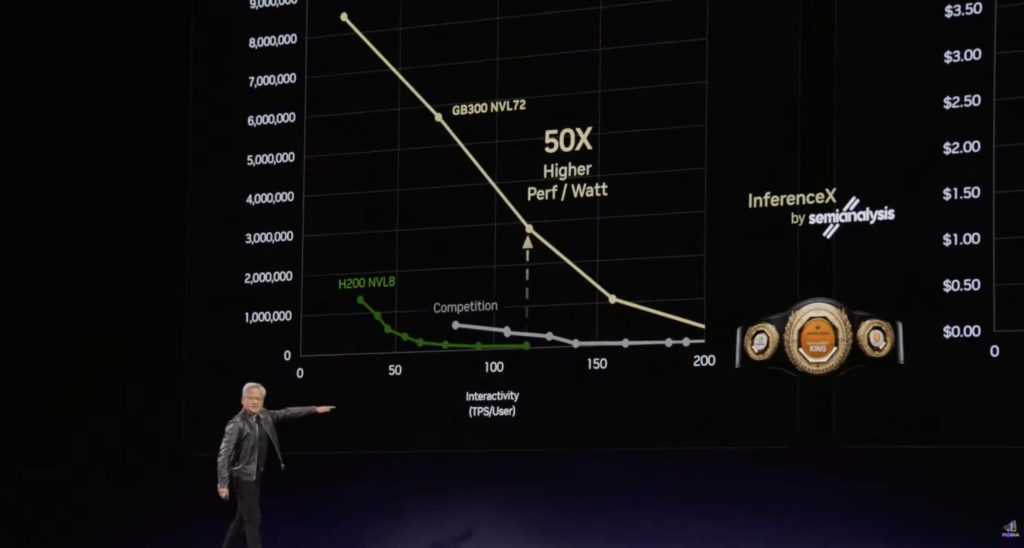
And then Huang stood in front of a graph showing the throughput (number of tokens per second at a fixed power level) on the vertical axis and token speed (response rate per inference step) on the horizontal axis. Data centers are no longer just compute hubs, but AI ‘factories’ – per the new terminology – that produce tokens at scale, and measure efficiency in terms of throughput, latency, and ultimately revenue per watt. The faster the speed, the larger the usable model, the longer the context, the more intelligent the AI – is the point.
This is what every CEO in every enterprise will be looking at, he said – token efficiency in their factories, as a core operating metric. The token is a new commodity, which will be tiered in pricing once it matures: from gratis (high throughput, low speed), as we consume AI today, through intermediate, advanced, high-speed, and ultra high-speed plans (going to $150 per million tokens). Nvidia’s NVL72 is presented as the “inference king”, delivering 50-times higher performance per watt at 35-times lower cost versus its old NVL8 line, and a jump on its competitors.
So the takeaway from GTC is not that Nvidia has new hardware, software, blueprints, frameworks, initiatives, coalitions. It is that all of these things, together with ecosystem developments on top, redefine how hardware is understood and monetised. Whoever controls the most efficient “token factories” will shape the next phase of the AI economy. And, as with previous AI cycles, Nvidia is not just supplying the tools, but setting the terms. Be interesting to see if and how operators might tokenize their networks, which they are pumping so much investment into.

James Blackman
Executive Editor
RCR Wireless News
RCR Top Stories
Nvidia talks AI-RAN: Nvidia’s trillion-dollar AI infrastructure forecast set the tone at GTC yesterday, framing its AI-RAN partnerships with Nokia and T-Mobile (part of a $2tn industry) as a new frontier for low-latency inference at the edge.
Meta chip roadmap: Meta is accelerating its custom silicon efforts with new MTIA 300, 400, 450, and 500 chips. It is moving to a six-month iteration cycle to optimize for AI inference workloads while maintaining modular design for DC racks.
Meta infra push: With its $27 billion Nebius deal, Meta is doing whatever it takes to build out or acquire data centers, silicon, and software – both reducing its reliance on other players and diversifying who it relies on for AI infrastructure.
Bell’s AI infra bet: Canadian telco Bell is investing CAD1.7 billion in a 300 MW AI data center in Saskatchewan, combining sovereign infrastructure, long-term tenant agreements and an infrastructure-first model to capture growing AI demand.
Japan telcos steady: GlobalData says Japan’s fixed telco market will see minimal growth through 2030 as fiber broadband expansion offsets declining voice revenues, with operators shifting to bundled services and multi-gigabit connectivity.

AI-Powered Telecom Infrastructure
Supermicro, in collaboration with NVIDIA, delivers AI-powered infrastructure tailored for telcos, enhancing operational efficiency, network management, and customer experiences. Explore now
Beyond the Headlines
Cognizant DC push: Cognizant has launched AI Factory, a multi-tenant platform built with tech from Dell and Nvidia to help enterprises scale AI deployments, reduce costs and manage workloads across hybrid and multi-cloud environments.
Wi-Fi 8 for AI era: Wi‑Fi 8 shifts focus from raw speed to ultra reliability, says Qualcomm; it brings consistent, low‑latency, high-throughput performance for mission-critical AI applications like robotics, XR, and industrial automation.
Creator-led MVNOs: There is a new path for telco growth: creator-led MVNOs, where community, identity, and brand drive adoption more than price or coverage. They afford operators a way to experiment with smaller digital brands, says Circles.
Agility is money: ‘Frontier’ telcos like AT&T and Vodafone are deploying hundreds of AI agents across the board, says Microsoft. It details a weeks–to-minutes use-case with the latter. But telcos also have three big problems in the AI race.
2Africa cable halted: Construction of the massive 2Africa subsea project has halted in the Persian Gulf as local conflict disrupts shipping routes, delaying a key connection to expand internet capacity between Africa, Asia, and the Middle East.
What We're Reading
AI DC template: Nvidia has unveiled its Vera Rubin DSX AI Factory reference design and Omniverse DSX Blueprint for enterprises to build and simulate large-scale AI infrastructure, optimise energy efficiency, and accelerate deployment.
Agent Orange: Orange Business has extended its Live Intelligence platform with new tools for enterprises to build, deploy, and manage trusted AI agents, aiming to accelerate adoption of agentic AI while enhancing automation and security.
Dell on AI ROI: Dell says the “enterprise AI ROI era” has arrived, with over 4,000 AI Factory deployments and early users achieving up to 2.6x returns, driven by integrated data platforms, scalable infrastructure, and commercial projects.
DDoS up 70%: Zayo says DDoS attacks grew 70% in 2025, increasingly targeting enterprises over telecoms. Attacks have become more sophisticated and impactful, highlighting rising cybersecurity risks as businesses face escalating threats.
DC capex up 57%: Global data center capex surged 57% in 2025, says Dell’Oro, driven by accelerating AI and hyperscaler investment. Spending is set to remain strong into 2026, potentially exceeding $1 trillion, as demand for AI rises.
Events
Join this RCR Wireless News‘ event to understand the current state of the Wi-Fi as we examine a myriad of evolving use cases and monetization strategies being deployed by industry. Register now
Industry Resources
Webinar, September 18th
The journey to a fully autonomous network – The evolution of network automation and how Amdocs is leading the way