

Table of Contents
Beyond data and infrastructure platforms, Dell is making the case that agentic AI adoption will depend on governance, locality and more favorable token economics
LAS VEGAS — At Dell Technologies World, company Founder and CEO Michael Dell kicked off the program by framing artificial intelligence as infrastructure spanning a continuum from the data center to the desktop. “Abundant intelligence is here,” he told a packed house. “It’s not coming, it’s here right now.” He provided a roadmap for where enterprise AI goes next as agentic systems that can reason, plan, use tools and take action across business processes transition from aspirations to outcomes.
As AI becomes more useful, it also becomes more expensive, more distributed, more data-intensive and more operationally sensitive. That shifts the enterprise infrastructure problem from access to control. In Dell’s telling, agentic AI will not be adopted at scale through cloud API consumption alone. It will require local and hybrid infrastructure that gives enterprises control over data, cost, governance, performance and security.
Dell Technologies said more than 5,000 customers are using the Dell AI Factory with NVIDIA and, two years in, the company is using agentic AI to reposition AI Factory from a hardware supply story into a controlled enterprise infrastructure stack spanning deskside systems, data orchestration, rack-scale AI infrastructure, networking, storage, cooling, services and partner software.
In his keynote, Dell sharpened the control point: he said 67% of AI workloads already run outside the cloud across on-premises, device, edge and colocation environments, and 88% of organizations are running at least one AI workload on-premises. “The risk is not the cloud,” he said. “The risk is losing control of your data.” In the agentic era, he said, cloud lock-in slows innovation and, existentially, “It actually limits what your company can become.”
Token economics become a structural constraint when agents are running around the clock
The clearest expression of the strategy is the launch of Dell Deskside Agentic AI workstations, which combine Dell hardware and services with NVIDIA accelerated computing, NemoClaw and OpenShell; depending on model class, users can run 30-billion- to 1-trillion-parameter models locally. Dell said token consumption could increase by 3,400% in the coming years, meaning token economics will shape agentic AI deployment decisions. Citing research from Signal65, the company said its Dell Deskside Agentic AI solutions could reduce spending by up to 87% compared to cloud APIs over two years.
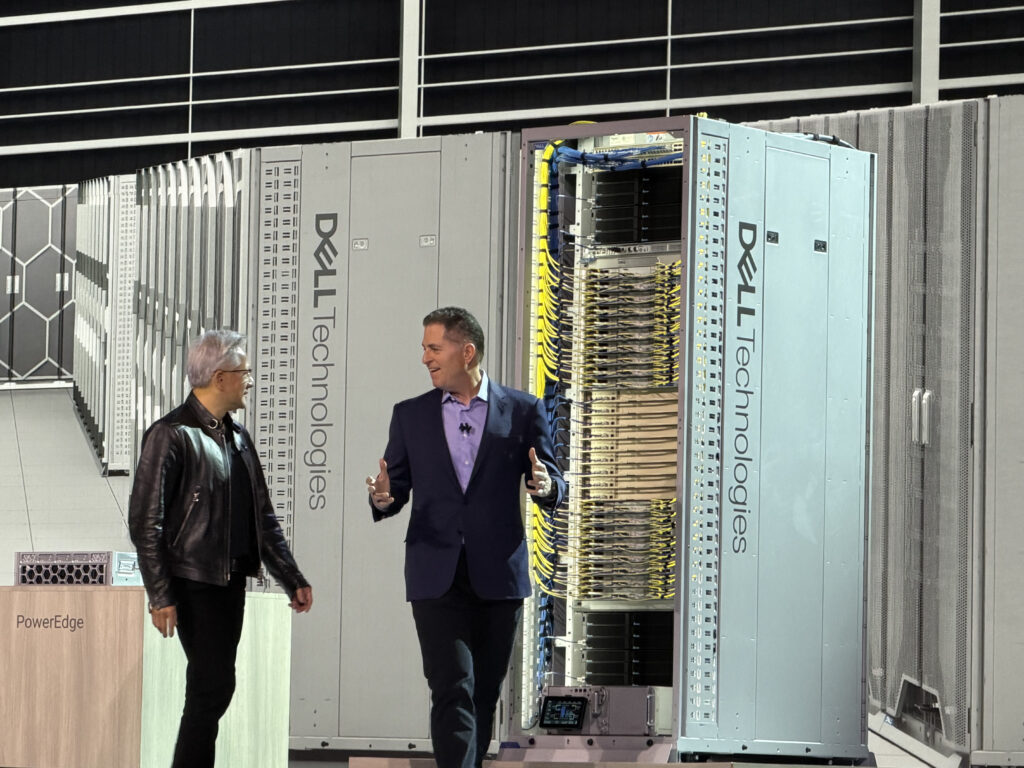
Toward the end of the session, NVIDIA CEO Jensen Huang came on stage and described agentic AI as a step-change in compute demand. He traced the progression of AI from generative content creation to reasoning, planning and now agency. Demand is going parabolic, he said, with compute requirements increasing sharply because AI has become more useful, rather than less efficient.
“We’ve now arrived at the era of useful AI, which is just really exciting for all of us,” Huang continued. He said usage is taking off as novelty gives way to practicality. By localizing parts of AI deployment, enterprises are moving beyond a cloud-only model. Now, he said, “You’re generating tokens; you’re not renting CPUs…You don’t have to struggle with token anxiety.”
This gets into a bigger constraint enterprises working to adopt agentic AI will face: you can buy all the technology you can afford, but if you don’t rearchitect how work gets done, ROI will be suboptimal. If you regard agents as digital workers with institutional memory, credentials, access and the ability to act, enterprises then have to govern workers who perform tasks at machine speed.
Dell’s continued refinement of the AI Factory with NVIDIA looks to address that requirement by bringing infrastructure closer to data and operations. Dell emphasized the need to take enterprise data out of silos so that “hard won” proprietary data fed into agentic systems can become a strategic differentiator. The circular dependency here is that data infrastructure and AI infrastructure need to be tightly coupled to the point that they’re fully converged to enable real-time decision making that’s controllable and secure.
That is where Dell is trying to turn its latest announcements into an architecture story. Deskside Agentic AI gives enterprises a local development and execution point for agents. Dell AI Factory with NVIDIA provides the scale-up path. Dell AI Data Platform addresses the data-readiness problem. PowerRack, networking, storage and cooling provide the physical substrate. The strategic claim is that agentic AI will require all of these layers to work together rather than as disconnected domains.
Eli Lilly on shortening the distance between discovery and execution
Diogo Rau, executive vice president and chief information and digital officer at Eli Lilly, provided strong customer validation. Rau described the 150-year-old company as an early and aggressive adopter of technology because pharmaceutical innovation only delivers change if it can be done at massive scale. He called out the company’s pioneering work in making insulin, penicillin and, now, GLP-1s broadly available.
Eli Lilly worked with Dell Technologies to build LillyPod, an AI supercomputer that uses 1,016 GPUs to train large AI models for pharmaceutical discovery. Rau explained that Eli Lilly uses Dell infrastructure for everything from R&D productivity to manufacturing efficiency. He said the use of Dell’s validated infrastructure stack makes operationalizing a new site much faster than in the past because the technology “just works.”
Rau suggested AI and accelerated infrastructure could help Lilly move closer to “ending disease as we know it,” but getting there is a matter of operational dependency. In manufacturing, he described medicines moving down filling lines while systems capture dozens of images to detect defects in milliseconds. “We used to have humans do that,” he said. “Humans mess up; these machines, they don’t.” In research, he described modern labs as connected environments “showering us with data,” making AI infrastructure inseparable from data movement, validation and availability.
So what comes next?
The commentary from the first day of Dell Technologies World aligns with where enterprise AI appears to be headed: toward distributed, governed, cost-conscious systems that operate close to enterprise data. But the next phase is execution. Dell now has to show that customers can govern autonomous agents, sustain utilization, validate the tokenomics and produce measurable business outcomes. In the agentic AI era, infrastructure leadership will be measured by who can turn controlled infrastructure into controlled outcomes.
