

Table of Contents
As enterprises move from generative AI advisor to agentic AI operator, Dell is positioning storage, compute, cyber resilience, private cloud and automation as the enterprise control plane
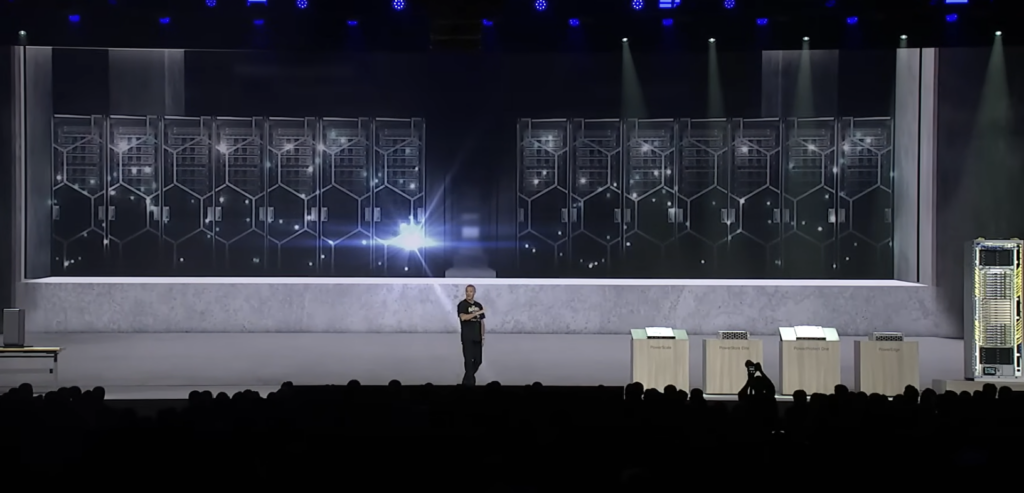
LAS VEGAS — As Dell Technologies World unfolded, Chief Operating Officer Jeff Clarke’s day two keynote presentation made clear the economics, usage patterns and organizational implications of AI have changed so quickly that infrastructure and operating models are now inseparable from enterprise success. Tokens need to be a line item on enterprise P&L statements, Clarke argued; in that paradigm, IT infrastructure modernization is a strategic differentiator tied to business velocity and overall productivity, rather than simply a case of adhering to refresh cycles.
Clarke led his talk in list form, emphasizing the staggering pace of change in the AI landscape. In the last 12 months, AI evolved from advisor to operator. Model costs have fallen by roughly 80%, token consumption has exploded by a factor of 10, context windows grew to millions of tokens and inference capabilities can now support business-critical operations. These factors collectively change the enterprise calculus (and Dell’s role in driving change) as the agentic AI era arrives. In the last year, “The conversation changed,” Clarke said. “Every CIO I meet has stopped asking me, ‘Should we?’ and started asking, ‘How fast can we?’”
The intersection of falling token costs and exploding consumption creates a Jevons Paradox dynamic wherein cheaper AI interactions may not reduce total spend; they may unlock radically more usage. This means that tokens are now central to enterprise resource planning and management. Coupled with the maturation of agentic frameworks, recurring token costs, data access, latency, governance and user experience are converging into a single architecture problem. The next question is about how enterprises can turn cheaper tokens into disciplined productivity, not out-of-control consumption. Operationalizing these new types of human/AI interactions at global scale will depend on a combination of technological transformation and change management.
There is no AI outcome without the right AI operating environment
Dell’s sweeping portfolio announcements from this week reiterate the point that AI-ready IT infrastructure has transitioned from background plumbing into a substrate that’s inseparable from a business’s ability to execute, grow and accrue competitive advantage. The portfolio messaging showcased the breadth Dell is bringing to market from “deskside to data center.” The key pieces for the data center include:
- Dell PowerStore Elite with a 3x storage performance increase and 6:1 data reduction.
- Eleven new Dell PowerEdge servers for both air-cooled and liquid-cooled environments
- Dell PowerProtect One and Dell Cyber Detect to drive cyber resilience by harnessing AI tooling
- Dell Private Cloud expansion to support the latest software from Broadcom, Microsoft and Nutanix
- Dell Automation Platform, which uses agentic AI and a conversational UI for infrastructure deployment, monitoring and management
- Dell Automation Studio for AI-driven, full-stack orchestration to help users build automation workflows across infrastructure and applications
For the deskside, Dell announced:
- Dell Pro Max with NVIDIA’s GB10 for small-scale agent prototyping with 30 billion to 200 billion parameter models
- Dell Pro Precision 9 enterprise workstation with Intel Xeon 600 and up to five NVIDIA RTX PRO Blackwell Workstation Edition GPU configurations to scale from 30 billion to 500 billion parameter models
- Dell Pro Max with the GB300 and Dell’s MaxCool tech for frontier-level inference based on models ranging from 120 billion to 1 trillion parameters
- NVIDIA NemoClaw reference stack to allow users to locally (and securely) manage agents developed in OpenClaw, tap into NVIDIA Nemotron models for reasoning and coding, and sandbox persistent agents and workflows in the secure OpenShell runtime environment
Considering Clarke’s commentary and the portfolio updates, the point is that using the latest models to develop built-for-purpose agents will be table stakes going forward. And getting it right in a way that retains security and governance requires rethinking the underlying enterprise IT architecture and estate, including at the desktop where humans and AI come together.
Agents need identities and enterprises need a new definition of work
Now that agents are operators — and in keeping with company Founder and CEO Michael Dell’s commentary from the first day of Dell Technologies World — they require identity, authentication, access controls, telemetry, observability and auditability. Clarke made clear the pressing need to secure autonomous systems, and Dell Chief Technology Officer and Chief AI Officer John Roese, in a separate discussion with press and analysts, stressed that all agents should sit under a unified security umbrella with a single approach to identity management and zero-trust principles applied from day one.
Roese framed agents as fundamentally changing the way enterprise workflows, including Dell’s, are architected to accommodate agentic systems. He explained how he used to get up-to-date information about Dell customers, and how that happens now. Previously, he’d make the request and “the human organization will spin into action and meetings will happen and dashboards will be created and, a month later, I will get my reports. That is not efficient.” Now, “We have built agents that I can simply give access to that data to. And on my behalf…they will go access that information. Their job is to summarize it, and continuously keep me updated.”
Roese then drove home the broader point: “What have I done there? It’s a task, but I changed the organizational dynamic. I’ve removed all of the theater between me and my data, which makes me much more effective and makes my organization much faster.” Agents are synonymous with “capabilities,” and, “They will change the way that work occurs, not at the individual level, but how workflows happen in the company. And sometimes those workflows cross organizational boundaries. The trick is to find the ones that matter. This pattern of using agents to accelerate the speed in which decision-makers can access the information needed to make an intelligent decision is kind of a universal pattern that, if you did nothing else with agents but you solve that problem in your organization, your organization would run faster, it would be more efficient, everything would be better.”
To summarize, building and deploying agents is getting much easier, much more cost-effective and much more important in modern business operations. The more difficult task is recomposing enterprise workflows in a manner that acknowledges the path between data and decisions is collapsing, hierarchical structures are being disintermediated and the center of gravity is shifting from possessing information to acting on it, owning the outcome, exercising judgment and managing relationships.
Measuring effectiveness in the AI-native enterprise
The big theme of conversations at Dell Technologies World was that an AI-native enterprise has to do five things at once. In Clarke’s telling, those action items are to build an AI-ready data foundation, distribute infrastructure to where inference and work happen, expand the security perimeter to include digital workers, integrate this expanded enterprise stack and restructure how work is done around agentic AI and tokenomics.
In an open Q&A session with Michael Dell, Clarke and the company’s Infrastructure Solutions Group President Arthur Lewis, I asked how corporate leaders should think about measuring human productivity in the transitory time when agents assume control of core business functions. My premise was that, as agents assume more work, enterprises may need new ways to compare the cost of AI-mediated decisions with the business value those decisions create.
Lewis stressed that “domain-level expertise continues to remain incredibly relevant” because functional agentic AI needs to have well-defined control paths and data paths, and the context to align with the desired outcome. Clarke, looking inwardly at Dell’s own work, pointed to “overall productivity and efficiency.” Are customers being served better, does Dell understand them better, is the company delivering services, products and features faster and more responsively? Those are the questions to ask, he said, “not what the AI did or what the human did.”
Michael Dell reflected on the company’s first annual report, which was published in 1989 when he was 24 years old. The company reported $257,810,000 in sales with a workforce of around 1,200 people. If we had the same revenue per employee now as we did then, he told me, we’d have 650,000 employees; current headcount is around 97,000 people. “What happened between 1989 and 2026 is we figured out a lot of better ways of doing things, and we continue to do that every single day. If we stop doing that, we’ll go out of business. That’s just what we believe. It’s not a bad thing. It’s actually how the economy propels itself forward. …It’s important to remember that when companies evolve by using better tools and techniques, that’s actually a great thing, and incredibly important to the economy being successful.”
Taken together, their answers suggest the relevant unit of measurement is shifting from the individual worker to the workflow, and from isolated productivity metrics to system-level output. Enterprises will not scale AI by treating it as a software overlay. They will scale it by rebuilding the technological and operating environment around AI-mediated work from the data foundation, the infrastructure, the security model, the automation layer and the human roles that remain essential when access to information is no longer scarce.