

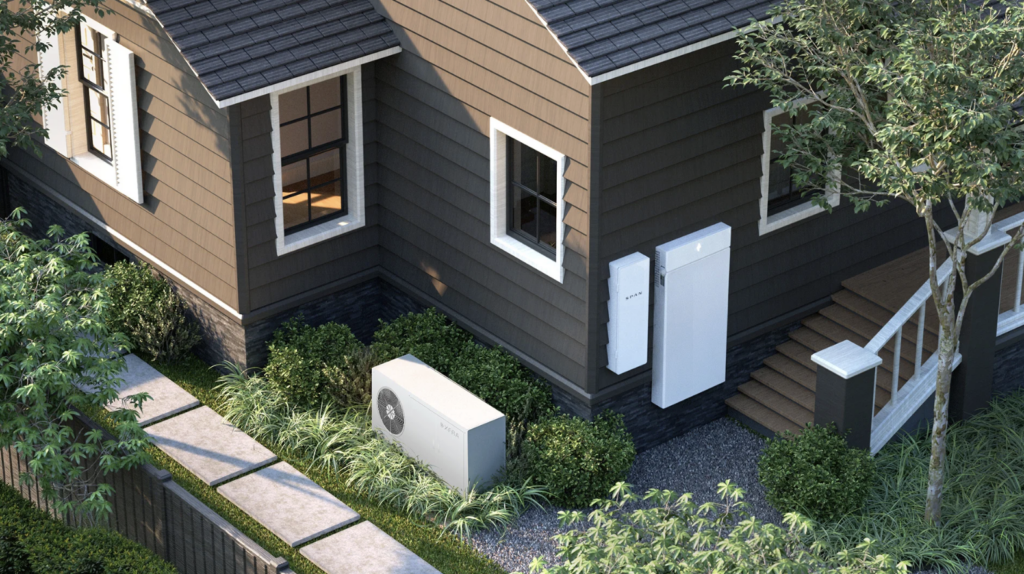
Can there by a symbiosis between communities and data center owners and operators? Rather than focus on building massive, centralized data centers, Nvidia and home builder PulteGroup are working with smart panel start-up Span to pioneer distributed, edge-computing.
By placing refrigerator-sized units adjacent to new and existing homes’ HVAC units, liquid-cooled, “low profile” XFRA nodes will detect and capture overprovisioned, “idle” electrical capacity from the grid, leveraging fanless, liquid-cooled Nvidia RTX Pro 6000 Blackwell Server Edition GPUs in what will be a decentralized AI compute network.
In exchange for being part of the deployment, homeowners will receive free or heavily subsidized electricity and internet.
Because AI companies can get GPUs faster than they can get a 50 -100 MW grid connection, the hope is that distributing nodes throughout neighborhoods might help mitigate the power bottleneck currently plaguing data center buildouts. Span has claimed that deploying these distributed residential nodes costs roughly 5x less and is 6x faster than building centralized hyperscale data centers.
Skeptics, however, raise concerns about the long-term viability, safety, and community impact of decentralizing enterprise AI compute into residential areas. Neighborhood grids are usually designed for intermittent use, and the logistics of managing hundreds, thousands, or perhaps millions of access points is another open question.
Some critics have also speculated about how much energy XFRA nodes will use, with some positing the nodes could consume in a few days what the average American home consumes in an entire month.
To tackle those problems, a proof-of-concept pilot is underway with approximately 100 new-construction homes, with plans to scale to over 1 GW of annual capacity. If the decentralized “distributed data center“ model bypasses grid bottlenecks, delivering AI computing capacity faster and cheaper than traditional hyperscale facilities, it may usher in an era of fractional data center nodes.
For homeowners, hosting a fractional data center node could bring incentives like discounted or free utilities, or a cut of the network’s utilization revenue.

Susana Schwartz
Technology Editor
RCRTech
AI Infrastructure Top Stories
Optics and fiber for Hyperscalers: Ciena CEO Gary Smith says hyperscalers are directing a larger share of spending toward network infrastructure, leading him to project the company’s addressable market could perhaps double to $50B by 2029.
AirTrunk’s $21B DC in India: Omdia’s Lian Jye Su says the scale of AirTrunk’s investment signals confidence in the long-term growth prospects for Maharashtra as a data hub. Approx. $21 billion will go toward a proposed 3 GW DC in Pen Taluka.
Synergy – $127B in enterprise cloud: Synergy Research’s John Dinsdale said enterprise spending on cloud infrastructure services reached $128.6 billion in Q1, a 35% YoY increase and the 9th consecutive quarter of accelerating growth.
AI Today: What You Need to Know
Microsoft CEO touts ‘zero water usage’: Speaking of “Community-First AI Infrastructure,” Microsoft CEO Satya Nadella said new AI data centers will use as little water annually as a single restaurant, with cooling loops filled only once.
South Korea’s ‘AI Valley’: CEO Jensen Huang announced AI factories in South Korea and deals with SK Telecom, SK Hynix, and Naver. His Vera CPU will use SK Hynix advanced memory, which will double its memory wafer capacity by 2030.
Intel 1 TW/year of compute: Elon Musk will use Intel’s 14A chip technology for his ‘Terafab’ project in Texas. Intel will design, fabricate, and package ultra-high-performance chips for SpaceX, xAI, and Tesla to produce 1 TW/year of compute.
SIA-Deloitte $4T projection: Semiconductors account for 95% of an AI data server rack’s value, according to a joint report by the Semiconductor Industry Association and Deloitte, which projects $4T in data center infrastructure investments by 2028.
Helium prices surge: Production strikes in Qatar, military strikes and geopolitical conflict in the Middle East have crippled Qatari gas infrastructure, forcing fabrication plants to scramble for alternative allocations, impacting semiconductors and more.
Stargate’s ‘The Barn’ breaks ground: Michigan’s largest-ever investment is a $16 billion DC campus in Saline Township, with contractor Walbridge breaking ground on “The Barn,” a 250-acre, 1 GW campus – part of Oracle – OpenAI’s Stargate.
RCR Events
Telco AI Forum, June 16th
Telco AI Forum brings together operators, vendors, hyperscalers, and academia to explore how the evolution of the industry and partnership ecosystems is laying the foundations for AI-native 6G networks and unlocking ROI. Register now
Quantum Safe Networks Forum, July 14th
Quantum Safe Networks Forum brings together telecom operators, cybersecurity experts, and industry analysts to explore how to build resilient, future-ready infrastructure in the face of quantum disruption. Register now
RCR Roundtables AI Infrastructure, October 21st, Dallas, Texas
Join 50 senior data center, energy and AI leaders at the Ritz-Carlton Dallas on October 21 for invitation-only roundtables on powering and scaling AI. Request your invitation
Industry Resources
Webinar, June 9th: Agentic RAN Management: Delivering OPEX efficiency and a path to 6G
Report: AI in testing: Developing trust, delivering results
Report: Test, measurement and service assurance in the AI era
Whitepaper: Powering sovereign AI at scale
Whitepaper: Scalable database design for 5G and beyond
Report: Scaling AIOPs from insight to action
Summit Access: GSMA Device Enablement Summit: How operators can fix device-network fragmentation