

Table of Contents
As AI moves from generating content to taking action in the physical world, T-Mobile US sees deterministic connectivity, distributed compute and AI-native networks as a path to capturing new value
The first phase of the generative AI infrastructure buildout has concentrated economic value around hyperscale data centers, accelerated compute and frontier models. Telecom operators have participated primarily by moving traffic between users, enterprises and someone else’s compute infrastructure. T-Mobile US sees physical AI as an opportunity to change that relationship.
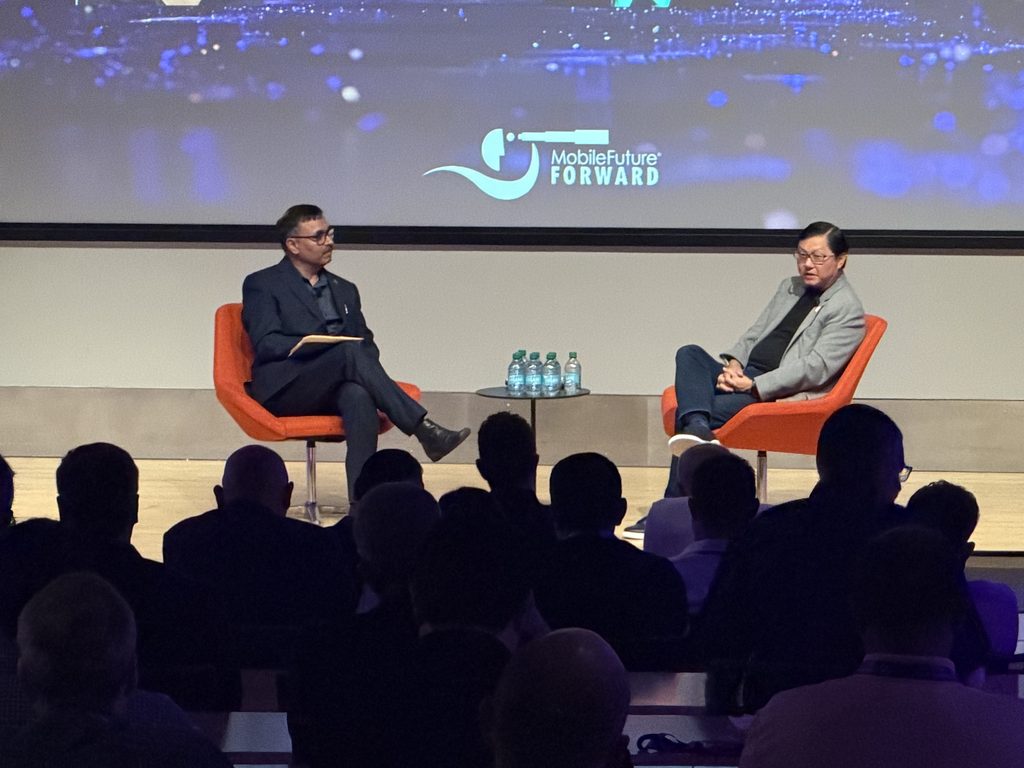
Speaking at the recent Mobile Future Forward in Seattle, T-Mobile US President of Technology and CTO John Saw framed the opportunity around what he calls “kinetic tokens.” Generative AI today largely produces informational tokens that describe, predict or represent the world. Physical AI, by contrast, connects perception and reasoning to action.
“When the nature of tokens changes, I think it gives telecom operators the opportunity to move up the food chain,” Saw said.
Consider a humanoid robot cleaning a house. Its vision system sees a piece of paper and has to determine whether it is trash or an important document. “It has to decide. That is a kinetic token waiting to happen,” Saw said. The system needs contextual information about the environment and the user, enough intelligence to make the correct decision, and the ability to translate that decision into physical action.
The terminology is T-Mobile’s, rather than an established unit of AI computation, but the distinction is useful. In a February essay, Saw described kinetic tokens as data constructs carrying intent, context and timing that initiate physical outcomes such as movement, control and coordination. The requirements, he argued, include deterministic performance, low latency, synchronization and what T-Mobile US calls space-time coherence.
The underlying idea is that as AI moves into the physical world, the network becomes more than transport.
From moving data to participating in execution
Physical AI changes the goal of networking because inference increasingly has to happen in the context of a particular place and moment. A robot, vehicle, camera or industrial system can send every difficult decision to a distant hyperscale data center, but latency, network availability and the loss of immediate environmental context can make that architecture unsuitable for some applications.
“If there is no space-time coherence, it goes back to a big data center to think about it,” Saw said at Mobile Future Forward. For physical AI, he said, the network has to “bring intelligence into the real world at the right time in the right place.”
That creates a plausible opening for operators. They already control widely distributed infrastructure, spectrum, mobility, identity and increasingly programmable quality of service capabilities. T-Mobile US sees a future where the operator could own part of the execution fabric through which AI perceives, reasons and acts.
The company is already experimenting with that architecture. In March, it detailed work with NVIDIA and Nokia putting physical AI applications onto distributed edge infrastructure, with vision and reasoning agents targeting smart city, industrial safety and utility applications. This allows computationally intensive processing to be moved from an endpoint toward nearby network compute rather than automatically backhauling everything to a centralized cloud. That is potentially a considerably better AI business for a telecom operator than simply carrying more traffic.
5G-Advanced provides the bridge
Importantly, Saw does not frame this entirely as a 6G opportunity. Asked whether physical AI needs to wait for the next generation, he said 5G-Advanced is where it begins.
That view maps reasonably well to T-Mobile’s existing network. The operator declared its 5G-Advanced network nationwide in April 2025, combining capabilities from 3GPP Releases 17 and 18 on top of its Standalone architecture. Those capabilities include network slicing, AI/ML-based optimization, uplink improvements and lower-latency mechanisms.
The commercial significance is determinism. A traditional mobile network largely sells connectivity and capacity. Physical systems can place a premium on predictable behavior. T-Mobile US already monetizes a version of that principle through T-Priority, which uses network slicing to provide differentiated connectivity for public safety users. Saw described it as an early example of moving away from a purely consumption-based model toward pricing network performance according to value.
That’s applicable in the context of a physical AI system that may care much less about the cost per gigabyte than whether a particular task receives the necessary network and compute resources within a prescribed performance envelope. The uplink also becomes more important. AI traffic today remains heavily concentrated around data centers, Saw said, but “when AI is distributed to the edge, that’s when it ramps.” T-Mobile US has already prioritized uplink enhancements in 5G-Advanced, including Release 17 uplink transmit switching.
AI-RAN links network intelligence with distributed compute
T-Mobile US sees AI-RAN as simultaneously being used to optimize radio performance and as part of an architectural continuum that could eventually support both RAN and external AI workloads on shared accelerated-computing infrastructure.
“I think AI-RAN and compute goes hand-in-hand,” Saw said. “AI-RAN, it’s not just a single product at a moment in time. To us, AI-RAN is a continuum of products and services and capabilities that allow us to actually embed AI in our network and to drive fallow compute” for additional monetization.
The first half of that proposition, AI-for-RAN, is already becoming tangible. T-Mobile US and Ericsson have moved an AI-native scheduler with link adaptation onto live 5G-Advanced traffic. Ericsson reported close to a 10% improvement in spectral efficiency and up to a 15% improvement in downlink throughput compared with legacy rule-based approaches.
T-Mobile US has demonstrated commercial RAN software and AI workloads operating simultaneously on accelerated infrastructure and is piloting NVIDIA compute at network locations for physical AI workloads. But Saw acknowledged the real work ahead is scaling the architecture in a manner that aligns with acceptable total cost of ownership, power consumption and form factors.
As with anything, this gets back to network economics. Fallow compute only represents a new revenue pool if operators can deploy accelerated infrastructure efficiently and if developers actually require distributed inference at enough locations and scale to pay for it.
6G could complete the architecture
The longer-term expression of the strategy is 6G. Saw rejects the notion of 6G as simply another generational speed increase. “6G isn’t the next G. It’s an opportunity to drive new growth,” he said, pointing to the convergence of wireless, AI and efficient compute.
T-Mobile US and Qualcomm are now explicitly organizing their 6G collaboration around advanced connectivity, integrated sensing and energy-efficient high-performance compute, with commercial deployments targeted beginning in 2029. Distributed computing across device, edge and cloud is part of that architecture, as is using radio infrastructure to sense and interpret physical environments.
Standards work remains early. 3GPP is using Release 20 primarily for 6G studies and Release 21 for normative work, meaning there is still considerable distance between the current vision and standardized commercial systems.
But the progression is increasingly clear. 5G-Advanced introduces greater programmability and determinism; AI-native techniques make the network more intelligent; AI-RAN potentially introduces distributed compute; and 6G converges connectivity, sensing and compute into a more unified platform.
Saw framed the opportunity emphatically at Mobile Future Forward: “You are sitting on a gold mine of assets and capabilities and distribution and customer base that hyperscalers don’t have and can’t replicate.”
That is ultimately the kinetic token thesis. The generative AI boom largely left telecom operators moving tokens created and monetized somewhere else. If AI increasingly produces instructions that move robots, vehicles and machines in the physical world, T-Mobile US is betting that the network can become part of the execution environment itself and, in doing so, move up the AI food chain.