

Table of Contents
Three key takeaways
- The AI infrastructure constraint is moving from acquiring GPUs to putting them into production. Structure Research sees demand continuing to run ahead of available supply as hyperscalers, AI labs and neoclouds compete for power and data center capacity.
- Neoclouds are selling speed as much as compute. Structure Research estimates roughly 14 GW of neocloud capacity could be live by 2028, much of it serving hyperscalers and frontier AI labs that need compute before other capacity is ready.
- Time to power is becoming part of time to revenue. The economics depend on how quickly capital, GPUs, power, networking and data center capacity can be converted into running workloads — and how productively those assets are used once online.
AI infrastructure demand is running into a deployment constraint
The AI infrastructure race is no longer only about getting GPUs.
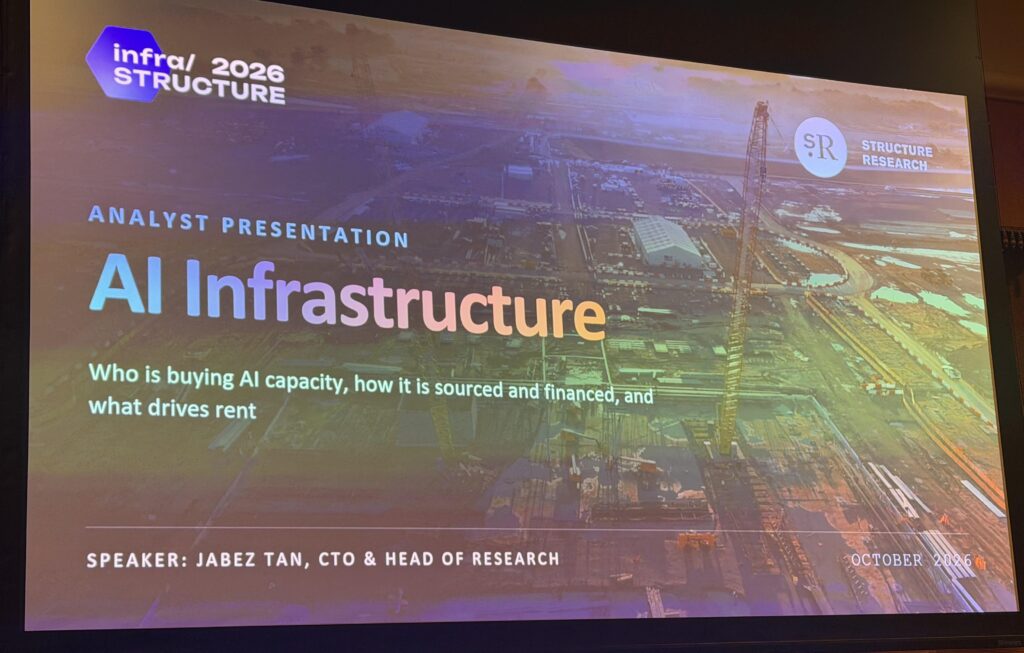
Structure Research CTO and Head of Research Jabez Tan put numbers behind the next constraint during his presentation, “AI Infrastructure: Who is buying AI capacity, how it is sourced and financed, and what drives rent,” at infra/STRUCTURE 2026.
Tan examined how AI capacity moves from chip suppliers and data center developers through hyperscalers and neoclouds to frontier AI labs — and how that infrastructure gets financed.
“It’s never really been a demand issue,” Tan said. “It’s more how can we bring online credible supply to power these workloads.”
That distinction fits RCRTech’s Time to Token framework: measuring how quickly capital committed to AI infrastructure can be converted into productive compute and ultimately revenue.
Structure Research sees neocloud capacity reaching 14 GW
Structure Research estimates approximately 14 GW of neocloud capacity could be live by 2028, subject to execution, construction and power availability.
The customers behind that capacity are concentrated.
Tan said Anthropic, Microsoft, OpenAI, Meta, xAI and NVIDIA represent about 65% of the live neocloud capacity being purchased among the buyers Structure tracks. Microsoft and Anthropic account for 56% of signed contracts in its dataset.
These are Structure Research estimates presented at the conference, rather than industry-wide reported totals. But they highlight an important characteristic of the market: neocloud demand cannot always be separated from hyperscaler and frontier-lab demand.
Microsoft, for example, contracts with multiple neocloud providers. Frontier labs are sourcing compute through hyperscalers, neoclouds and direct infrastructure arrangements.
Structure’s public research also finds frontier labs driving neocloud leasing. Structure Research analysis of frontier labs and neocloud leasing
Neoclouds are selling time to power
Tan offered a concise description of the neocloud value proposition.
“What the neoclouds provide is time,” he said, specifically citing “time to market” and “time to power.”
For an AI lab waiting for a self-built campus or hyperscale capacity, that time has economic value.
A neocloud can secure GPUs, lease powered data center capacity, arrange financing and make compute available as a service. The customer gets capacity sooner. The neocloud assumes much of the financing, deployment, utilization and GPU-generation risk.
That maps directly to RCRTech’s Time to Token framework.
The clock does not stop when a GPU is purchased. It runs through installation, power, networking, cluster commissioning and customer deployment before the infrastructure starts producing tokens and revenue.
Financing is part of time to token
Getting there quickly takes capital.
Tan said neoclouds had raised more than $120 billion in committed equity and debt during 2026 through the time of his presentation, including undrawn facilities and excluding letters of intent.
CoreWeave provides a public example of how financing connects directly to deployment.
In August, a CoreWeave subsidiary entered into a $2.6 billion delayed-draw term loan facility primarily to fund GPUs and associated infrastructure required to support customer contracts. CoreWeave SEC filing
The financing is therefore part of the production timeline. Access to capital affects how quickly GPUs, power and data center infrastructure can be assembled into revenue-producing capacity.
AI data center rent prices credit and technology risk
The same economics extend to the data center developer.
Tan said Structure Research is paying closer attention to how tenant credit and cost of capital affect AI data center rents.
An investment-grade hyperscaler does not present the same underwriting profile as a young neocloud making a large capacity commitment. Developers and lenders have to account for tenant credit, contract duration and the cost of financing the facility.
They also have to price technology risk.
GPU generations can move considerably faster than data center financing and lease terms. Tan identified chip obsolescence as one reason AI labs have historically been cautious about leasing large amounts of infrastructure directly.
Neoclouds can take some of that risk onto their own balance sheets. The economics of the contract have to compensate them for doing it.
Time to power is only the first AI infrastructure metric
Getting a GPU cluster energized solves the deployment problem. It does not guarantee attractive economics.
Utilization comes next.
For an AI infrastructure operator, the sequence is straightforward:
capital committed → GPUs acquired → power secured → cluster deployed → customer workload running → tokens produced → revenue generated
A delay anywhere in that sequence pushes revenue farther away from the original investment. Low utilization after deployment creates a different problem: infrastructure has been financed and built but is not producing its expected economic output.
That is why RCRTech’s AI Infrastructure Economics framework extends beyond Time to Token to four operating measures: revenue per GPU, revenue per MW, gross profit per GPU and gross profit per MW.
RCRTech has examined the same issue through GPU utilization: expensive infrastructure creates economic value only when customers are using it. RCRTech analysis of AI infrastructure utilization
Conclusion: Measure the time between capital and revenue
Tan’s presentation helps explain why neoclouds have become an important part of the AI infrastructure market.
They are not simply another place to rent GPUs.
They connect capital, chips, data centers and customers, taking on risk to make AI compute available sooner. Tan’s description — “time to market” and “time to power” — captures the first part of that value.
RCRTech’s Time to Token framework extends the measurement to the economic outcome.
How long does it take from committing capital to putting GPUs into production and generating revenue?
Once the infrastructure is running, the measurement shifts to productivity: revenue per GPU, revenue per MW, gross profit per GPU and gross profit per MW.
For neoclouds and their capital providers, both sides of the equation matter: get GPUs into production faster, then generate more economic output from every GPU and every megawatt.
Editorial disclosure: This article is based on an infra/STRUCTURE 2026 presentation attended by RCRTech. Otter was used to transcribe the session, and AI tools assisted in preparing the initial draft. The article was reviewed, fact-checked and edited by RCRTech before publication.
Source note: Proprietary capacity, leasing and financing estimates attributed to Structure Research are drawn from Jabez Tan’s presentation at infra/STRUCTURE 2026. RCRTech’s Time to Token and AI Infrastructure Economics frameworks are RCRTech analysis.