

Table of Contents
Three key takeaways
- U.S. colocation capacity is entering a massive expansion cycle. Structure Research estimates operational U.S. colocation capacity at roughly 23 GW in 2026 and projects it could approach 100 GW by 2031, representing a 33.6% five-year growth rate.
- The headline pipeline overstates what will actually get built. The increasingly important distinction is between operating capacity, projects under construction and enormous land banks that may still lack committed customers, financing or deliverable power.
- Time to power is becoming time to revenue. With GPUs, capital and customers waiting on capacity, securing and delivering power increasingly determines how quickly AI infrastructure can move from a development plan to productive compute and revenue.
U.S. data center capacity is moving from megawatts to gigawatts
The scale of the U.S. data center pipeline is getting difficult to comprehend.
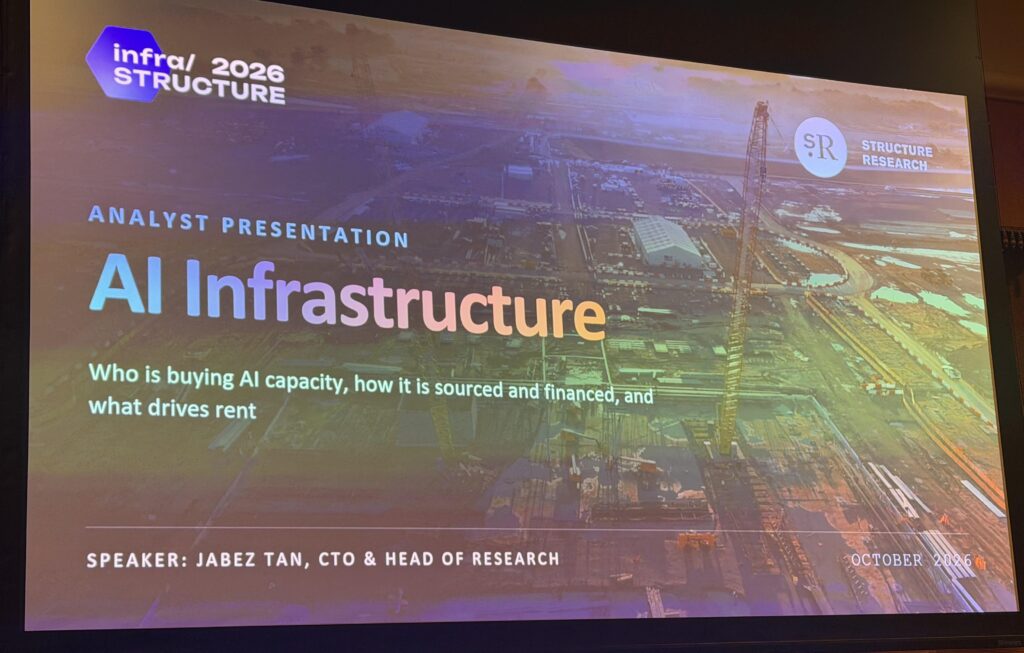
During the Americas market update at infra/STRUCTURE 2026, Structure Research analyst Vivian Kong put the current U.S. pipeline at roughly 40–42 GW of operating data center capacity, another 25 GW under development and approximately 150 GW in land-banked capacity.
The more revealing number may be the growth trajectory for commercial colocation.
Structure Research estimates approximately 23 GW of operational U.S. colocation capacity in 2026, growing to nearly 100 GW by 2031. That represents a five-year growth rate of 33.6%.
Those numbers need context. A land bank is not a data center, and an announced gigawatt is not necessarily a future operating gigawatt.
That distinction is becoming increasingly important as established data center developers, real estate owners, former cryptocurrency infrastructure operators and new entrants compete for land and power.
Structure Research estimates speculative entrants account for approximately 17% of capacity currently under development and 27% of land-banked capacity.
The next question for the market, then, is no longer simply: How many gigawatts have been announced?
It is: How many gigawatts can actually be energized?
That distinction is consistent with other RCRTech reporting. In February, RCRTech examined the increasingly difficult search for what JLL calls “digital dirt” — land that can actually support power-intensive data center development. More recently, RCRTech reported that power availability is actively reshaping where AI infrastructure and the networks connecting it are being deployed.
Power is redrawing the U.S. data center map
Northern Virginia remains the largest individual U.S. colocation market in Structure Research’s dataset, with approximately 16.4 GW across operating and pipeline capacity.
But growth is moving outward.
Texas has emerged as the largest state-level colocation market and pipeline, with Structure Research tracking approximately 42.4 GW of total capacity. West Texas, in particular, is developing as what Kong described as a “pure AI” market — infrastructure being created specifically around large AI campuses rather than expanding from a traditional enterprise data center base.
Similar movement is occurring into Ohio, Illinois, Nevada, Arizona and less traditional data center markets.
The driver is increasingly straightforward: power.
ERCOT’s March 2026 data showed 43.5 GW in its large-load interconnection queue for 2026, rising to 150.6 GW for 2027. Those figures include projects at different stages of development and should not be interpreted as committed future load.
Texas regulators have also moved toward a batch-review process for large loads of 75 MW or greater as the grid responds to unprecedented requests for large-load interconnections.
RCRTech has been following the same constraint from the infrastructure side. Recent reporting found that power access is influencing not only where AI data centers get built but the fiber and optical networks required to connect increasingly distributed facilities. RCRTech has also examined how shortages of transformers, switchgear and other electrical infrastructure can delay data center construction.
For AI infrastructure economics, that changes the meaning of Time to Token.
Before a GPU can generate a token — or a dollar of revenue — the underlying facility has to be financed, constructed, connected and energized.
Time to power is becoming one of the first components of time to revenue.
Former crypto infrastructure is becoming AI infrastructure
Another important shift is occurring among companies that already control large blocks of power.
Structure Research estimates GPU-oriented providers account for 40% of U.S. colocation capacity currently under development.
Several of these operators built their original infrastructure around cryptocurrency mining and now control something AI developers badly need: sites with access to large blocks of power.
The transition is visible in actual contracts.
Cipher Digital, formerly Cipher Mining, signed a 15-year agreement with AWS covering approximately 300 MW of gross capacity at its Black Pearl facility near Wink, Texas. According to Cipher’s SEC filings, bitcoin mining at Black Pearl was decommissioned in February 2026 and approximately 85% of the site’s existing data center infrastructure is expected to be repurposed for the AWS lease. Cipher puts the contracted revenue associated with Black Pearl at approximately $5.5 billion.
Applied Digital provides another example. According to the company’s 2026 SEC filing, CoreWeave has contracted for 400 MW of critical IT load at Polaris Forge 1 in North Dakota under long-term leases.
The broader numbers show how quickly the model is scaling. Applied Digital reported 1,410 MW of contracted critical IT load across five campuses as of May 31, representing approximately $36.2 billion of contracted revenue over the initial lease terms.
The economics help explain why this part of the market is moving so quickly.
A developer that already controls a viable site and power position may be able to shorten the distance between an AI customer’s capacity requirement and revenue-producing compute.
Hyperscaler self-build is not replacing colocation
Structure Research also highlighted an important distinction in the relationship between hyperscaler-owned infrastructure and commercial colocation.
The firm’s forecast shows self-build capacity growing at a slower rate than colocation through 2031. But Kong cautioned against interpreting that trend as evidence that hyperscalers are abandoning self-build.
Long-dated projects simply have less visibility.
At the same time, hyperscalers remain major customers of colocation providers. Their own campuses and leased capacity can therefore expand simultaneously.
That dynamic is also pushing infrastructure into markets outside the traditional data center hubs.
Structure Research estimates that roughly 48% of approximately 60.9 GW of hyperscale self-build capacity sits in what it classifies as the “rest of U.S.” market — locations outside the established major data center hubs.
States including Wyoming, Iowa and Missouri are attracting large hyperscale projects. In some cases, hyperscaler investment can establish the power, connectivity and infrastructure ecosystem that subsequently attracts colocation development.
Canada’s AI data center growth shifts west
Canada shows a similar relationship between power availability and geography.
Toronto and Montreal remain major markets, but Structure Research expects slower growth as power and land constraints limit expansion.
Western Canada is moving in the opposite direction.
Structure Research projects a 22.5% five-year growth rate around Calgary and the broader western Canadian market, where developers have access to land and more opportunities to pursue large-scale power strategies.
Meta provided a significant proof point in July, announcing a 1 GW AI-optimized data center in Sturgeon County, Alberta. Meta says the project represents more than C$13 billion of investment and will be the company’s first data center in Canada.
The shift resembles what is happening in Texas: large AI campuses are increasingly going where power, land and permitting can support gigawatt-scale development.
Regulation becomes another variable in time to power
Power availability is only part of the constraint.
Community opposition and regulation are beginning to affect project schedules as states wrestle with electricity costs, transmission requirements, water use and the local economic impact of enormous AI facilities.
On July 14, New York Gov. Kathy Hochul signed a one-year statewide moratorium on new hyperscale data centers while the state develops a new regulatory framework intended to address ratepayer, environmental and community impacts.
The issue is becoming an increasingly important part of data center development. RCRTech has also reported on the growing role of community opposition in delaying or blocking data center projects.
For developers and AI infrastructure operators, permitting and regulatory risk now join power procurement, financing, construction and hardware availability in determining when a project can begin generating revenue.
From gigawatts of capacity to productive AI compute
The Americas data center market does not appear short of proposed capacity. It has hundreds of gigawatts of it.
The constraint is deliverable capacity.
That creates an important distinction between several stages of the AI infrastructure development cycle:
Announced capacity → credible capacity → powered capacity → operational compute → revenue-generating compute
Structure Research’s data documents the enormous amount of capacity moving through the first stages of that chain.
From an RCRTech AI infrastructure economics perspective, the next step is measuring how efficiently operators move through the rest of it.
Power alone does not make AI infrastructure productive.
Once the facility is energized, GPUs need to be interconnected, fed with data and kept highly utilized. As RCRTech Principal Analyst Sean Kinney has examined in his work on distributed inference, the shift from centralized AI training toward inference introduces another infrastructure question: where should compute run, and how should those compute resources be connected?
That extends the economics beyond the data center itself.
Kinney’s work on scale-up, scale-out and scale-across AI network fabrics examines the networking required to connect GPUs inside racks, clusters and data centers and, increasingly, across geographically distributed compute environments.
For RCRTech, those infrastructure layers fit into a broader operating sequence:
Time to power → time to production → time to first token → GPU utilization → revenue per GPU and revenue per MW
The nearly 100 GW U.S. colocation market Structure Research projects for 2031 is therefore about more than real estate.
It represents a test of execution.
Demand for AI infrastructure may be enormous. The harder question is how much of the announced infrastructure can actually be powered, built, connected and converted into productive AI capacity — and how quickly that capacity begins generating revenue.
Disclosure: This article is based on the “USA Market Pipeline & Americas” presentation at infra/STRUCTURE 2026 in Las Vegas. RCRTech reviewed the session transcript and independently checked selected company, regulatory and infrastructure claims against company filings, government sources and other primary materials. Otter.ai was used to transcribe the session, and AI-assisted tools were used in preparing the initial draft. The article was reviewed and edited by the author before publication.
