

Table of Contents
Three key takeaways
- Circular financing does not establish an AI infrastructure bubble. Structure Research argues that GPU utilization, contract pricing, customer commitments and underlying revenue provide more useful indicators of market health.
- Older GPUs may remain commercially productive long after newer chips replace them in frontier training. Their ability to support inference and batch processing could extend revenue-generating lives and change infrastructure financing assumptions.
- Inference is reshaping data center investment. Workloads will increasingly span metropolitan, regional and remote facilities, placing greater importance on network connectivity, compute utilization and revenue generated per megawatt.
Is AI infrastructure repeating the telecom bubble?
The AI infrastructure financing cycle has an uncomfortable resemblance to the telecom investment boom of the late 1990s.
Chip suppliers invest in AI companies. Those companies contract for compute from hyperscalers and neoclouds. The infrastructure providers purchase GPUs, often supported by financing tied to customer commitments.
The money moves among a relatively small group of companies.
But circular financing does not necessarily mean artificial demand.
That was the argument presented by Jabez Tan, CTO and head of research at Structure Research, during infra/STRUCTURE 2026.
Tan compared the current buildout with the telecom industry’s dark-fiber expansion. During the dot-com boom, operators installed substantial fiber capacity without sufficient paying customers.
Today’s AI infrastructure market presents a different picture, according to Structure Research. Demand for compute continues to challenge available supply, including capacity using older GPU generations.
The distinction matters for investors. The question is not simply whether suppliers finance customers, but whether those customers can generate sufficient revenue to support the capital invested.
Older NVIDIA GPUs challenge depreciation assumptions
One of Tan’s more revealing observations concerned the continuing demand for NVIDIA A100 and H100 accelerators.
Structure Research cited GPU rental pricing, contract renewals and extended customer commitments as evidence that older accelerators remain commercially valuable.
That challenges the assumption that GPUs become economically obsolete within three years.
New architectures may displace existing accelerators from frontier-model training, but older chips can continue supporting inference, fine-tuning and batch processing.
Structure Research described a progression in which GPUs move from frontier training into premium inference and subsequently into less time-sensitive workloads.
For lenders financing GPU infrastructure, the distinction between technological and economic obsolescence is important.
Equipment value depends on its ability to generate revenue above operating costs, not simply the arrival of a newer chip.
Longer equipment lives could support different depreciation and financing assumptions. However, utilization, electricity costs and declining inference prices remain important risks.
Frontier AI revenue growth drives compute investment
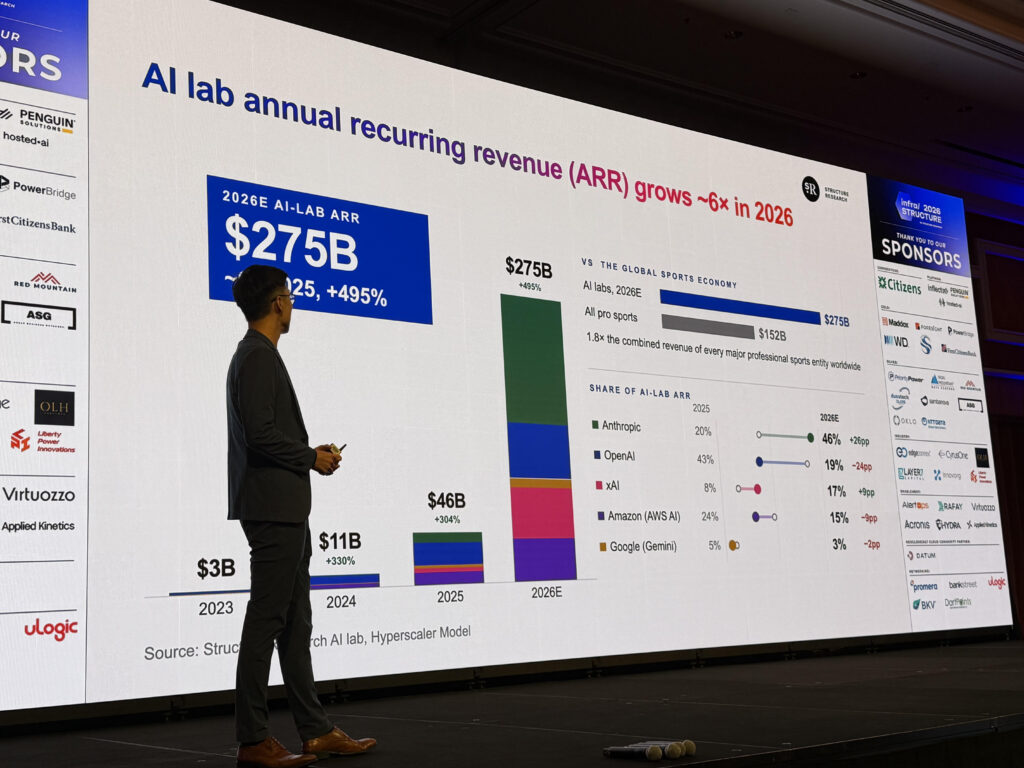
Structure Research estimates that aggregate annualized revenue across frontier AI labs could increase from approximately $46 billion in 2025 to $275 billion by the end of 2026.
The firm also estimates that OpenAI generates approximately $10 billion in annualized revenue per gigawatt of deployed compute.
These are Structure Research estimates, not independently reported company financial results.
The projections help explain why frontier AI developers are securing compute capacity years before deployment.
Competition among OpenAI, Anthropic, Google and open-weight model providers could increase overall token consumption while placing downward pressure on inference pricing.
That raises an important financial question: How much revenue generated by AI applications ultimately reaches the companies financing the infrastructure?
As examined in my earlier RCRTech analysis of neocloud time to token securing GPUs is only the beginning. Infrastructure must be powered, connected, commissioned and running customer workloads before it generates revenue.
Inference changes the data center map
Training and inference have different infrastructure requirements.
Large training clusters benefit from concentrated compute and high-performance interconnects. Interactive inference requires responsive systems, often closer to users and enterprise data.
Batch inference and some model-refinement workloads can operate farther from major metropolitan markets.
Tan described a future in which facilities accommodate different workloads throughout the day, serving interactive applications during business hours and shifting available capacity toward batch processing or fine-tuning at other times.
Structure Research calls attention to the growing importance of fungible compute: infrastructure capable of supporting different workloads as demand changes.
The concept introduces operational challenges. Moving workloads between facilities requires compatible hardware, orchestration, sufficient network capacity and compliance with customer security and data requirements.
RCRTech Principal Analyst Sean Kinney explored related architecture questions in his analysis of test-time inference scaling and edge AI.
For data center developers, the question becomes which combinations of workloads a facility can economically support over its operating life.
Connectivity becomes part of compute economics
Distributed inference also changes the importance of networking.
Moving workloads among metro facilities, regional campuses and remote AI clusters requires high-capacity connections and predictable latency.
A remote facility with inexpensive power may still be unsuitable for certain inference applications if network performance or connectivity costs undermine its economics.
Kinney and industry executives examined these requirements in RCRTech’s Scale-Up, Scale-Out, Scale-Across webinar.
The same relationship between power, geography and infrastructure investment was examined in my recent article, AI Data Center Capacity Could Approach 100 GW in the U.S. by 2031 — but Power Is Deciding What Gets Built.
Power determines where capacity can be developed. Networking and workload requirements help determine how productively that capacity can be used.
Neoclouds transfer time and technology risk
Structure Research characterizes neoclouds as infrastructure intermediaries providing access to power, accelerated deployment and GPU ownership arrangements that hyperscalers and AI labs may prefer not to undertake directly.
According to Structure Research’s conference estimates, Microsoft and Anthropic account for approximately 56% of signed neocloud compute contracts in the firm’s tracked dataset.
That concentration creates counterparty exposure for infrastructure lenders and operators.
Structure Research also reported increasing interest in smaller 20- to 50-megawatt compute deployments alongside much larger AI campuses.
These smaller blocks can offer more manageable financing and deployment requirements, particularly for inference workloads.
The broader migration toward secondary data center markets has also been examined by RCR Wireless News journalist James Blackman in his reporting on the generational AI build-cycle.
Conclusion: From installed megawatts to productive compute
The AI infrastructure industry may eventually confront overinvestment. Customer concentration, GPU financing and rapidly changing hardware generations all create legitimate risks.
But Structure Research’s analysis suggests that circular financing alone is an insufficient basis for declaring a bubble.
The stronger indicators will be GPU utilization, contract renewals, compute pricing, customer cancellations and returns on deployed capital.
For neoclouds and infrastructure investors, the operating measures worth tracking include time to first token revenue, revenue per GPU, revenue per megawatt and gross profit generated from installed capacity.
The next phase of AI infrastructure investment will not be measured solely by how many gigawatts get built.
It will be measured by how much productive, profitable compute those gigawatts deliver.
Editorial disclosure: This article is based on a presentation by Jabez Tan, CTO and head of research at Structure Research, at infra/STRUCTURE 2026. Otter.ai was used to transcribe the presentation, and AI-assisted tools supported preparation of the initial draft, research organization and editing. The article was reviewed, fact-checked and edited by RCRTech before publication. Editorial responsibility rests with RCRTech.
Source note: Proprietary market estimates, forecasts and research findings attributed to Structure Research were presented by Jabez Tan at infra/STRUCTURE 2026. RCRTech’s discussion of Time to Token, revenue per GPU, revenue per megawatt and infrastructure productivity reflects its independent editorial analysis.
Publication recommendation: Use both the editorial disclosure and source note as written. They clearly distinguish the conference research from RCRTech’s independent analysis and document the use of transcription and AI-assisted editorial tools without diminishing your byline.
The draft is ready for your confirmed final editorial review. Structure Research’s proprietary forecasts remain attributed estimates, rather than independently audited financial figures.