

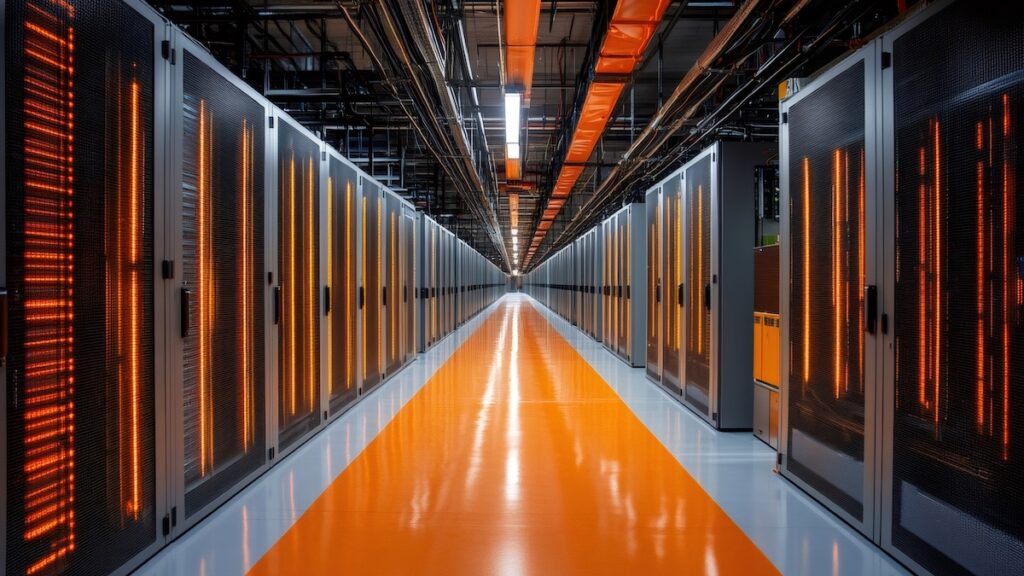
AI data center clusters use many times more fiber than conventional data centers, and the strain is reshaping internal fiber architecture and interface rates. In response, hyperscalers are seeking out long-term rights to both fiber infrastructure and pathways, rather than short-term leased circuits.
In sum – what to know:
- Density is the new constraint – AI data centers with densely packed GPUs use 10-20 times more fiber than traditional server configurations.
- The conduit bottleneck – Corning says its AI-oriented cable can fit 2-4 times as much fiber into existing conduit, and carriers including Lumen and Verizon are adopting it.
- Long-term rights beat renting – Large dark fiber agreements generally run 10-20 years, against 3-5 for lit services.
The race to build AI clusters is usually told as a story of brute GPU and compute power. While far less attention is being given to the infrastructure that connects them, data center operators increasingly realise the role that fiber plays in delivering reliable network performance. In fact, demand is so high that the Fiber Broadband Association estimates fiber use inside data center walls at somewhere between 10 and 20 times that of traditional server configurations. Fiber strand counts are also rising rapidly, with multi-building data center campuses housing multiple 6,912-fiber cables connecting buildings, compared with traditional 3,456 and 6,912-count cabling often seen in cloud environments.
Hyperscale data centers are adding to network pressures. The deployment of 800-gigabit transceivers not only results in added network complexity, but in congestion issues, particularly for older data center campuses. An 800G transceiver often utilizes MPO-16 connectors, meaning a single connection requires 16 distinct fiber strands (8 to send, 8 to receive). For Corning, the answer is to avoid digging new trenches by packing more fiber into the existing ones, including a flexible single 144-count ribbon cable to connect servers that would previously have required multiple jumper connectors.
Density dilemma
Power density compounds the problem. According to AFCOM, a US data center association, average rack densities have risen from 8.5 kW per rack in 2023, to 12 kW in 2024, 16 kW in 2025 and 27kW in 2026. It estimates a potential average of 100kW by the end of the decade. Modern single 16-GPU racks push these numbers even higher, capable of pushing well over 6.4 Terabits per second (Tbps) of east-west network traffic, depending on the architecture.
Carriers face the same pressure outside the campus, and are responding in two ways. The first is to densify the duct they already own. When Lumen agreed a supply deal with Corning in August 2024, the fiber manufacturer said it represented the first outside-plant deployment of its new next-generation fiber, capable of cramming 2-4 times the usual amount of fiber into an existing conduit. Verizon has since agreed a multi-billion-dollar Corning supply deal for cable designed to fit significantly more fiber into conduit, while AT&T has a $3 billion-plus Corning deal of its own, although that is mainly aimed at household fiber.
The second is to build spare duct into new routes from the start. Zayo’s Umatilla–Prineville–Reno route has multiple conduits, and Uniti is building multi-conduit systems for a hyperscaler customer. Neither approach comes without drawbacks. Densification buys a one-off gain of two to four times, and once a duct is full again, the only option is new conduit, which is often slow to permit and expensive to dig. That helps explain why long-term pathway rights are becoming valuable. Lumen has secured them on 55 more routes, and Uniti’s 20-year award for a hyperscale customer covers the conduit as well as the cable in it. On the buyer side, Meta has agreed to buy up to $6 billion of fiber, cable and connectivity products from Corning, a sign that hyperscalers are also moving to secure physical supply.
Changing economics
This same logic is changing the commercial model. Where carriers once leased circuits, the largest hyperscalers are now also signing dark fiber IRUs lasting 10 to 20 years, lighting the glass with their own equipment. That gives them control of the physical path and lets them upgrade optics on their own schedule. Uniti’s recent disclosures show it generated $85.5 million in incremental sales revenue from a single hyperscaler IRU in the first half of 2026. An earlier 20-year Windstream deal covered 296 strands, with a right of first refusal on another 432.
The accounting shows what carriers get in return. Uniti’s CFO has described these deals as classic IRUs, in effect prepaid leases, with much of the cash up front. Some of them will be booked as sales-type leases, so the present value of the payments is recognized as revenue and EBITDA in the period when the route is delivered. That brings cash forward for the carrier, but it means large dark fiber sales can be somewhat uneven between quarters. It also means a carrier’s growth can rest on a handful of very large buyers.
Dark or lit
This shift towards long-term dark fiber sales has its limits. More than half of Uniti’s second-quarter fiber infrastructure bookings were for lit waves, not dark fiber, and hyperscalers accounted for 10% of bookings, against 20% from neoclouds and 18% from superscalers. For now at least, dark fiber ownership is the habit of the biggest buyers, rather than the whole market.
AI has turned fiber from a background utility into a design constraint. Density inside the data center is pushing strand counts and interface rates beyond what older campuses and ducts can carry, and that exposes where the real scarcity lies, not in bandwidth but pathway. Optics can be upgraded and cable made denser, but a full duct or a missing route can only be fixed with construction. Value is therefore shifting to whoever holds the conduit and the long-term rights to use it, and the commercial model is shifting with it. Long-dated rights give the largest buyers control of the physical path and give carriers cash up front, although for now this remains the habit of the biggest buyers rather than the whole market. How far it spreads to neoclouds and other buyers will show whether fiber, once treated as spare capacity, is now priced as a scarce and valuable asset.