

Table of Contents
Photonic integrated circuits (PICs) have become essential to data centers, but could adding an organic molecular qubit with a native photonic interface revolutionize data center design by inviting semiconductor-style mass manufacturing?
German quantum technology company NVision Imaging Technologies and U.S.-based chipmaker HyperLight have achieved a massive structural convergence between quantum computing and AI hardware infrastructure with what is being touted as the “world’s first manufacturable organic molecular qubit.”
By depositing single-molecule qubits as thin films on standard semiconductor materials, it’s possible to bypass traditional manufacturing bottlenecks. These photon-emitting organic molecules store quantum information and interface with light, so applying them to photonic circuits could place scalable quantum functionality directly within photonic circuitry, essentially adding “quantum” to PICs. By bridging the gap to semiconductor-style mass manufacturing, it might become possible for the industry to leverage existing multi-billion dollar commercial foundries so that quantum chips shift from high-cost scientific anomalies to more scalable IT hardware. Because organic qubits use light to route and process information on a semiconductor chip, they do not require massive cryogenic dilution refrigerators. Instead, they would natively fit the footprint of a regular 19-inch server blade.
In a landmark, peer-reviewed study titled “A Single-Molecule Spin-Photon Interface,” which appeared today in Nature, bridging the gap between quantum hardware and mass manufacturing is seen as a possible steppingstone toward more scalable quantum processors. Those processors could sit alongside standard GPU/CPU clusters for highly complex optimization workloads that traditional AI chips cannot handle. Acting as specialized coprocessors, they could plug straight into standard server rows via high-speed optical switches, hence absorbing specific computational tasks and transmitting results directly to a primary GPU/CPU cluster.
According to NVision CEO Dr. Sella Brosh, greater scaling of quantum processors could set the industry on a path toward “rack-ready” quantum computers. In an interview with Reuters, he said the company would manufacture and sell entire “rack-ready” quantum computers rather than just specialized. “We want to do the whole thing, to fabricate the chips, to deposit the molecules, to do all the error correction on top of it. Eventually, what we will sell is a rack-ready computer.”
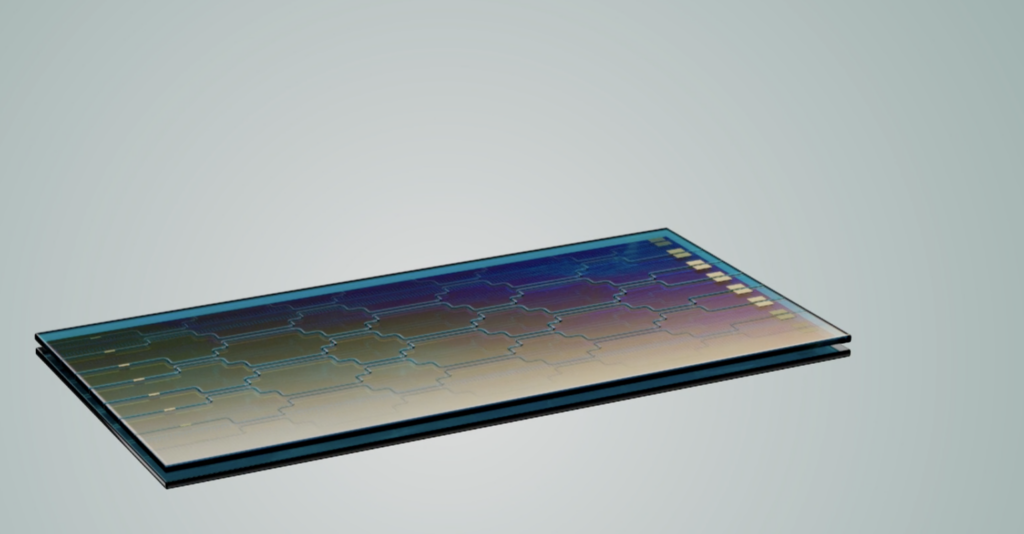
NVision is actively collaborating with HyperLight to build on their thin-film lithium niobate (TFLN) photonics platform. Having native quantum compatibility could mean photonic-based computing that runs at room temperature and that has standard plug-ins to existing liquid or air-cooling setups. That could help data center operators drastically cut wasted space on the whitespace floor and jam more compute into fewer square feet.
And, if data center tenants swap standard silicon photonics chips for advanced molecular quantum chips, they could stave off obsolescence, since foundational optical fiber can remain completely unchanged. The same high-speed photonic platforms HyperLight scales for AI data centers is adopted as the native photonic routing system for NVision’s molecular qubits. Whether this breakthrough opens a pre-built commercial market for quantum hardware or not, it will be of interest for AI data center operators transitioning to silicon photonics and trying to tackle massive compute, power, and real estate constraints.