

Table of Contents
On the way to 800 VDC, traditional transformers will give way to solid state transformers
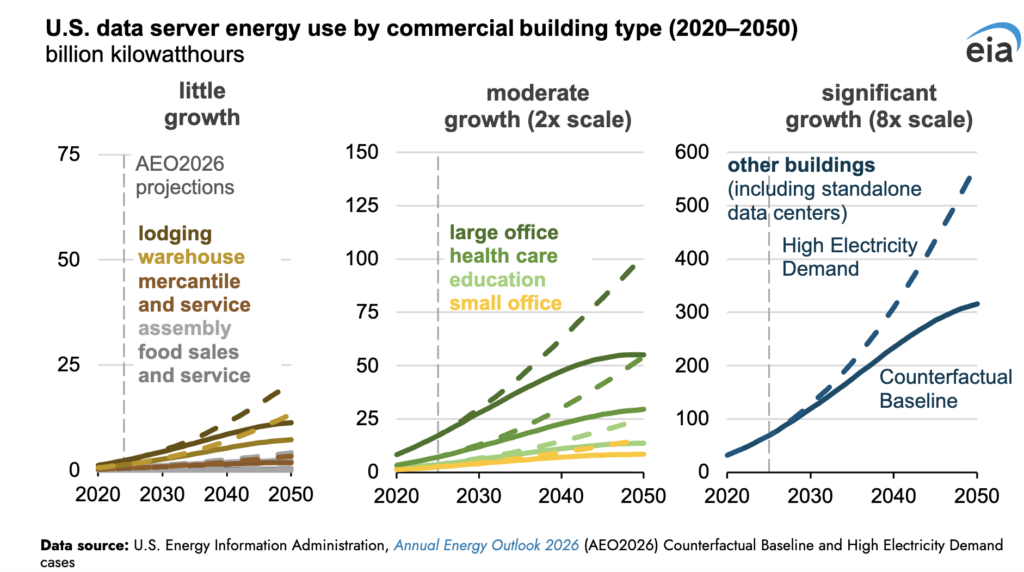
In its Annual Energy Outlook 2026, the U.S. Energy Information Administration projects electricity consumed by data center servers will increase across the commercial building stock – more in standalone data centers than in all other data center rooms combined.
By 2050, server consumption will reach between 446 billion BkWh and 818 billion BkWh, with servers accounting for up to 33% of all U.S. commercial sector electricity use by mid-century. The report notes that after 2040, there will be a 10% reduction in average annual operational power draw every three years, as servers will become increasingly efficient.
Acting as a bridge between massive utility grids and power-hungry server infrastructure will be transformers, for grid substations and facility distribution, and down in the server rack and motherboard. The problem is the physics of legacy power delivery collapse once racks jump from 10 kW densities to120 kW (and some say even as high as 600 kW per single rack). At the 2026 Open Compute Project (OCP) summit, the industry codified 800V DC as the universal standard for next-generation AI data halls. That means that traditional copper and iron transformers will hit a wall when it comes to the demands of agentic agents and the crushing workloads and physical bottlenecks they will bring to data centers. For example, the NVIDIA GB200 and GB300 superchips will fuel massive, trillion-parameter generative AI workloads, heavy LLM training, and real-time AI reasoning. Physics dictate that the size and weight of iron cores and copper windings, plus the lack of precision power control needed for denser workloads, will usher in an era of solid-state transformers (SSTs) for modern data centers. Grand View Research anticipates the market will rise from $169.4 million to $935.8 million by 2030, reflecting a blistering CAGR of 32.0%.
Rich Miller recently wrote that SSTs powered by silicon carbide or gallium nitride devices could reduce data center electrical equipment footprints by as much as 80%, while also addressing “speed to power’ issues. He pointed to growing VC interest in companies like Heron Power, DG Matrix, Amperesand, and Eaton (which is pivoting from automobile to data centers with its $5.1 billion Dana deal). Additionally, Heron struck a deal with LG Energy Solution Vertech to integrate SSTs with battery energy storage systems (BESS). And, DG Matrix is making headway with its Interport system for Nvidia MGX modular rack and a new partnership with InfraPartners.
Though the SST market is still in the nascent commercialization stages for megawatt-scale, 800V DC power architectures, there is a marked increase in momentum. Data center owners and operators want the precise voltage regulation and space savings that SSTs can offer. For example, tier-2 cloud providers like Nebius, CoreWeave, and Lambda Labs are working with Nvidia to design data centers around 800 VDC power distribution, and some are placing commercial orders for SSTs.
When it comes to hyperscalers, Meta, Microsoft, and Google are also co-developing 800V DC architecture, working toward rack-scale power setups that leverage advanced silicon infrastructure. Additionally, OpenAI is working with renewable energy startups like Exowatt to deploy SSTs.
As demand for SSTs grows, semiconductor and power electronics manufacturers will scale up their factories and prices will come down. Right now, SSTs come with a heavy upfront capital cost. Usually purchased as megawatt-scale systems, the equipment cost can range between $60,000 to $100,000 (for a baseline unit of around 50 kVA). The largest portion of that cost is attributable to the high prices of SiC and GaN power semiconductors.
There is also a cost associated with the more intricate and complex nature of SSTs, which makes them “higher maintenance” than their traditional transformer brethren, which had a reputation for lasting decades. Because SSTs are made up of complex electronics, they require more advanced cooling, and their DC link capacitors might also wear faster than the standard components of traditional transformers.
Despite the growing pains, the SST market has shifted from treating SSTs as experimental concepts to utilizing them as essential hardware for specialized, high-density infrastructure.