

Table of Contents
Consider brownfield locations when possible, abandon isolated real estate transaction models for ecosystem-shaping models, and engage communities early on
In sum, what to know:
- Opposition to data centers is now a major constraint to $130 billion to $170 billion in data center projects.
- Loss of multigenerational farms and ranches to data centers has triggered a particularly visceral response in certain communities.
- Data center operators can do better by building frameworks for regional tech ecosystems that bring tangible, longer-lasting effects to local communities.
When it comes to data center siting and approval, local opposition to data centers is becoming a major constraint, cutting across political parties and demographics, especially in regions with strong community connections and deeply entrenched pride about local food, culture, and stewardship of green spaces, clean water and clean air.
About $130 billion to $170 billion in data center projects has been halted by local opposition, with 3.5 GWs on hold in Q1 2026 alone. The opposition is growing especially fast in states with highly visible losses of rural farmland to data center development, such as Virginia, Ohio, Texas, and Pennsylvania. The resentment is pointed to not only data centers, but accompanying BTM and BYOP initiatives that leave residents feeling their local landscape and way of life are being permanently changed by “outsiders.” They equate data centers with a loss of community control, which they feel is being stripped away in exchange for promises to local elected officials that they feel do not come to fruition: with tax breaks that exceed revenues, and lower-than-promised permanent job creation for “locals”.
Perhaps more than any other factor as of late, the loss of multigenerational farms and ranches to data centers has become one of the more emotionally charged issues in communities and in political circles, especially with primaries and midterm elections looming. Though farms present their own type of environmental stresses on land and water, emitting metric tons of CO₂ emissions into the atmosphere, the perception in most communities is that sustainable regional food security and longer-term local economic circulation is better than short-term gains offered by data centers, and their long-term sustainability of infrastructure demands for electricity, water, and public services.
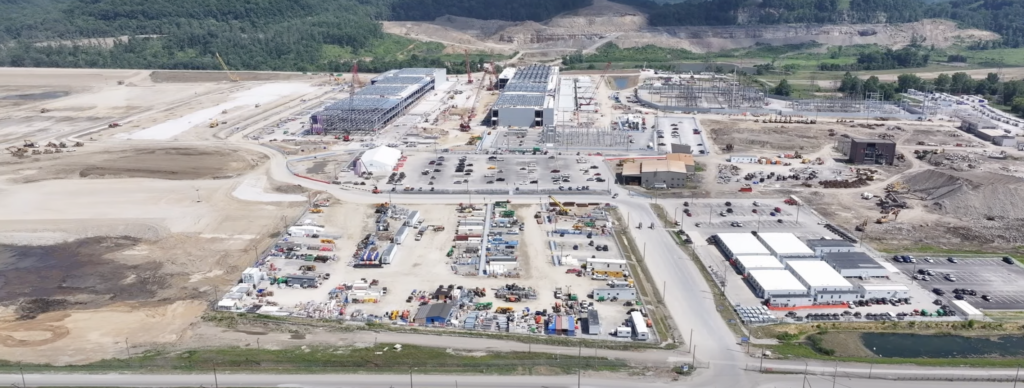
In Ohio, whose landscape of flat, open, and contiguous agricultural land is ideal for current data center designs, about 1 million acres of farmland has been lost the past 20 years – approximately 200,000 of which has been lost in the last five years. This acceleration is a trend not unique to Ohio, but in many states that traditionally prided themselves on their agricultural histories and receipts.
In Virginia, between 2021 and 2026, farmland loss accelerated sharply with AI data center builds and expansions, as well as co-dependent energy projects. According to annual USDA National Agricultural Statistics Service (NASS) data tracking, the state is losing roughly 100,000 acres of agricultural ground per year, at a blistering pace of nearly 2,000 acres per week.
In Texas, approximately 1.6 million to 2 million acres of total farm and ranch land have been lost since 2017, and while that was initially due to a combination of factors, like urban sprawl, renewable energy, and oil exploration, the Texas Department of Agriculture believes planned data center megaprojects will account for more than 70,000 acres of land targeted for industrial conversion. Currently, there are about 355 active data centers and 250 more planned or under construction. In an attempt to halt some of these projects, Texas landowners in McLennan and Hill County recently tried to invoke District Texas Agriculture code chapter 60, but the attempts were struck down by local leaders, who noted the current law has no zoning power to block private sales to data centers. In light of such losses, Texas Agriculture Commissioner Sid Miller and Congressman Pete Sessions have proposed federal or state-designated Agriculture Freedom Zones (AFZs). AFZs would use targeted tax incentives to promote data center development outside of zones important to current or future food production. They propose less productive zones and brownfields be used for projects like the 7,500-acre Project Matador and 8,400-acre Mega Ranch.
What can data center operators do better?
Because modern, high-capacity data centers increasingly require scores, hundreds, and even thousands of contiguous acres per campus, what are some of the immediate changes that can be implemented in siting new data centers?
One idea that is gaining traction is to prioritize brownfield sites whenever it’s feasible to do so. In Ohio, the Farm Bureau has poured $700 million into a Brownfield Remediation Program, preparing approximately 700 former industrial sites for reuse. The state’s inventory database reveals at least 72 brownfield properties are ready for redevelopment in northwest Ohio.
Some developers are ripping pages out of Ohio’s playbook to repurpose stranded assets. In Pennsylvania, where the PJM grid capacity crunch has been highly publicized, data center developers are increasingly evaluating the transformation of several major industrial brownfield sites, including former steel mills, coal plants, and manufacturing complexes:
- NorthPoint Development is building an 1,800-acre, 2-million-square-foot data center complex on a former U.S. steel plant site, utilizing legacy industrial grid connections;
- Homer City Energy Campus is repurposing Pennsylvania’s largest coal-fired power plant, a 3,200-acre brownfield site being converted by Homer City Redevelopment and Kiewit Power Constructors. The project will use natural gas-fired turbines to supply up to 4.5 GWs of dedicated power for AI and high-performance data centers.
While these examples are inspiring, it sometimes does not make sense to repurpose industrial sites, even if they are equipped with electrical substations, water lines, and even fiber-optic connections. Often, the risks and costs outweigh the “pros” of going with already-zoned industrial sites. Sometimes, “brownfields” are fraught with ongoing environmental cleanups (soil and water), as well as legal disputes. That means hazardous materials in the soil and groundwater can become a cost and time expenditure many developers would rather not have – especially if under pressure to meet aggressive development timelines and to meet or beat financial expectations (yes, that’s basically everyone).
When brownfields don’t make sense, hyperscalers, REITs, wholesale developers, and colocation giants could work toward creating a greater economic-multiplier effect for communities. Rather than operate as “economic islands,” they could consider the Brooking’s framework increasingly used by some local governments and regional leaders that want tangible Community Benefit Agreements (CBAs), public tracking of resource usage, and localized co-investments for localized innovation and workforce training.
Rather than rely on data center development models that are perceived to be opaque and transactional, they can jointly develop frameworks for building regional tech ecosystems. These would be ecosystems that are involve co-investment by data center operators, as opposed to having one-off real estate transactions that do not transform communities in positive ways.
In a summary of the 2026 America’s Rural Future symposium, the central question was one of “how benefits and risks get allocated and what forms of governance, local authority, and transparency can help leaders maximize local benefits while protecting community interests.”
In a 10-point insights list developed by America’s Rural Future, American Enterprise Institute, and Brookings, there are suggestions for how data center operators and communities can develop mutually beneficial regional tech ecosystems, with recommendations to:
- Treat rural communities as partners with meaningful input and leverage to benefit from siting decisions;
- Focus on job quality, duration, and steps to train local people for those jobs;
- Consider how residents are affected by changing demands and prices for electricity, water, public services, and housing pressures;
- Jointly work to create real, tangible economic benefits through local tax revenue and payments in lieu of taxes;
- Be transparent upfront and develop a shared vision with residents and local leaders and stakeholders.
Whether developing data centers with these tenets in mind can help mitigate the growing constraint of community objections remains to be seen. In a follow up article, RCRTech will look at which data center operators are working to improve local agreements to address growing community concerns about farm loss, grid strain, heavy water usage, rising costs, and permanent loss of rural character.