
Table of Contents
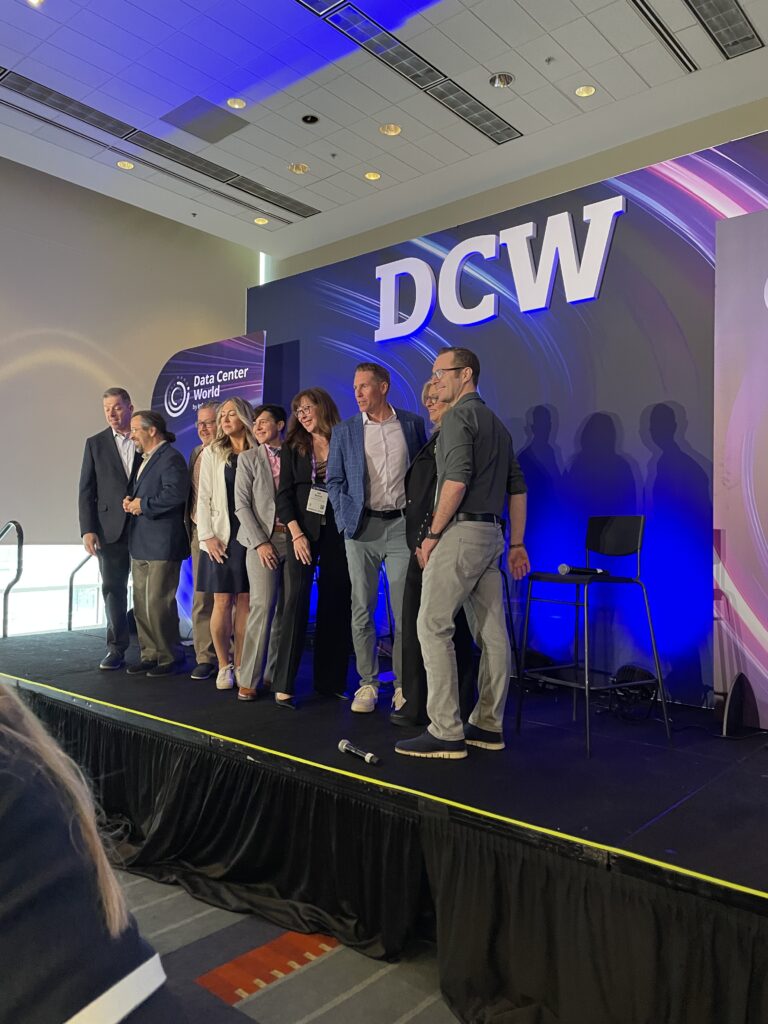
During an interactive workshop at Informa’s Data Center World in Washington, D.C. data center operators, students, educators, workforce leaders, legislators and other stakeholders discussed how public and private partnerships could align the industry’s technical needs with public educational infrastructure.
The construction industry in the U.S. is short approximately 439,000 skilled workers and for data centers, specifically, there’s a labor shortage of about 200,000 people. During yesterday’s Data Center World interactive workshop, “Building the Next Generation Data Center Workforce,” experts from Vantage Data Centers, Menlo Digital, Casne, MPINarada, GOR Group, and educational institutions like NOVA/NVCC, and the International Coaching Federation participated in a three-hour session that answered critical questions, such as:
- What should a successful new hire be able to do in 90 days on the job?’
- How can the workforce pipeline ensure new hires are “job-ready” as plumbers, welders, electricians, diesel mechanics, HVAC technicians, and fiber technicians?
- How can public-private partnerships be fostered so that private industry’s technical needs align with public educational infrastructure?
- What is the ideal age to introduce students, and their parents, to “new collar work,” that is not blue collar or white collar, but rather an amalgam that can be created with a one-year certification and rewarded with a no-debt beginning salary of $80,000 and up?
To the first question, CTO TJ Ciccone of Menlo Digital, who is also an adjunct professor at Northern Virginia Community College (NOVA), said “Don’t boil the ocean but give people the knowledge they need to land in data center or adjacent job and then they evolve from there.” He pointed out four foundational principles that he feels should inform the course work that colleges and even high schools can develop for data center curriculums:
- Describe the flow of electricity from utility to rack, naming the major electrical components and their functions;
- Draw and describe the theory of operation of a double conversion UPS
- Describe how heat is generated and removed from a data center;
- Draw and describe the basic refrigeration cycle (or vapor-compression cycle)
According to Ciccone, less than 50% of the people working in data centers today can answer those four questions accurately. “Not only can learning those answers help people enter the data center industry, but they can also help upskill people from the current workforce to pivot toward data center jobs.”
Many of the panelists agreed that those core engineering principles do not change from site to site, with Amy Garner, vice president workforce planning and strategy at Vantage Data Centers pointing out that “from that foundation, students can branch out into safety, data center design, building controls, and more.”
According to Chrissy Olsen, vice president of Critical Power Solutions at MPINarada, on top of that foundational knowledge, “there are industry standards and code to adhere to, and then you get into the nuances of how each data center does things,” and that, she points out, is where things get to be more proprietary. “But the industry standards can be the starting point for students and education.”
In order to bridge the gap between theory and real-world environments, the panel and audience members explored the ways in which the industry and learning institutions could raise community awareness about data center careers, develop courses and curriculum, and forge industry connections for work-based learning, apprenticeships, and internships.
‘New collar’ jobs
In discussing pathways toward tailored, accredited, and specialized education programs—including one-year or short-term, community college-based programs—a conversation broke out about stigmas in data center jobs. The consensus was that students and parents often associate data center careers with either “blue collar” jobs that they see as dirty or fleeting, or as “white collar” jobs that require expertise in Math or Engineering. The panel described how “new collar” jobs’ require advanced skills, but not advanced degrees. According to Ciccone, these jobs emphasize a need for mission-critical thinking: “If you are a person who can think through a problem, communicate well, type, use Microsoft Windows, and occasionally clean a clogged filter, then you have what it takes.”
There was overwhelming support among the panelists for the idea of a “mission-critical” mindset, not only because of the sensitive and critical nature of the information, but because of the threats and risks that have to be addressed, such as inclement weather, geopolitical stresses, and other factors that sometimes require a higher degree of grit and dedication.
MPINarada’s Olsen pointed out “No matter what, you have to keep the data centers going. People are expecting their credit cards, telehealth, payments, and banking, and everything else they count on, to keep running.”
Garner characterized the approach to solving problems as two-fold, “First, you want to be a ‘toddler’ with lots of ‘whys’, and then a commander-in-chief when tackling the problem whatever issues it may trigger for tomorrow.”
The panel also observed that many people incorrectly believe data center jobs “pigeonhole” people into something temporary, even though they are stable for years and constantly evolving into “adjacent” jobs that are easy to pivot to, especially as innovations continue to characterize mechanical, electrical, plumbing, HVAC and other related fields.
Regarding the misconception that AI will mitigate the need for human capital in data centers, the panel’s experts pointed out that “for every engineering or data center operations job that exists, there are potentially 6 to 10 other jobs created.” In other words, for every engineer hired to design, build, inspect and run an AI data center, there is a subsequent need for positions that support that engineer. According to AFCOM’s State of the Data Center Report, 58% of data center managers identified multiskilled data center operators as the top area of growth, while 50% signaled increasing demand for data center engineers.
For these reasons, data center pathways should include modifications of existing IT, networking, and cloud-related curriculums, or new, specialized education programs that are focused on data centers.
Symbiotic sharing
The intentional opacity of data center and colocation environments has over the past 20 years or so made the sharing of information among data centers and schools challenging, but Garner pointed out that the “compounding” of problems around staffing, power, community relations, and public relations have made it imperative that data center companies talk to each other and to the communities in which they operate. She and the others in the room discussed how to facilitate more sharing of information so that workforce education can evolve, but without having to give up proprietary information. “We don’t want people to know how we design our facilities and the efficiencies we have in our equipment and through our processes because that is what makes customers come to us. But, the problem statement hasn’t materially changed, so we can let our service providers know what we think the problems are going to be three to five years out, and then bring people along with us by partnering with colleges and trying to show in good faith that we will work with local educational institutions in our expansion efforts.”
Some of the panelists and members in the audience described how they have begun engaging students from community colleges with case studies that help the students learn while helping the data centers to solve problems. “For example,” said Garner, “we want students to help us solve problems with AI, so we pose a problem and then colleges will orchestrate and manage a program, or something tangential to a class, like a case study competition.”
Tiffany Kovaleski, CEO of the GOR Group, which builds “grit-ready” workforces with training and deep public-private partnerships, is also working on case studies with a local, technical college for which she created a 101 internship program. “I did it out of the passion I have for this industry, and organized a tour of a local data center, assisted with resumés, conducted mock job interviews, and connected students with employers.”
In addition to collaborating with local technical institutions and community colleges, many in the room advocated for starting younger, with high schools, and even middle schools. Kovaleski mentioned programs like Hands-On Heroes for elementary to middle school kids, and a growing number of programs to help youth and female populations explore skilled trades like welding, plumbing, and others through storytelling and STEM education.
Kovaleski admitted it’s sometimes challenging to get access to middle and high schools, noting “it has to be a two-way street.” She asked legislators in the room to explore how access could be opened in a healthy, regulated way that allows data centers to more readily knock on educational doors and to cultivate talent in the industry. Many on the panel cited the Dept. of Labor and other agencies (i.e., Dept. of Commerce, Dept. of Energy), as examples of who could, and is, pushing for more data center and AI-related grants and specific training programs.
Garner recommended that data center operators work with high schools to feature data-center career days that highlight what people in different roles do. “If educators have had trouble getting data centers to schools, it’s now getting much easier to get them to do workforce development work,” said Garner, urging “grace” for the fact data-center responses may have been slow in the past.
Donate time, money, resources
Whether student stipends or equipment donations, the panel explored the different ways resources could help students, without burdening schools financially. “You can start small by donating a couple of racks and chillers, just so the students can learn the basic concepts,” said a member of the audience. “The schools shouldn’t have to pay for anything, as data centers will donate pretty much anything that’s needed. Many of us are retrofitting all the time and can donate anything students need.”
Also suggested were redesigns of level-one data center jobs to apprenticeships, increasing the number of applicants who can move up quickly to level two. With so many “underemployed” people with relevant skills, the panel thought talent could be upskilled in areas of data center jobs that have very low numbers of people. Robert Weinman of the International Coaching Federation said getting people into apprenticeships can bring deep engagements. He talked of Micron, TSMC, Nokia, Western Digital, Applied Materials, Global Foundries and others that are using apprenticeships or “modularizations of apprenticeships to glue things together” for more contextualized learning, using level one as a gateway to level-two positions that put the right people on the pathway. “There are Tier A people, or veterans with a year of experience in adjacent industries, or a wider band of candidates who can evolve and pivot,” Weinman explained.
ROI for a sustainable workforce strategy is the focus for many right now, and techs that learn how to use AI to be more efficient will help bring about that ROI.
“In a data center, I need electricians to make sure the power gets from our primary power source to the rack; mechanics to maintain all the critical systems; plumbers, especially now with liquid cooling; all jobs where you have to use your hands,” explained Garner. That is not something that can be replaced with AI; however, she is seeking the data about how teams can more efficiently tackle problems. “If a group of technicians takes just four hours to complete a specific procedure that takes others with a different type of skill six hours, then the aggregation of that data would help me decide where I put people and how I staff the facility, so that is where AI can help me. It’s not a threat to the jobs within the facility. But we can all operate more efficiently with the understanding and the data we glean from what AI tells us about an activity,” explained Garner.
The emphasis, she and others agreed, is people of many backgrounds handling the complexity of next-gen infrastructure. Even as routine rack-and-stack operations are automated, smaller, more specialized teams are increasingly need, and physical labor that AI cannot perform remains essential. More and more, specializations are emerging to manage specialized workloads, which will create more, not less jobs, in data centers.