

Table of Contents
3M, Oracle, Meta, AMD, and 17 other companies have joined a consortium to scale optical connections for data centers
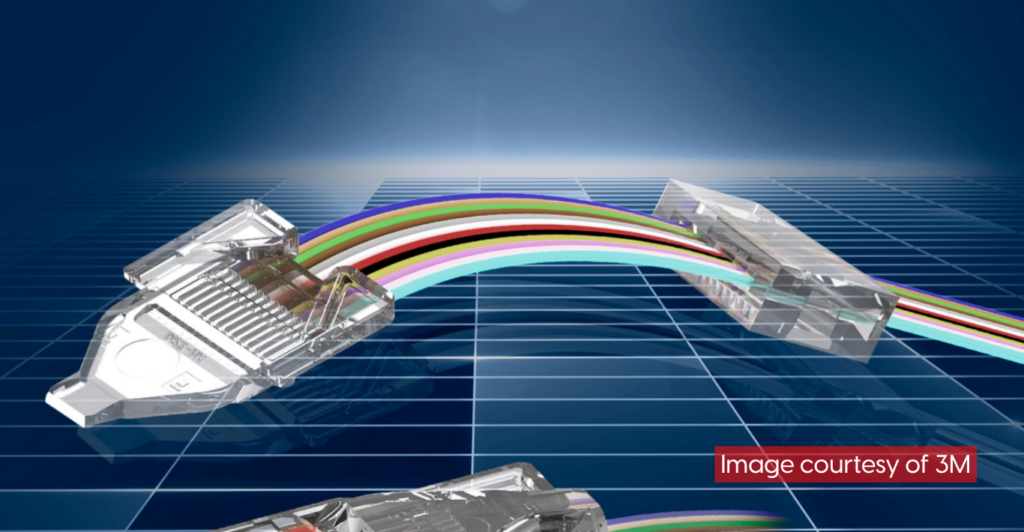
Sensitivity to dust, maintenance downtime, and limited bandwidth density are all challenges for data center hyperscalers and assemblers. Modern AI clusters (224G/448G) require high-density, low-latency connections that physical contact connectors cannot always provide reliably. That’s why expanded beam optics (EBO) is becoming an attractive option for optical fiber infrastructure in data center designs. EBO means you can pack 12 to 16 fibers into a single ferrule (with some systems even scaling to 144 fibers).
Additionally, EBO connectors use internal lenses to expand light beams over a much larger area across the mating interface. For a microscopic dust particle that would hinder a traditional physical-contact fiber core of 9 microns, the EBO connector instead blocks only a tiny fraction of the expanded beam. In addition, the intentionality of a “physical gap” between lenses prevents dust from being ground into the glass surface during mating. The advantages include fewer cleaning cycles, faster field deployment, and higher durability.
Recognizing the need to standardize specs for a range of EBO connectors solutions, a wide variety of companies have signed a multi-source agreement (MSA) to build open, interoperable specs for EBO. So far, the MSA includes 17 companies hoping to enable more resilient cluster topologies and future rack-scale optical architectures, including:
Hyperscalers/chipmakers:
- Oracle (co-chair of MSA)
- Meta
- AMD
NECs:
- Cisco
- Arista Networks
Component/Connector manufacturers
- Amphenol
- Molex
- TE Connectivity
- Senko
- Sumitomo
Optical Specialists
- Aperion
- Accelink
- Nexthop-ai
- Source Photonics
- viaPhoton
- Xscape Photonics
For these companies, the MSA is the foundation for a collaborative framework in which each member can contribute to a shared specification for multiple EBO connector configurations. The focus is not only bandwidth, but flexibility and scalability (especially with transmission speeds of 400G, 800G, and beyond). Standardizing the optical path could mean more reliable performance, even at speeds of 224G and 448G per-lane, which would help optimize data throughput per square inch of rack space.
Standardization could also allow for seamless CPO/transceiver integration, with high-density connectors sitting directly next to co-packaged optics (CPO) and high-speed ASICs.
In its press release today, 3M’s Alex An, vice president of the company’s data center vertical said the open, standards-based approach could potentially speed time to revenue, as well as improve reliability and scalability of next-gen AI infrastructure. “As AI workloads scale, the physical layer of data centers is being pushed to new limits — requiring optical connectivity solutions that are not only high-performance, but also interoperable and scalable across a growing ecosystem.”
Oracle’s Rajagopal Subramaniyan, SVP, OCI networking, also commented in the 3M announcement, stating, “Strict connector hygiene requirements slow network builds and add operational overhead for ongoing link triage. Expanded beam technology can overcome these bottlenecks, enabling more resilient cluster topologies and future rack-scale optical architectures. Reflecting Oracle’s commitment to innovation and industry leadership, we are pleased to serve as co-chair in the formation of the EBO MSA, which is essential to establishing a diverse supplier ecosystem for hyperscale cloud and AI operators.”
He noted that multi-fiber physical contact connectors are critical to a “highly resilient layer 1,” which he and others believe will foster interoperability among components and reduce the risk of vendor lock-in for data center operators.
Other advantages noted in the MSA announcement were:
- Accelerated installation, which 3M says could accelerate from months to days;
- Faster scaling of AI clusters, due to faster deployments;
- Stronger supply chains;
- Boost to U.S. manufacturers
The MSA is open to additional members across the data center and networking ecosystem. The initial technical working group has begun development of the first connector specification.
To learn more about the MSA and framework, or to become a member, contact admin@eebomsa.org.