

Table of Contents
The facility will deliver around 25MW of capacity and is backed by Keppel Data Centre Fund II
In sum – what to know:
Floating model – Keppel has started construction on a ~25MW floating data center, positioning it as a scalable alternative to land-based facilities.
Constraints focus – The project is designed to address land, energy, and water limitations, using seawater cooling and modular infrastructure.
Hyperscale demand – Capacity is already committed to a global hyperscaler, underlining continued demand for new data center formats.
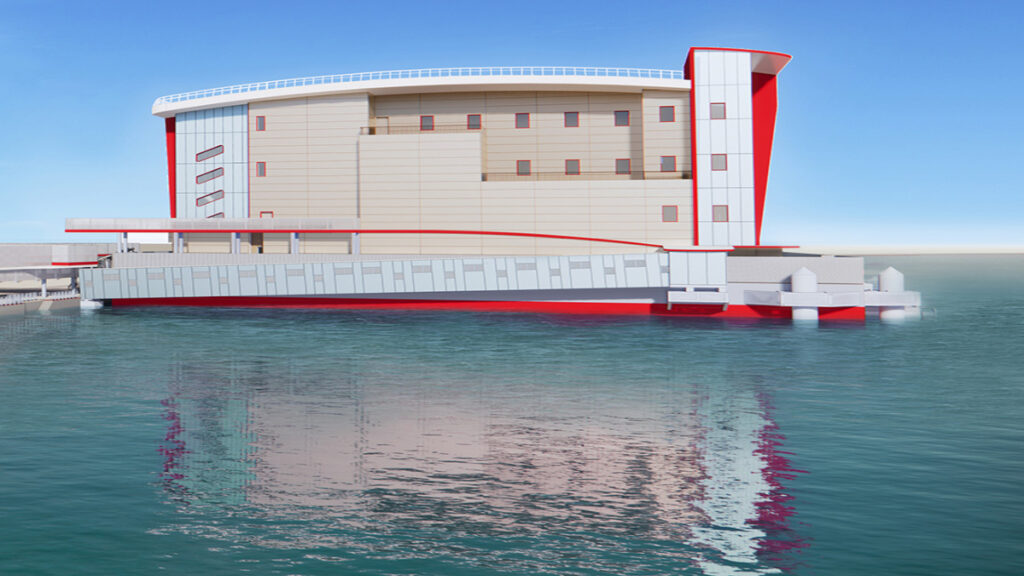
Global asset manager and operator Keppel has begun construction on a floating data center in Singapore, marking a new phase in a concept it has been developing since 2019.
The project, which received regulatory approval in 2023, is expected to go live in 2028.
The facility will deliver around 25MW of capacity and is backed by Keppel Data Centre Fund II. It has already secured a hyperscale customer, reflecting continued demand for large-scale infrastructure despite constraints in established markets such as Singapore.
The development combines a multi-story floating module with supporting onshore infrastructure. The design incorporates seawater cooling and modular construction.
“The facility will operate a closed-loop seawater cooling system, utilise low-GWP refrigerants, and include bunded underground diesel storage to ensure environmental safeguards are met,” Keppel said in a previous report.
“The shoreside infrastructure will support FDCM operations and comprises substations, offices, diesel storage tanks, pipe racks, photovoltaic panels, walkways, and administrative facilities. All components have been designed in accordance with PUB’s platform height requirements and follow best practices for environmental integrity and operational efficiency,” it added.
Floating data centers remain an emerging segment, but interest has grown as operators explore alternative deployment models. Other initiatives include projects in the U.S., Europe, and Japan, ranging from barge-based facilities to offshore platforms integrated with renewable energy sources.
“Floating data centers should not be seen merely as novelty infrastructure. They represent a serious attempt to rethink the geography of compute, cooling and land use. For Singapore, this is especially relevant. As AI drives higher rack densities and growing demand for sustainable digital infrastructure, the next generation of data centers will need to integrate power, cooling, water, land, resilience and environmental impact from the outset,” PS Lee, head of the Department of Mechanical Engineering at the National University of Singapore (NUS), said in a LinkedIn post.
“The critical question is whether floating data centers can demonstrate not only technical feasibility, but also bankability, operational resilience, regulatory acceptance and lifecycle sustainability at scale,” he added.
Floating data centers are facilities deployed on water—typically on barges or floating platforms. They use similar IT infrastructure to traditional data centers but are designed to operate in marine environments, often integrating seawater cooling systems to dissipate heat more efficiently.
They are gaining attention because they offer a potential way to bypass key constraints facing the industry, particularly in dense markets where land, power, and water are limited. By moving infrastructure offshore, operators can reduce pressure on urban real estate and, in some cases, improve cooling efficiency and energy flexibility.
However, they are still an emerging model. Challenges around deployment costs, maintenance, environmental impact, and regulation remain significant. As a result, floating data centers are more likely to complement traditional facilities rather than replace them, at least in the near term.
