Susana Schwartz
Iran threatens 'utter annihilation' of OpenAI site
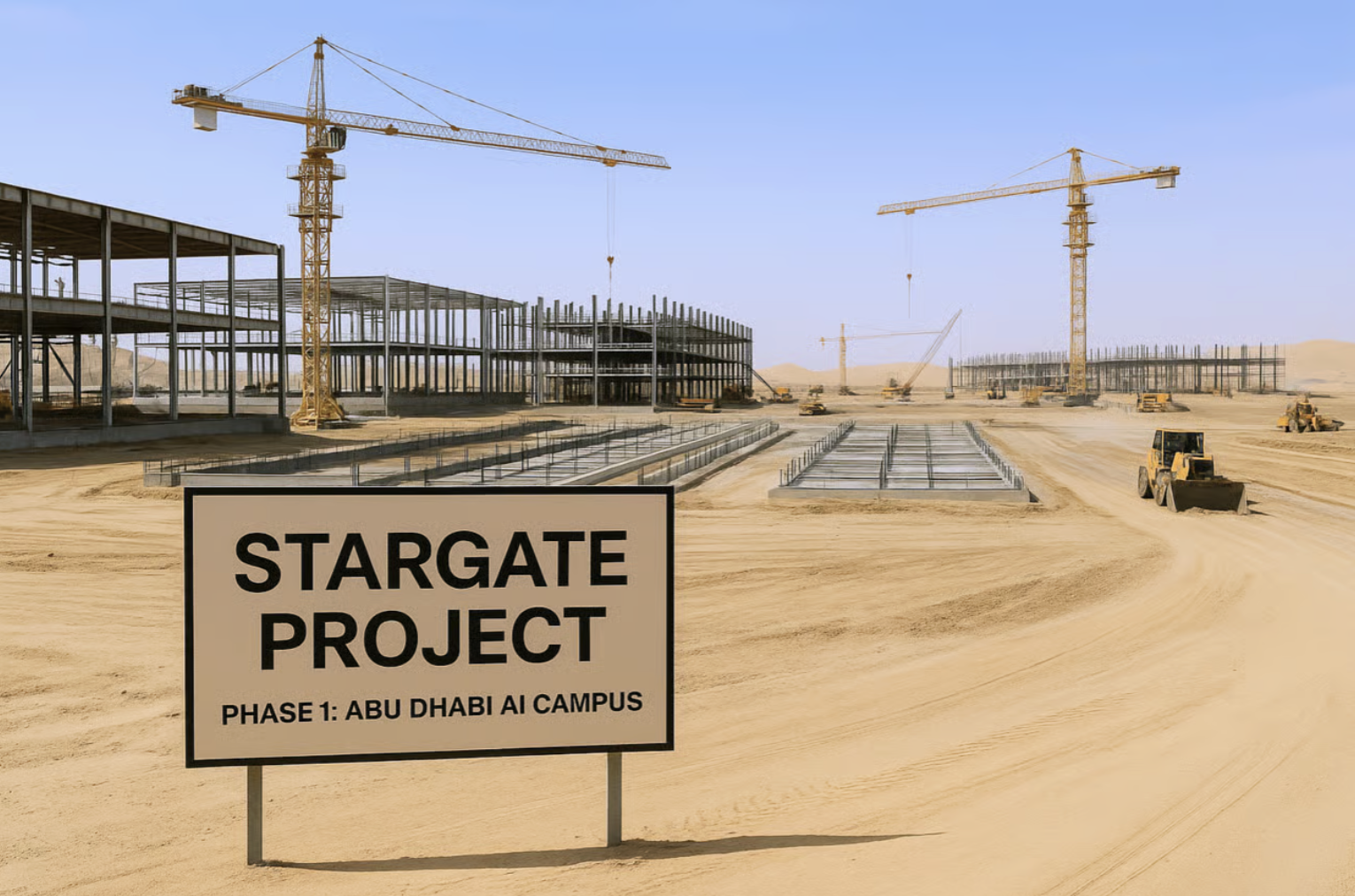
In a provocative video statement over the weekend, Iran’s Islamic Revolutionary Guard Corps (IRGC) threatened “complete and utter annihilation” of OpenAI’s $30 billion Stargate AI data center in Abu Dhabi. The 1-GW AI campus sits within a planned 5 GW campus that spans 10 square miles (26 sq km). Currently, it’s an active construction site with thousands of workers and tons of heavy equipment.
Citing U.S. and Israeli strikes on its power grid, oil fields, and newly launched threats on civilian targets, such as desalination plants, the IRGC named 17 other tech firms, including Microsoft, Google, Nvidia, and Apple. According to Iranian Lieutenant Colonel Ebrahim Zolfaghari, these companies are “enabling” U.S. and Israeli military operations through AI-driven surveillance, tracking, and targeting tools. He referred to a modern era of “algorithmic warfare,” in which “nothing stays hidden from our sight, even if you attempt to conceal it through Google,” said Zolfaghari.
In terms of infrastructure and civilian targets, the IRGC has also hit such targets, like the oil refinery in Haifa, which houses Israel’s largest petrochemical and oil refineries, and the Vardiya neighborhood in Israel, with a strike on a residential building on April 5. In addition, the IRGC has struck targets in Kuwait, Bahrain and other neighboring regions.
As of this morning, Pakistan, Egypt, and Turkey made a proposal for a 45-day cease fire, which both President Trump and Iran have thus far refused to accept. In a Truth Social post yesterday, President Trump wrote, “Tuesday will be Power Plant Day, and Bridge Day, all wrapped up in one, in Iran,” adding, “Open the F***in’ Strait, you crazy bastards, or you’ll be living in Hell – JUST WATCH!” That follows the Friday post on TruthSocial, which said, “With a little more time, we can easily OPEN THE HORMUZ STRAIT, TAKE THE OIL, & MAKE A FORTUNE.“
As we enter the 6th week of the war, aerial bombardment by the U.S.-Israeli coalition continues as a “systematic attrition,” and the Iranian people continue to be silenced by an ongoing communication blackout.

Susana Schwartz
Technology Editor
RCRTech
AI Infrastructure Top Stories
Keysight on the 1.6T inflection point: Manodipto Ghose of Keysight spoke to RCR about a “1.6T demand surge,” explaining that interconnects are emerging as “first-class citizens of infrastructure,” sending 200G signals over longer distances.
Inside Microsoft’s SE Asia strategy: To close the “noticeable gap” in AI diffusion between the world’s advanced and developing economies, Microsoft will invest $1 billion over two years in Thailand for infrastructure and technical capabilities.
AIOps a critical lever for telecom: Register for the April 23rd Redhat-Tupl webinar about AIOps as a critical lever for turning data-driven insight into operational impact, an evolution toward automated decisioning and closed-loop action.
AI Today: What You Need to Know
Oracle’s new CFO: Amid concerns about AI DC builds and reliance on OpenAI, Oracle has tapped Schneider Electric’s Hilary Maxson as its new CFO, overseeing infrastructure and energy amid Oracle’s plans for a massive AI spending surge.
Digital Reality secures $3.25B: Digital Realty closed its U.S. Hyperscale Data Center Fund after securing $3.25 billion of total equity commitments. The company also appointed Michael Yang as managing director of Fund Management.
Expanding options for inference: SUSE Rancher Prime and SUSE AI joined the Vultr Marketplace as an open-source alternative to hyperscalers – targeting organizations scaling AI workloads and infrastructure on Kubernetes.
QTS touts ‘Responsible expansion’: QTS Data Centers, owned by Blackstone, is rapidly expanding, with massive DC projects in the UK, Iowa, and Finland. QTS recent withdrew its proposal for a 1,600-acre, 750 MW Wisconsin site in Wisconsin.
Made-in-the-USA solar farm: In support of QTS in Oregon, Avangrid, has installed more than 250,000 Houston, TX-made solar panels at its Tower Solar project in Morrow County, Oregon, adding 166 MWdc (120 MWac) to PGE’s power grid.
h-BN thermal management grows: The global hexagonal boron nitride (h-BN) market will reach $1.05 billion in 2026, expanding to $1.76 billion by 2036, as demand for high-performance thermal management materials grows.