

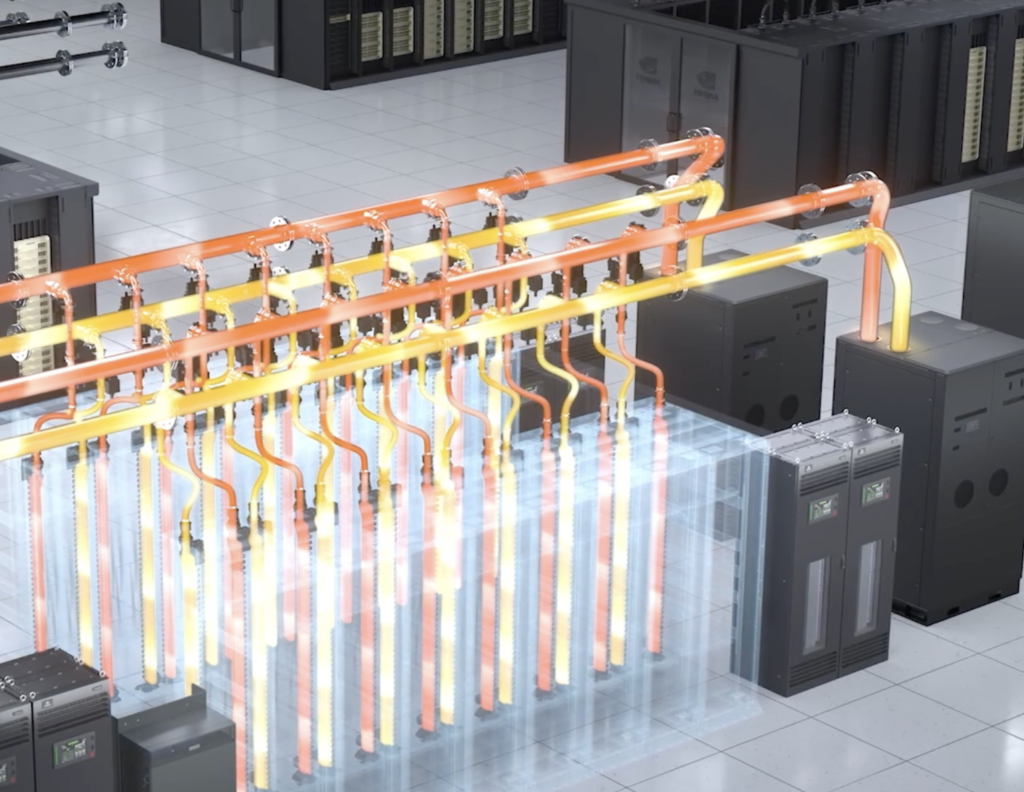
When Nvidia this week announced that the “Rubin generation of NVIDIA AI infrastructure is the world’s first to achieve 100% liquid cooling,” some media outlets inaccurately touted it as a “100% reduction in water.” There were Nvidia comments that touted “zero water consumption” and “the elimination of massive amounts of power usage and pretty much all water usage.”
I have since requested an interview with Nvidia to clarify what the design can and cannot do, but in the meantime, remain skeptical about some of the claims. A blog by MIT Sloan Management Review says it best, calling attention to the way in which environmental impact is being measured: “The company’s claims focus on water consumed within the data center’s boundaries. While that metric may accurately reflect facility-level performance, it captures only part of AI’s total water footprint. Significant water consumption occurs upstream, particularly during electricity generation and semiconductor manufacturing.”
In the new closed-loop liquid system, a mixture of 75% water and 25% propylene glycol will be recirculated, with the coolant running much hotter than conventional limits (up to 45°C or 113°F). Because the fluid is already quite hot, outside air can dissipate heat through dry radiators, eliminating the need for evaporative cooling towers. The liquid remains sealed in pipes, so the data center does not need to redraw fresh water after the initial draw because there are no cooling towers. But, important to note is the 45-degree limit, so data centers in hot places, like Arizona and Texas, will need chillers if outdoor air temperatures go above the coolant’s limit.
Also, it seems that in data centers, the internal coolant circulation isn’t the biggest culprit in water use, but rather the evaporative cooler outside to maintain coolant temperature. In other words, a data center’s direct on-site water consumption is overwhelmingly driven by building-level heat rejection, not by the internal coolant loop. There’s also the whole issue of water consumed by power plants supplying the data center’s electricity. The International Energy Agency (IEA) found that for every kilowatt-hour produced, natural gas plants draw down 1.17 liters of water, while coal-fired generation draw 2.2 liters.
As I said, RCRTech is seeking clarification from Nvidia, and will follow up with more detail in subsequent AI Infrastructure Daily.

Susana Schwartz
Technology Editor
RCRTech
AI Infrastructure Top Stories
RCRTV AI TechTalk: See interviews with visionaries in the AI infrastructure space, including data center operators, neoclouds, semiconductor innovators, and more. Upcoming are interviews with Equinix, Corning (GlassWorks), Schneider Electric, and others.
Recent semiconductor Insights: Check out RCRTech’s Christian de Looper’s semiconductor industry coverage, featuring stories on TSMC, AMD, Intel, SK Hynix, Qualcomm, Nvidia, Blackstone and others.
AI Today: What You Need to Know
Oracle legal challenge in WI: Oracle, a partner in Port Washington’s Stargate project, is suing the PSC of Wisconsin, claiming Wisconsin Electric’s proposed Financial Support Requirements create “harmful and unintended consequences.“
Blockbuster Memory Earnings: Micron announced a massive profit surge, sparking rallies across memory-heavy Asian stocks,including a 12% jump for SK Hynix. SK Hynix also announced plans for a $29 billion listing on the Nasdaq.
Status of Ratepayer Protection Act: The Bipartisan Ratepayer Protection Act, intended to protect ratepayers from DC-driven energy costs, was held up yesterday by Frank Pallone (D-N.J.), who claims the legislation “is not nearly enough.”
Fuel cells as a power resource: Rystad Energy projects a tenfold increase in fuel cell market revenues by 2030, with roughly $30 billion projected. A “contracted order book of approximately 9 GWs points to growing confidence among major operators.
European semi ecosystem: The research institute TNO and ASML will jointly develop photonic chips through lithography, process control, and metrology solutions. The R&D will focus on technical workshops and joint innovation.
Qualcomm releases Dragonfly roadmap: Qualcomm released a “comprehensive data center roadmap for the agentic AI era” featuring Dragonfly C1000 CPU, High Bandwidth Compute, Qualcomm Dragonfly AI300 inference accelerator, and connectivity products, together with custom silicon solutions.
RCR Events
Quantum Safe Networks Forum, July 14th
Quantum Safe Networks Forum brings together telecom operators, cybersecurity experts, and industry analysts to explore how to build resilient, future-ready infrastructure in the face of quantum disruption. Register now
RCR Roundtables AI Infrastructure, October 21st, Dallas, Texas
Join 50 senior data center, energy and AI leaders at the Ritz-Carlton Dallas on October 21 for invitation-only roundtables on powering and scaling AI. Request your invitation
Industry Resources
Webinar, June 29th: Agentic RAN Management: Delivering OPEX efficiency and a path to 6G
Webinar, June 30th: Building the 6G Standard: Key developments to know
Webinar, July 7th: Noise-Figure Measurements with RFmx and PXI VSTs
Webinar, July 16th: NTN in motion — evolving standards, expanding services
Whitepaper: Powering sovereign AI at scale
Whitepaper: Scalable database design for 5G and beyond
Report: Scaling AIOPs from insight to action
Summit Access: GSMA Device Enablement Summit: How operators can fix device-network fragmentation
Whitepaper: Telco AI Enabler: Mediation’s defining role
Report: Securing telecom infrastructure for the quantum era
Report: Scaling optical networks for the AI and hyperscale era