

Table of Contents
With its Qualcomm Agentic RAN Management Service, the company is linking near-term operational cost efficiency with the long-term move to autonomous networks
As mobile network operators (MNOs) continue to densify, virtualize and diversify their networks, the operating model behind the radio access network (RAN) is under growing pressure. More spectrum bands, more cell sites, more services, more traffic patterns and more demanding users all add complexity. At the same time, operators are being asked to improve performance and reduce cost without waiting for a wholesale network refresh.
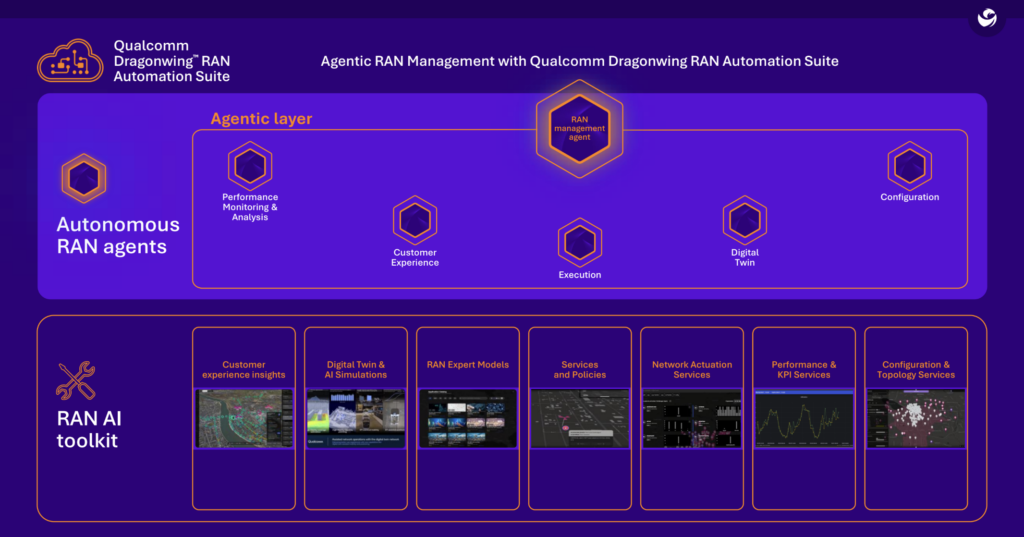
That is the problem Qualcomm is targeting with its Agentic RAN Management Service, part of the Qualcomm Dragonwing RAN Automation Suite. The service is designed to move operators beyond conventional automation and toward 6G-grade autonomous networks by applying AI agents, RAN-specific models, digital twin simulation and production-grade execution tools to live network operations.
For Alex Teper, senior director and head of network management products at Qualcomm, the timing matters. AI-native 6G will not simply be another radio upgrade. It will arrive alongside profound changes in devices, applications and user behavior. New classes of connected devices, including AI-enabled wearables, autonomous systems and physical AI endpoints, will create traffic patterns that static or semi-static networks will struggle to support.
“Whatever was possible in the 3G, 4G and 5G era — manual to somewhat automated network operation — will no longer be enough,” Teper said. “A move to true autonomy needs to happen in coincidence with the move to 6G.”
The core idea is that future networks cannot rely only on prescribed responses to known problems. Instead, specialized RAN AI agents need to monitor network conditions, understand customer experience, reason over issues, generate action plans, validate those plans through RAN-specific digital twins, execute changes through trusted tools and continuously learn from the outcome.
“One thing that cannot happen from our perspective is a set of prescribed solutions on the network that will be reactive to traffic that is being generated on the device side,” Teper said. “The reason is because we cannot be fast enough to that, and at the end it’s all about user experience.”
This is also why Qualcomm emphasizes a RAN-specific AI toolkit rather than a generic large language model pointed at network data. Telecom networks have their own language, operational constraints, vendor-specific interfaces and safety requirements. The agentic layer, in Qualcomm’s architecture, sits on top of production-grade RAN tools that already have operational mileage in real networks.
That distinction is central to adoption. Operators are rightly cautious about allowing probabilistic AI systems to touch deterministic telecom infrastructure. Qualcomm’s model is not to hand the network directly to an agent, but to combine human-in-the-loop adoption, expert models, digital twin validation and certified execution capabilities.
Teper said roughly 80% of what Qualcomm showed in its agentic RAN workflow is already production-grade, with the agentic layer being trialed and proof-of-concepted with key customers and in Qualcomm labs. The path forward, he said, is not a single leap to full autonomy, but a focused progression through high-value use cases such as fixed wireless access, performance troubleshooting, RAN supervision and energy management.
That use-case orientation connects the technology roadmap to the business case. Qualcomm has positioned Agentic RAN Management as a way to drive near-term operational efficiency while preparing for 6G. The company has targeted up to 40% opex reduction as networks move toward higher levels of autonomy.
For Teper, that opex argument is not secondary to 6G. It is foundational. “The only reason that 6G can be introduced, and can actually be economic to network carriers, is having the operation part figured out,” he said. “We cannot have the same opex equation, the same labor equation and engineering equation behind every new G that is coming in. That is simply not scalable.”
In that framing, agentic RAN management is not a speculative 6G concept. It is a practical bridge from today’s automated networks to tomorrow’s autonomous ones, giving operators a way to build trust, capture efficiency and prepare the RAN for an AI-native future.
