

Table of Contents
VIAVI explains how 3GPP Releases 17, 18 and 19 expand NTN services, while 6G builds toward resilient, AI-managed terrestrial/non-terrestrial network convergence
Direct-to-device (D2D) services served by non-terrestrial network (NTN) connectivity is often discussed as though it were a single technology. In practice, the label covers both services that connect existing phones through largely unmodified cellular stacks and newer 3GPP-defined non-terrestrial network capabilities designed specifically for satellite links.
“The direct-to-device term is a bit overloaded,” said Obilor Nwamadi, senior product manager at VIAVI Solutions. Today’s unmodified systems can use existing cellular technologies without requiring the device to recognize that it is communicating through a satellite. That approach offers immediate compatibility with conventional handsets, while shifting responsibility for compensating for Doppler, delay and other satellite-link dynamics toward the satellite and radio network.
Release 17 changes that model. The handset becomes aware of the satellite environment and uses its own GNSS-derived position, together with information about the satellite’s location, to estimate and pre-compensate for Doppler and propagation delay. “The UE is now responsible for managing the dynamics of the satellite link on the service link,” Nwamadi said.
According to Nwamadi, making the device responsible for managing those conditions can improve the gain available from the satellite beam and provide a stronger technical basis for voice, messaging, data and IoT services such as tracking and monitoring.
Release 18 expands the standards framework toward broadband. VIAVI’s roadmap highlights wider channel bandwidths in Ka-band, support for very-small-aperture terminals and electronically steered antennas, and mobility enhancements covering terrestrial-to-NTN transitions, satellite switching and handover. Coverage improvements, including repetition and reference-signal changes, are intended to strengthen the challenging uplink from terminals to satellites.
Release 19 adds further spectrum and capacity options. Ku-band support can enable both direct-to-handset and terminal-based services, while a new 3 megahertz NR bandwidth gives operators greater flexibility in constrained mobile-satellite-service spectrum. RedCap support extends NTN toward lower-complexity devices, and additional uplink and downlink enhancements are intended to allow more terminals to share the same satellite beam.
The service progression is cumulative. Unmodified systems currently emphasize emergency communications and messaging. Release 17 provides a standardized foundation for IoT, voice and data; Release 18 moves toward fixed wireless access and true broadband; and Release 19 increases capacity, reliability and scale.
“6G will not do away with everything introduced in 5G advanced for NTN,” Nwamadi said. “6G will build on the technologies from release 17, 18 and 19.”
Potential 6G enhancements include GNSS-resilient operation, multi-satellite connectivity, carrier aggregation, spectrum sharing and satellite-based positioning, navigation and timing. AI-assisted channel compression and beam management could also improve how networks respond to changing link conditions.
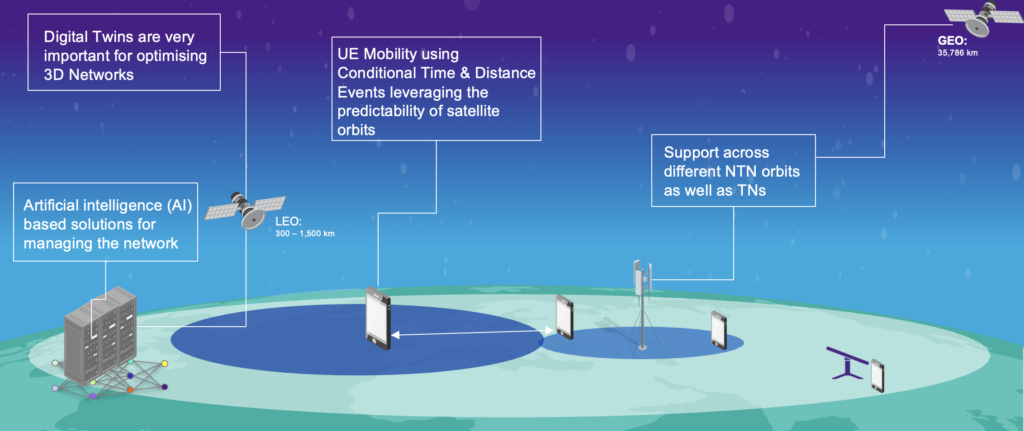
The longer-term objective is a 3-D network combining terrestrial cells, low-Earth-orbit satellites and geostationary systems. The layers would deliver different levels of performance, but mobility mechanisms could move devices among them based on time, distance and predicted satellite position.
Managing that environment will require more than conventional optimization. “Digital twins become a really really important tool for optimizing this type of 3-D network,” Nwamadi said.
AI can then build on those models to coordinate moving devices, satellites, terrestrial cells and changing obstructions. The goal is not identical performance across every access layer, but a network capable of selecting and optimizing the best available connection as terrestrial and non-terrestrial systems progressively converge.
