

Table of Contents
In 5G, AI is an overlay focused on optimization; in 6G, AI will be embedded end-to-end
“AI-native” is now a part of the standard vocabulary around 6G. But the mobile industry is already applying AI across devices, radio access networks and operations, which raises an obvious question: what has to change for 6G to legitimately be described as AI-native rather than simply more AI-enhanced than 5G?
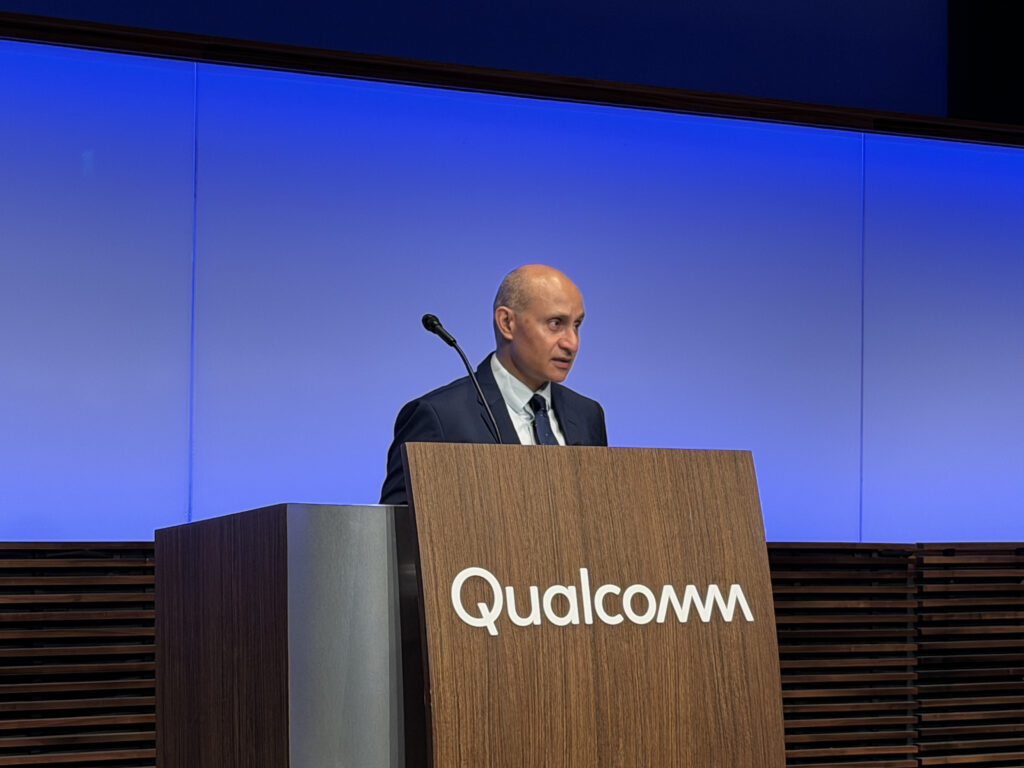
Qualcomm provided a fairly expansive answer during its 6G Leadership Day last week in San Diego. Durga Malladi, senior vice president and general manager of technology planning and edge solutions, described wireless and AI as technologies that have developed in parallel over successive mobile generations. Now, he said, “The technologies are converging in their own way — they feed off each other…We are at a point in time when we say AI-native 6G, it’s kind of important to depict the idea of how these things come together.”
Based on presentations and discussion from Qualcomm executives, AI-native means intelligence begins influencing how the communications system itself behaves in terms of how devices interact with networks, how protocols adapt, how resources are allocated, how networks are operated and how radio systems can help perceive the physical environment. Suffice to say, AI-native 6G is significantly more nuanced the current industry focus on AI-RAN.
One fundamental change is the user interface itself. Qualcomm Vice President of Engineering Hemanth Sampath told media and analysts, “AI is the new UI and AI is changing user behavior.” He described persistent, context-aware agents accessed through smartphones, glasses, watches and other devices, with those experiences generating substantially more uplink traffic and requiring responsive access to both local and edge compute resources.
Qualcomm’s larger premise is that mobile computing evolves from device-centric applications toward agent-centric, multi-device experiences. Instead of a person opening an application and requesting a service, AI agents increasingly understand context and act on the user’s behalf. That change has implications down into the communications protocol.
Sunil Patil, vice president of product management, framed the question as what an AI-driven transformation means “at the protocol level.” Devices will host more AI applications with different performance and quality of service (QoS) requirements, while also having local intelligence capable of understanding how those applications are performing.
Qualcomm’s idea is to give the device greater ability to respond within network-defined parameters. “The protocol layer itself needs to have some flexibility,” Patil said. “The UE is in the best position to detect…the performance of those applications.”
Potential adaptations could span RLC, PDCP, CDRX and QoS parameters, along with decisions such as accelerating a handover or moving between lower- and higher-power modes. If the device always has to wait for the network to recognize changing conditions and prescribe a response, Patil said, “There’s going to be some latency and in many cases the user would’ve moved on to doing something else.”
The focus on 6G as context-aware and responsive extends from the device into the how network resources are allocated. With dynamic 6G signaling, the device agent could track application-level user experience metrics and provide real-time feedback to the network. The RAN could then allocate additional capacity where it materially improves the experience and reclaim resources where they are unnecessary. Sampath described the approach as designed around “fast-changing AI traffic and content complexity.”
Qualcomm SVP of Engineering and Global Head of Wireless Research John Smee described the broader evolution as a move from relying primarily on statistical network behavior toward using more direct data about applications and conditions. The operator still determines policy, but richer context creates another input into radio optimization. As Smee put it, “The operators will say, ‘Hey, what’s the most efficient way of serving this opportunity?’…If there’s a better way to improve air link efficiency for a particular application….they’ll do it.”
This aligns with industry discourse on intent-based networking. The concept is that the network understands radio conditions and traffic characteristics as well as what a particular workload is trying to accomplish.
AI-native also applies to how the network itself is operated. Qualcomm executives used the familiar autonomous-driving framework to describe the progression from manual network operations through AI assistance and toward increasingly agentic systems capable of diagnosing and resolving problems within defined guardrails.
Alex Teper, vice president of technology, said leading operators today are generally between Levels 2 and 3 of network autonomy, with many targeting Level 4 between 2027 and 2029. But his more consequential point concerned 6G economics. “From our perspective, 6G must have autonomy inside even to be economic,” Teper said. “We want to run fast but we want to make sure we don’t run too fast.”
Production telecom networks have reliability, safety and domain-specific requirements that make unconstrained agentic behavior unacceptable. Qualcomm’s view is that autonomy has to advance alongside the validation and control mechanisms operators require.
The most distinctive part of Qualcomm’s AI-native vision may be sensing which was described as an additional input modality that can better inform AI. Malladi described 6G sensing as a multimodal AI problem in which RF measurements become another source of perception alongside cameras, radar, maps and other sensors.
Qualcomm demonstrated potential applications ranging from presence detection and autonomous robot location and speed detection to aerial drone tracking. Other examples included perception-assisted beam management, network dimensioning and generating channel information for ML model tuning. Defense industry and governmental stakeholders have advocated for cellular sensing for obvious reasons. The content at 6G Leadership Day expanded that to more broadly applicable applications; this is important because ISAC needs to be a dual-use technology to incentivize operator investment at any sort of scale.
Qualcomm is also grounding this work in prototyping before standardization. Smee described (and attendees later saw) an R&D testbed where the company is flying drones and using different frequency bands to understand position, velocity and object classification. His explanation of the company’s development philosophy was straightforward: “If you didn’t test it, it doesn’t work. We really believe in building things first.”
There is an important nuance to all of this. AI-native does not mean 6G is a clean-sheet replacement of 5G. Qualcomm’s own presentations show substantial continuity between 5G and 6G in waveform design, channel coding, modulation, frame structure and MIMO. The physics remain the physics. I explored this with colleague Will Townsend in an episode of our video podcast Beyond the Network; the takeaway is that the path from 5G to 6G is evolutionary while use cases like sensing are revolutionary.
With 6G, the major shift is in the feedback loops surrounding those fundamentals. Applications provide more context to devices; devices become more adaptive; networks respond dynamically; agents automate increasingly complex operations; and RF itself becomes an input into AI perception. In that sense, the difference between AI-enhanced 5G and Qualcomm’s vision of AI-native 6G is that intelligence becomes the operating logic of communications systems rather than an optimization overlay.