

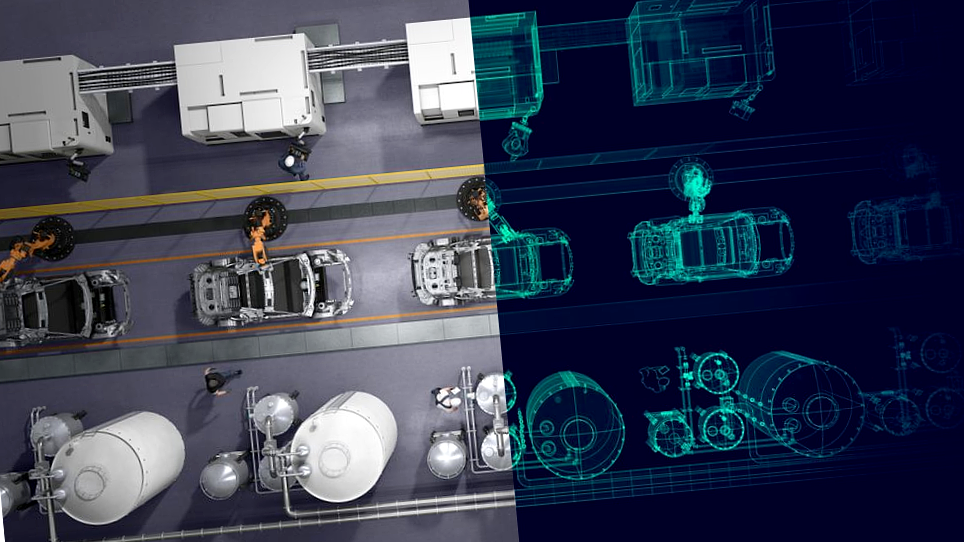
It’s funny, this physical AI stuff. Like, funny-complicated – right? At writing, Siemens is giving a press conference at Hannover Messe in Germany, which is all about industrial AI – from industrial design to supply chains to production work. It has a new “entry-level” industrial computer with an Nvidia GPU inside, geared for physical AI in factories. It has a new industrial AI agent, called Eigen, that goes inside engineering systems to understand projects, write code, configure systems, and “iterate until pre-defined performance benchmarks are met”.
This is after writing, quite quickly, an interview with NTT Data that strips industrial AI back to its mathematical roots. NTT’s argument is corrective, actually – that factory-grade physical AI is not built on hallucinatory token-hungry language models but on bounded and deterministic maths and physics, with a narrow remit just to direct robot traffic. In that context, GPUs are surplus to requirements; CPUs suffice because robots solve for precision, not probability. The implication is that much of the current AI hardware narrative is misapplied to industrial automation.
But both arguments are correct. Siemens just reframes the discussion, and takes it further. In Hanover, Cedrik Nieke, in charge of its digital industries business, is talking about AI like a “brain in a jar” – powerful, but isolated and disconnected. Its value only materialises when embedded into industrial systems – like electricity was transformative only when it was applied to trains and factories, and all the other places his dynamo forbears at the German juggernaut-firm found for it 180 years ago. The challenge with AI is not model size but the system integration.
As an aside, the message for Europe, squeezed between the fast-digitalizing industrial economies of China and the US, is to make the applications – to apply AI in industrial applications. Because the models will be commoditized, and the value will be to make them work. It has a fight on its hands, all the same – but it has some of the biggest automation companies, and an urgent agenda to get it right. The point is that the Siemens is bigger; it is taking the industrial AI story way upstream, above the private 5G network running the humanoid robot.
Its talk, here, about engineering agents and digital twins says that complexity is migrating away from the shop floor into design, orchestration, and lifecycle management – where AI is less about control loops and more about coordinating workflows, automating tasks, making data usable. Industrial data is vast, siloed, and untapped, says Nieke; that’s the bottleneck, he says – not guessing games about where to put GPUs. He has an analogy about all the manufacturing data in the world – 1.9 zettabytes, apparently, the equivalent of 36 million years of Netflix movies.
Like Netflix needed to be named. The thing is, 80 percent of these industrial flicks are never seen – and so maybe name-drop is right. “PLM silos, ERP silos, CRM silos,” he says. This is the layered view of industrial AI. At the edge, it looks like IoT-plus: efficient, local, and CPU-driven. Above it, it becomes agentic and system-wide. Private 5G, in case we’re still interested, is just connective tissue to bind these layers at the edge – into something that finally works, on the shop floor.

James Blackman
Executive Editor
RCR Wireless News
RCR Top Stories
Easy as Raspberry Pi: Physical AI for robot automation requires lightweight maths models, not token-hungry LLMs, says NTT Data. It does need private 5G for mobility, however – and, contrary to reports, private 5G is doing fine, finally.
World Cup networks: Verizon has outlined to RCR how 5G, fiber and network slicing will support FIFA World Cup 2026, with three-to-five times more capacity increases, 50TB per match demand and long-term infra upgrades across host cities.
Sovereign cloud deals: The EC has awarded a total of €180m in sovereign cloud contracts, introducing a new framework to measure compliance and resilience while boosting Europe’s push for secure, independent digital infrastructure.
10 GW DOE DC site: With 100% private funding of sovereign AI infrastructure on federal land, SoftBank’s SB Energy investment of $4.2 billion and $33.3 billion in Japanese funding is a ‘blueprint’ for what’s to come.
Qualcomm’s 6G vision: Qualcomm frames 6G less as a generational upgrade and more as end-to-end platform for intelligence. John Smee, head of wireless research, lays out the vision for converged connectivity, compute and sensing.

AI-Powered Telecom Infrastructure
Supermicro, in collaboration with NVIDIA, delivers AI-powered infrastructure tailored for telcos, enhancing operational efficiency, network management, and customer experiences. Explore now
Beyond the Headlines
FX and AI drag: Ericsson saw organic growth in Q1, but slumped in real terms on currency swings, divestment costs, and higher AI chip prices – causing it to miss targets. EMEA and APAC made up for a mixed show in the Americas, and…
P5G versus DCI: … most interestingly, Ericsson chief Börje Ekholm defended the firm’s approach to the AI ‘supercycle’, to borrow a Nokia term, by saying enterprise 5G and APIs are a better longer-term bet (for a 5G vendor) than DCI fiber.
Musk’s end game: Starlink looks like a foundation for Elon Musk’s space-comms empire, going beyond telcos to global D2D coverage, and, eventually, to a space network linking connectivity, compute, and broader inter-stellar economic ambitions.
Robots are ready: Industrial humanoid robots and physical AI are moving from pilot to production – as Siemens, Nvidia, others, plus lots of private 5G providers (including Nokia) roll up to Hannover Messe.
Questions for Leo: Amazon’s Globalstar deal accelerates its satellite ambitions, but launch bottlenecks, integration challenges, and Starlink’s scale advantage mean it still cannot close the competitive gap.
What We're Reading
MNOs rise 4%: Global telco connectivity revenues rose 4% to $1.3 trillion in 2025, as 5G subs surpassed 3 billion, says analyst house Omdia – although operators face slow core growth and ongoing challenges monetizing new technologies.
Nokia ECE pitch: Seems like Nokia has removed the gag from its ECE unit – which has some new PR, its first in months, timed to coincide with Hannover Messe; it sounds either like a sales pitch, or a reminder of all its Industry 4.0 innovation.
T-Mo SME push: T-Mobile is offering up to $5,000 in activation credits and workshops for selected new SME customers, aiming to boost growth with its SuperMobile plan and enhanced connectivity features.
Dollar trackers: Hubble Network and InPlay are to deliver dollar asset trackers by combining low-power chips with a satellite-backed Bluetooth network, enabling real-time data without infrastructure and targeting large-scale IoT applications.
Real AI problems: New analysis from HFS Research lists the top AI challenges, including a shortage of skilled talent (55%), difficulty integrating AI with legacy systems (41%), and data quality and governance issues (40%).
Events
Join defense leaders, technology innovators and system integrators and explore how commercial network solutions can be adapted to meet defense-grade requirements, enabling secure, resilient, AI-driven, multi-bearer networks. Register.
Join us at Connect (X) 2026, the premier event for the connectivity industry. This flagship gathering will explore the latest growth drivers shaping wireless, broadband, and smart city innovation, featuring insights from 200+ speakers. Register today.
Test & Measurement Forum, May 19
Join the annual Test & Measurement Forum where industry leaders, innovators, and engineers come together to tackle the most pressing test and measurement challenges in telco today. Register now
CCA’s 2026 Mobility & Connectivity Show
Join industry stakeholders and innovative leaders in the communications service provider community this spring at CCA’s 2026 Mobility & Connectivity Show, April 14-16 in Louisville, KY. Register now
Industry Resources
Webinar April 21st
Scaling AIOPs from insight to action banners
Powering sovereign AI at scale
