

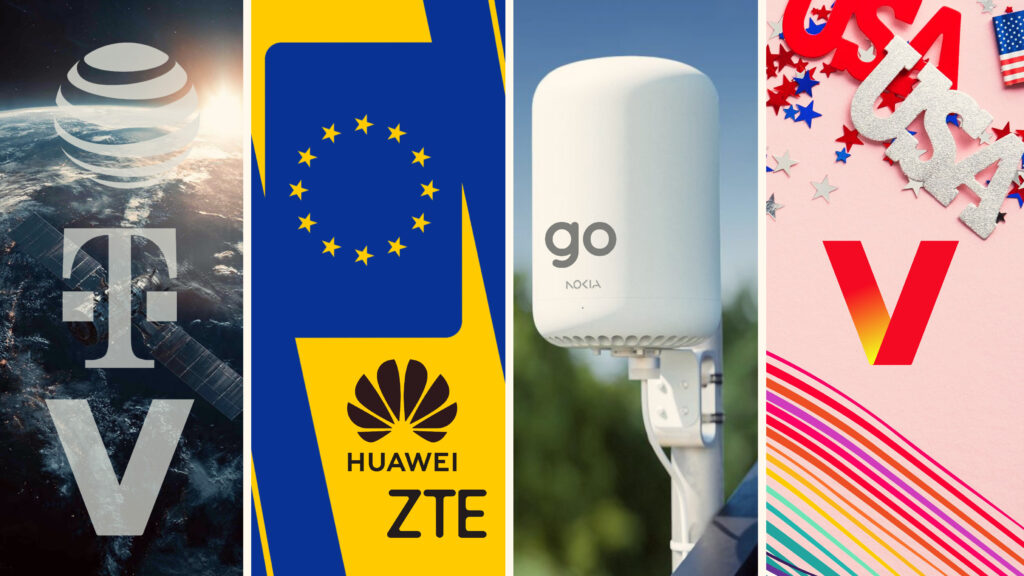
Some quick news for you, in some kind of order, just to keep us honest. Nokia has a new sovereign sat-com venture with compatriot space group ICEYE – which is about new connectivity frontiers (of course), but also (plainly) about ownership and control of the satellites, ground systems, and terminals. The Finnish firm has also, for the record, completed the sale of its FWA unit to Inseego, which doubles the latter’s revenue, adds 250 staff, and gets a bunch of tech, contracts, and carrier relationships – in return for an 11% stake in the business, at least. Next up: the sale of Nokia’s ECE unit, the erstwhile king of private 5G – due any day now (surely?). And back on satellite-NTN, quickly: the big three US telcos – AT&T, T-Mobile, Verizon – have formalized their anti-Starlink JV to pool spectrum resources to eliminate coverage “dead zones” and expand satellite coverage. It is a “complementary service” to fiber and 5G, they reminded everyone. The trio has also appointed Paul Roth as interim CEO, while the search for a permanent placement continues. Roth was previously with AT&T, Cingular Wireless, and Ameritech. And to flip flop: on the subject of completed deals, Softbank has handed over $3.1bn for digital infrastructure investor DigitalBridge, giving it greater exposure to data centers and connectivity infrastructure. DigitalBridge will remain separately managed under Marc Ganzi. Also, and as picked up everywhere: Reuters says the EU’s attempt to force high-risk (Huawei, ZTE, etc) equipment out of its mobile networks might be delayed – as governments concede that networks, critical as they are, are also expensive to rip-out and replace.
Meanwhile, here’s the intro section from a well-written review of a well-executed interview from Intelligent RAN Forum last week… Maybe it was just the quality of the questions (chapeau, Sean); but Verizon rose above it all at Intelligent RAN Forum – above the commercial tests at Orange, the early wins at Optus, the scare stories at SK Telecom – to draw the line between automation and autonomy, capability and context, tools and platforms, research and action, order and chaos. It was a useful closing session, which painted the US firm like it had all the right questions, if not the answers just yet. But then probabilistic AI is an awkward bedfellow for a deterministic telco. Which is why Verizon talked at some length about guardrails, arbitration, provenance, and (human) intent. The firm wants to move beyond the kind of rule-based automation that drives helpful changes in its own radio (RAN) network – of the sort, actually, that Optus referred to in another session – to an agentic operating model where AI systems reason across its different network domains, and also coordinate with one another, and take actions in response to problems that are not already scripted by humans. Which is the AI dream for Level 4/5 network operations, of course. More here, or via the link below.

James Blackman
Executive Editor
RCR Wireless News
RCR Top Stories
Verizon draws line: Verizon is moving from scripted RAN automation to agentic network ops, where AI reasons across domains, shares context and takes action – with the operator retaining control of intent, outcomes and guardrails.
An AI-RAN double: Samsung has signed AI-RAN contracts with KT and SKT for Korea’s Hyper AI Network, a two-year, KRW 17.2 billion program testing private 5G and edge AI with industrial robots.
800G raises bar: The move to 800G and 1.6T is increasing optical testing complexity in AI data centers, with signal integrity, interoperability, power and thermal behavior requiring validation.
Network context: Telco AI projects stall not because of the model, but because it lacks network context. Operators need mapped data, controlled actions, realistic testing and rollback paths before agentic systems can safely touch live networks.
IoT war chest: Onomondo is getting a new owner and €100m in fresh funding as it pitches integrated global infrastructure, rather than just airtime – as the platform for IoT sensing to support physical AI sense-making.

AI-Powered Telecom Infrastructure
Supermicro, in collaboration with NVIDIA, delivers AI-powered infrastructure tailored for telcos, enhancing operational efficiency, network management, and customer experiences. Explore now
Beyond the Headlines
Growth pockets: RAN revenue will remain flat through 2030, says Dell’Oro. Growth will be concentrated in AI RAN, massive MIMO, and cloud RAN, while private 5G adds new enterprise RAN spending, and 6G remains uncertain.
Supercycle fever: AT&T has signed a $3bn fiber supply deal with Corning, adding to a string of major commitments as AI data-center construction tightens optical supply and telcos bulk up their networks.
Snapdragon takes: Persistent context, sensory wearables, and heterogeneous software will connect endpoints – per Qualcomm’s diversification strategy. Oh, and in five hours of keynotes at Snapdragon Summit, 6G was referenced… twice.
AI-RAN risks: Don’t repeat your 5G mistakes with AI-RAN, SK Telecom tells its fellow telcos – while Optus considers how they should re-architect their infrastructure as “social networks for agents”.
Massive MU-MIMO: SRG has run the first independent test of 5G massive and multi-user MIMO in FDD spectrum across cells in Verizon’s network in Minnesota, with Ericsson as vendor. It found performance gains, incuding enhanced uplink.
What We're Reading
Nokia NTN deal: Nokia is to develop sovereign LEO satellite systems with Finnish space group ICEYE from 2028, combining satellites, ground infra, and rugged terminals to support defense, border security, and emergency services.
Telefónica rejig: Telefónica is restructuring its Spanish operation into independent B2B, B2C, and wholesale units, targeting simpler operations, faster decisions, and international growth in cloud, cybersecurity, AI, and defense.
Rip-out slowdown: The EU proposes more flexible deadlines for telcos to remove high-risk kit from the likes of Huawei, reports Reuters, after operators warned replacement could cost €40bn and divert investment from fiber, 5G and 6G.
Inseego bags FWA: Inseego has completed its purchase of Nokia’s FWA unit, doubling revenue and adding 250 staff, global carrier deals, and indoor, outdoor and mmWave tech. Nokia retains an 11% stake and technology partnership.
Softbank purchase: Softbank has completed its $3.1bn deal for DigitalBridge, which will remain separately managed under Marc Ganzi. It gives Softbank greater exposure to data centers and connectivity infrastructure.