

Table of Contents
The deal could see OpenAI train its new models on Amazon silicon
In sum – what we know:
- Early-stage discussions – Amazon and OpenAI are reportedly in preliminary talks for a $10 billion investment, though no agreement has been finalized.
- Trainium chip commitment – The deal would involve OpenAI using Amazon’s custom Trainium AI chips for model training on AWS infrastructure.
- Diversification, not exclusivity – This represents another step in OpenAI’s broader strategy to build a multi-supplier chip ecosystem rather than an exclusive arrangement with any single provider.
Amazon is reportedly in early discussions to invest as much as $10 billion in OpenAI, with the deal structured around OpenAI’s commitment to use Amazon Web Services’ custom Trainium AI chips. The news would value OpenAI at more than $500 billion if finalized — a figure tied to the company’s recent transition to a for-profit structure. Both companies declined to comment on the reports.
The potential investment follows a familiar pattern in the AI industry — a circular arrangement where a hardware or cloud provider invests capital in an AI company, which then uses those funds to purchase the investor’s services. For Amazon, the deal represents an opportunity to validate its proprietary chip development efforts as a credible alternative to Nvidia’s dominant position in AI hardware. For OpenAI, it offers another avenue to diversify its infrastructure supply chain while securing capital for continued expansion.
The mechanics
The discussions remain in early stages, with no final agreement signed. Reports indicate the deal could push OpenAI’s valuation beyond $500 billion, though the exact figure remains unconfirmed. This valuation milestone comes in the wake of OpenAI’s transition to a for-profit model, completed a couple of months prior, which freed the company to pursue deals beyond its early backer Microsoft, which holds a 27 percent stake.
The structure of the proposed investment follows what has become a standard playbook in AI industry dealmaking. Amazon would provide capital, which OpenAI would then use to purchase Amazon’s cloud computing and chip services. This circular arrangement benefits both parties — OpenAI gains funding and infrastructure access, while Amazon secures a major customer for its cloud and semiconductor businesses. The deal would position Amazon as a full-stack AI provider, offering cloud infrastructure, proprietary chips, and investment capital as an integrated package.
Trainium
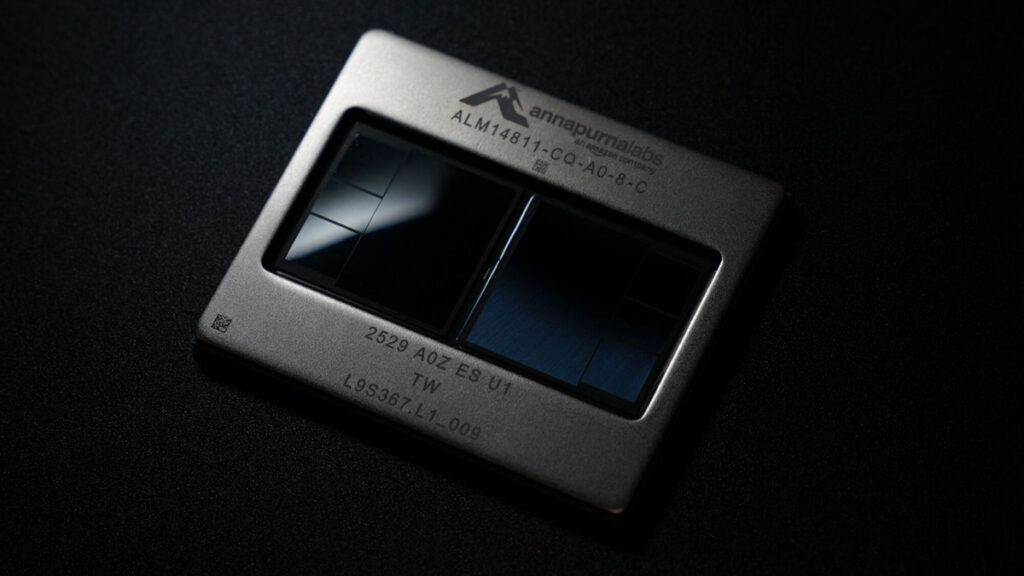
At the core of the reported discussions is OpenAI’s commitment to use Amazon’s custom Trainium AI chips. Amazon recently unveiled the latest iteration of its Trainium series, called Trainium3, and has outlined development plans for the next generation, signaling continued investment in building proprietary alternatives to Nvidia’s hardware. Under the proposed arrangement, OpenAI would train AI models on AWS infrastructure powered by these chips.
The partnership would represent a significant validation of Amazon’s proprietary silicon efforts. Nvidia has long dominated the AI chip market, but Amazon has been working to establish Trainium as a viable alternative for large-scale AI workloads. Landing OpenAI as a customer would demonstrate that Amazon’s chips can handle the demands of training frontier AI models. That said, the deal won’t be an exclusive one — OpenAI would retain access to other hardware providers, making the deal a diversification play rather than a lock-in to Amazon’s ecosystem.
The diversification play
The Amazon discussions fit into a broader pattern of OpenAI actively building a multi-supplier chip ecosystem to avoid over-reliance on any single vendor. The company has pursued a series of deals throughout 2025 aimed at securing access to diverse hardware options.
In October 2025, OpenAI signed a deal to acquire a 10 percent stake in AMD and committed to using AMD’s AI GPUs, while separately signing a chip development agreement with Broadcom. Then in November, OpenAI signed a $38 billion cloud computing deal with Amazon — a precursor to the deeper partnership now reportedly under discussion.
Amazon itself is pursuing a similar hedging strategy. The company has invested $8 billion in Anthropic, one of OpenAI’s primary competitors, while simultaneously pursuing this stake in OpenAI. Both companies appear to be diversifying their bets rather than committing exclusively to single partners, reflecting the competitive pressures and supply chain uncertainties that continue to shape the AI industry.
