

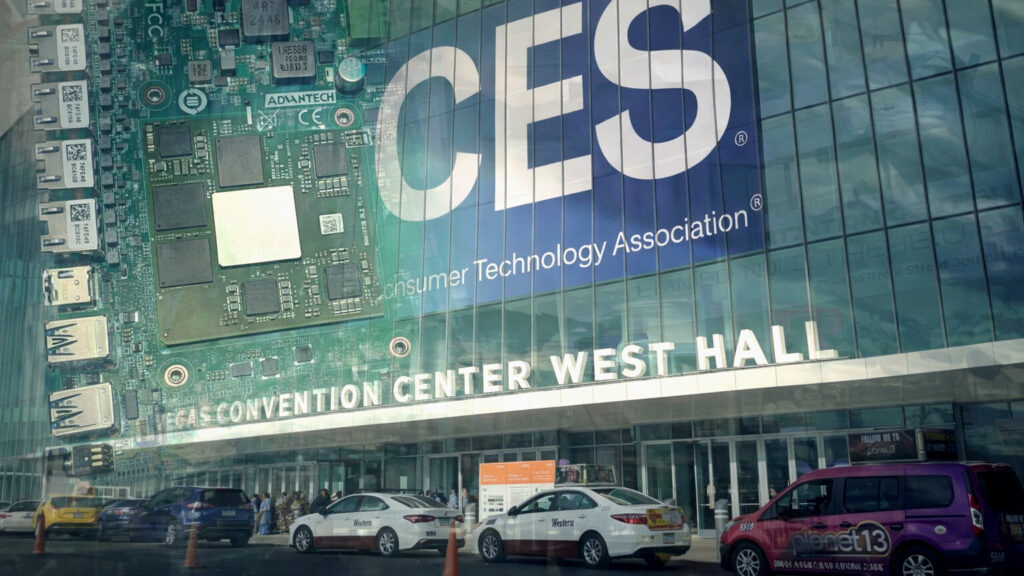
The decorations have only just come down, and the industry is on the road again, making its first pit stop of the year at the Consumer Electronics Show (CES) in Las Vegas. Sean Kinney was there – his twelfth visit, he says – and he has written a beery (spirits and sours) travelogue about how it has changed. CES is now a show about the infrastructure and underpinnings of consumer tech, he says, rather than just about consumer gadgetry.
And it’s about AI, of course – and he reflects in his piece on the big announcements from the big chip vendors. But it is the same with MWC, too, just around the corner, which was all about smartphones for a period, until networks became more capable and interesting again – to the point ‘phones’ turned into cars and drones and factory lines.
The same under-the-hood intrigue, about how to prop-up the new AI apps that will drive the future economy, will be on show at PTC’26 in Hawaii in 10 days – where the conversation shifts back to the fixed side of telecoms. Suddenly, fiber backbones, subsea cables, and metro infrastructure matter – as the dampener in your new AI pyrotechnics. I’ll be there, January 18-21; get in touch if you are also.

James Blackman
Editor
RCR Wireless News
RCR Top Stories
AI pub talk at CES: Drinking and thinking on the Vegas strip; CES has shifted from gadgets to silicon, says Sean Kinney, with AI infra front and center. Nvidia, Intel, and Qualcomm showed next-gen chips – all mixed, here, in a classic Kinney cocktail.
UK 6 GHz split: UK regulator Ofcom is prioritizing near-term Wi-Fi capacity while keeping the door open for mobile and 6G. Its split-priority approach gives Wi-Fi early access to the upper 6 GHz band while reserving spectrum for mobile.
Tokyo 5G XR trial: SoftBank, Ericsson, and Qualcomm cut wireless latency by around 90% in a Tokyo field trial, showing how 5G Advanced features and network slicing can enable stable, real-time XR experiences on commercial networks.
AI for digital twins: AI is poised to supercharge digital twins in telecom, transforming them from reactive simulations into proactive, intelligent, and real-time network models that enable operators to test, predict, and optimize performance.
Brazil’s AI moment: Brazil is at a key phase for AI data center development, driven by renewable energy availability, rising capacity needs, and coordinated efforts across operators, government, and the broader energy supply chain.

AI-Powered Telecom Infrastructure
Supermicro, in collaboration with NVIDIA, delivers AI-powered infrastructure tailored for telcos, enhancing operational efficiency, network management, and customer experiences. Explore now
Beyond the Headlines
Data center boom: AI-driven compute demand, rising server densities, and shifting financing models are setting the stage for an unprecedented data center buildout in 2026, according to a new report from GlobalData.
AI-era assurance: GSMA Intelligence says 2026 telco priorities show a shift toward customer-centric service assurance via unified platforms, large-scale agentic AI, and real-time data infrastructure. Check out the key takeaways.
AI, out of the lab: The new solution seeks to close the gap between the performance of AI models in the lab and in real-world, paving the path to building trustworthy, transparent AI systems for all kinds of safety-critical scenarios.
BT’s global story: BT has sold BT Federal, its US government contracting unit, to integrator 22nd Century Technologies, marking another step to gut its international infrastructure portfolio as BT International pivots to a multi-cloud platform.
Wi-Fi power-up: The FCC will vote to create a new category of ‘geofenced variable power’ (GVP) devices that can use 6 GHz; the idea is to enable outdoor and longer-range Wi‑Fi, and to support new innovations in AR/VR, and sundry IoT.
What We're Reading
Private 5G spectrum: French regulator Arcep has opened private 5G in 3.8-4.2 GHz spectrum, enabling 10-year enterprise networks for all industrial automation; it aligns with the UK’s position, and with the EU line on regional harmonization.
An OpenAI pen? OpenAI is reportedly developing a screenless AI pen, code name ‘Gumdrop’, which combines voice interaction, handwriting capture, and ChatGPT access. It signals a push into ambient, hardware-based AI assistants.
AT&T in-car media: AT&T and iM Media Labs have announced a partnership to build next-gen in-vehicle entertainment combining AI personalization and AT&T’s 5G network, aiming for unified audio/media experiences and OEM scalability.
DC blueprints: Data center design is evolving for AI and hyperscale scale. ABI presents a set of blueprints for building them – to accelerate construction, reduce risk, and ensure systems (compute, cooling, power, networking) work together.
Cementing private 5G: Vodafone and Ericsson, plus others, are deploying private 5G networks at cement plants, enabling automation, real-time monitoring and improved safety as manufacturers accelerate Industry 4.0 digitisation.
Events
Join this RCR Wireless News‘ event to understand the current state of the Wi-Fi as we examine a myriad of evolving use cases and monetization strategies being deployed by industry. Register now
Industry Resources
Webinar, September 18th
The journey to a fully autonomous network – The evolution of network automation and how Amdocs is leading the way