

First came compute bottlenecks, than memory, and now connectivity, with a shift from copper to optical ‘unlocking new architectural possibilities.’
This week, Marvell CEO Matt Murphy was visibly elated when Nvidia CEO Jensen Huang declared during Murphy’s Computex 2026 keynote that Marvell would be the “next trillion-dollar company,” going on to praise Marvell’s data center connectivity, optical networking, and custom silicon, all of which sent Marvell shares surging over 32% in a single day.
In a statement to RCRTech after the keynote, a Marvell spokesperson said the message to convey was that “AI infrastructure is no longer primarily a compute challenge, but a connectivity challenge.” On stage, Murphy and Huang reinforced the importance of connectivity in the era of AI agents and distributed computing, with speed, efficiency and density of compute as only part of the story. Murphy many times highlighted that computing at a high scale will increasingly become a “connectivity challenge” and one that will define the performance of the system.
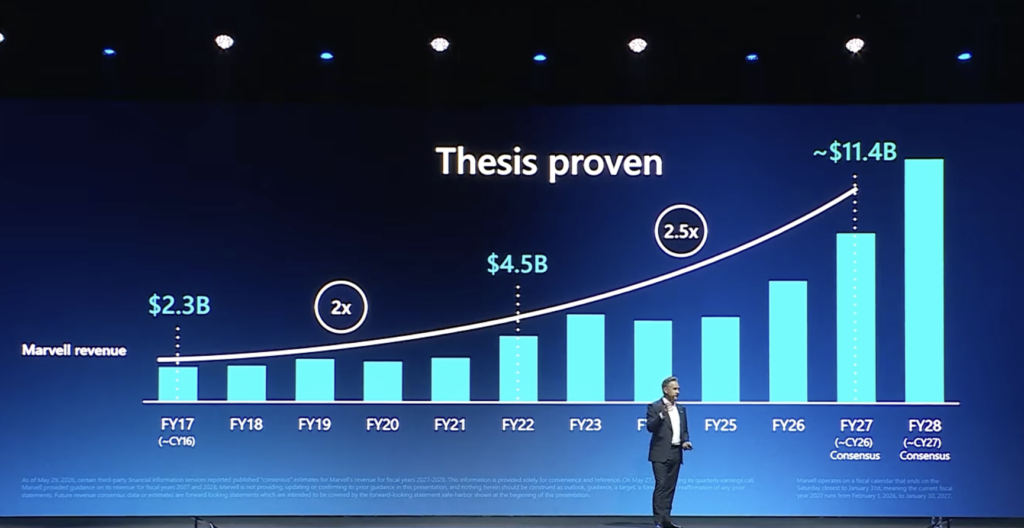
As Murphy explained, eventually, hundreds-of-thousands and even millions of processors will work together as a single massive compute engine, and “the next major wave of innovation and scale will come from the underlying connectivity of these systems, with connections moving from copper to optical, they will unlock new architectural possibilities,” with an emphasis on the architecture and characteristics of connectivity that define the performance of the system. Looking ahead to what’s left of this year and what’s coming next year, Murphy said Marvell is “in the on-ramp” to move data at massive scale – the main driver behind what he described as a decades-long transformation into a “data infrastructure company,” with leadership across optical interconnects, custom silicon, switching, silicon photonics, co-packaged optics, and coherent networking. On the screen behind him, Murphy illustrated that data center revenue now represents about 75% of Marvell’s revenue (as of last quarter), with an accelerating growth rate that is expected to reach $16.5 billion in revenue by next year.
Evolution of ‘Bottlenecks’: Compute, Memory, Connectivity
In terms of the pillars of AI infrastructure bottlenecks, compute was a major one, with Nvidia being the primary company to address that challenge, becoming a $5 trillion market-cap company in the process.
Next, the memory bottleneck was driven by larger models needing enormous amounts of memory and bandwidth created three $1 trillion market-cap DRAM and High-Bandwidth Memory (HBM) leaders (Micron Technology, SK Hynix, and Samsung Electronics).
Third, connectivity will, according to Murphy, define the limits of the architecture. “The industry will rally to meet this challenge,” he said, noting that the largest hyperscalers are reimagining their entire network architectures. “Scaling AI infrastructure is now, first and foremost, a connectivity challenge, as reasoning models, mixtures of expert architectures, agentic AI, all continue to evolve, more data has to move across the infrastructure, demanding higher-bandwidth and lower latency.”
Because workloads no longer fit within one data center, he envisioned what’s to come, with larger data centers being built, and bigger and bigger campuses “full of data centers.” That’s where high-speed connectivity, between all of those data centers and campuses, will become a critical enabler of scale and compute. And according to Murphy, “Optics is the way forward to build larger, faster networks, and at scale.”
As written in the statement to RCRTech, the point being made was that “AI data centers are transitioning from copper to optical architectures, which will enable larger scale-up clusters, disaggregated memory, and eventually AI infrastructure where compute, memory, networking, and photonics operate as one unified system.”
As a connectivity leader, Murphy believes “the next major AI bottleneck is moving data efficiently across increasingly large AI systems.” To that point, Marvell strives to be uniquely positioned to provide the connectivity foundation for that future. As Murphy said in his keynote: “The vast majority of our revenue comes from connectivity. We built this company around data movement…even the portion of our revenue that comes from compute, is fundamentally because customers embed our connectivity into their compute engines.”
Indeed, Marvell is in a unique position as a “pure-play” connectivity leader, especially now that it has struck a $2 billion deal with Nvidia for hardware-level integration via NVLink Fusion. That will allow customers to build semi-custom AI data infrastructure – something analysts believe heavily validates Marvell’s position, though many are cautioning that the stock’s meteoric surge makes its valuation highly demanding.
The “trillion-dollar” validation by Huang was surprising, as a $1 trillion market cap implies a ~4x upside from its current ~$254 billion valuation. But, the public endorsement from Huang signals that the core bottleneck in AI scaling has officially shifted from raw compute (GPUs) and memory to data center connectivity and optics—Marvell’s primary differentiators.
