

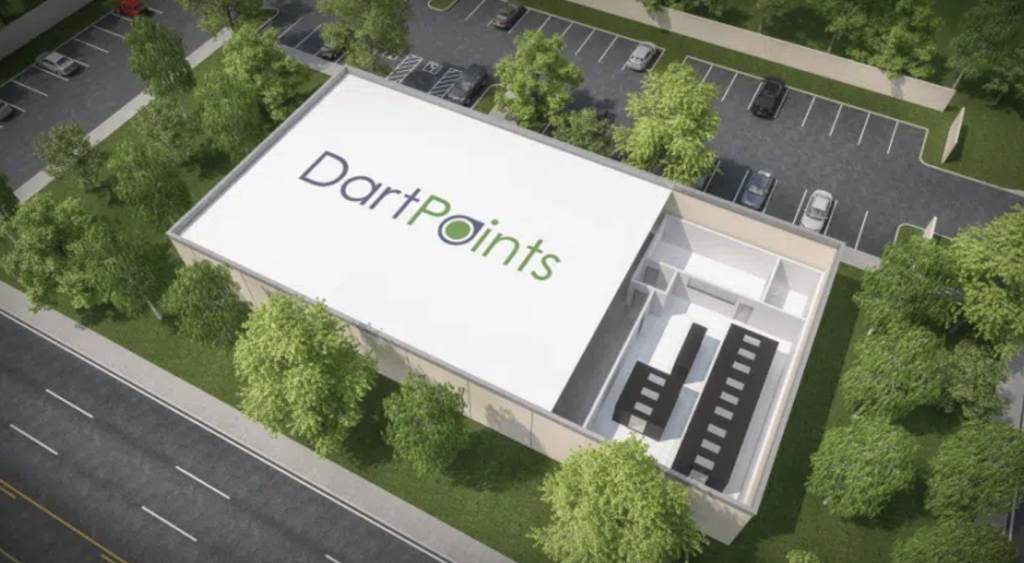
DartPoints President and CEO Scott Willis spoke with RCRTech AI TechTalk about the company’s differentiators as an enterprise-focused colocation space and power provider offering cloud/hybrid cloud managed services in non-tier one markets, with a particular focus on edge and inference AI workloads, with high-density micro data centers in underserved tier-2 and tier-3 markets.
“I think there’s always been a really good investment thesis around the enterprise – even in non-tier one markets,” says DartPoints President and CEO Scott Willis, referring to DartPoints’ sweet spot as an enterprise-class infrastructure provider for regional businesses that want to avoid congested Tier-1 hubs and that seek more network and interconnection options in distributed enterprise IT environments.
With 900+ enterprise customers, Willis identified four key customer segments that tie to the company’s evolving investment thesis and strategy:
- Larger enterprises, particularly around space and power;
- HPC (high performance compute), and what we believe are the strong tailwinds supporting those opportunities;
- AI, which to us means inference and teaching workloads;
- Hyper,’ but not big-learning hyper workloads, but rather more regional, concentrated hyper workloads where we’ve got a number of active conversations.
Willis emphasized that “big, concentrated learning workloads” are not where the DartPoints platform is going to play, with its target capacity in the 10 – 60 MW range, supporting high-density server racks that require between 40kW to 100kW+ per rack when supporting multiple enterprise or neocloud within a single regional hub.
From leasing to ownership
To continue to meet its customers’ edge inference needs, and to fit into the regional utility grids of smaller cities in DartPoints’ target markets, the company has made a notable transition from leasing to direct asset ownership. Last April, DartPoints received a large injection of capital from Nova Infrastructure, which led to a recapitalization and a current expansion into new markets.
“Leveraging M&A on a contiguous basis strategically makes sense as the company fills out its geographical presence,” contends Willis, who considers “M&A an instrument for growth and for adding capacity to the portfolio,” which in the case of DartPoints, includes 11 markets and 12 data centers across the Midwest, Southeast and Southcentral United States, with data centers in Ohio, Indiana, and the Carolinas.
The company’s recent $29 million acquisition of a massive 343,000-square-foot data center in Lexington marked its debut in Kentucky. The former Lexmark facility is a 29.5-acre site with an owned on-site power substation, which Willis says resonates with the strategy to leverage existing power to add capacity to DartPoints’ overall portfolio. “We’ve got on-site power coming into the facility that sits today at about 20 MWs, with significant expandable capacity beyond that near and midterm over that.” According to industry reports, the site could evolve to support 70 MW as an AI and high-density computing hub.
Willis says Kentucky is a “nice contiguous extension” that will help meet customers’ needs as more are added to the pipeline. “Geographically, deciding where to go and deploy on behalf of our customers is a maturing process. It’s a little bit about where we know we’re well positioned today – with capacity that is secured– and expanding our existing footprint,” with what he deems as a particular interest in “available power and speed to market.”
To determine where and when to expand, Willis says it’s essential to communicate with customers about their geographical needs and business drivers, which then informs decision-making about where to add capacity and infrastructure.
“We’re not trying to bifurcate the market and target one segment of the enterprise. As enterprise adopts AI, we want to be able to support that. We want to build ecosystems with kind of a wider catcher’s mitt that will support all the different types of workloads that we see coming from the enterprise,” says Willis. “We have to deploy an ecosystem where it is compelling for a wide range of workloads that are going to come into our data center.”
Strategic segments: direct enterprise and neocloud
When thinking about data centers that serve the enterprise, it’s not so much sector or vertical that drives decision-making, but rather the adoption rates. Early adopters drive the momentum for cutting-edge edge AI architectures, while mainstream enterprises have a more pragmatic approach that drives regional market decision-making.
“We understand the early adopters, but we’re not trying to limit it by certain segments. We want to be a compelling ecosystem across the enterprise…and I think that’s going to bring natural growth, as we build out and deploy and scale,” says Willis, who considers both direct enterprise and neocloud segments as strategic to DartPoints’ growth. For direct enterprise, DartPoints provides high-performance colocation, hybrid cooling, and high-density computing power; for neocloud, DartPoints provides low-latency interconnection, edge capabilities, and direct peering to major cloud services, such as AWS, Azure, and Google Cloud,
“Whether it’s space and power, private or multi-tenant cloud solutions or a hybrid approach to both, we want to be a strategic partner to the enterprise. Secondarily, we’re very active with neoclouds, which are an important customer segment because at the end of the day, their end user is who we’re targeting,” explains Willis.
Because neoclouds are providing services on behalf of the enterprise, he believes DartPoints is on the right path as a strategic partner, building and deploying capital around compelling ecosystems. “That’s who we are. That’s what our vision is. We have a really nice set of tailwinds that are supporting that strategy, especially as we look at the second half of ’26 and into 2027, ’28, and beyond.”
Remaining ‘relevant’ with old and new
To continuously prepare the organization for what’s to come, Willis constantly evaluates where the bigger structural loads are and where capacity will be needed. “What’s in flight and where construction for expansion has to be in process for the next year, and the year after that.”
Willis is looking to deploy future state facilities that will accommodate future state workloads, not only for near term, but mid term and long term. “We’ve got a really good business already in place, with market awareness around branding, and we are going to extend that by building more future state ecosystems to support the denser workloads and the demands of the customer segments that I described.”
From a personal perspective, Willis says he enjoys the excitement of dealing with today’s challenges and the granular details around dispersing heat, ceiling heights, power, water, cooling: “Innovation is playing a tremendous role across our ecosystem in terms of the types of data centers we are building…our configuration, our architecture.” For example, explains Willis, “Advanced air cooling technologies are going to have a sustainable life for an extended period of time. And then, in other segments of our new expansion projects, we’re deploying current state and future state liquid-based technologies because we want to get up into 100, 160, 200 kW/ rack, in terms of density.”
“In our new expansion projects, we’re deploying current state and future state liquid-based technologies because we want to get up into 100, 160, 200 kW/ rack, in terms of density.”
Scott Willis, President and CEO, DartPoints
When it comes to decisions about architecting, expanding, and retrofitting regional data center platforms, Willis says it’s a team sport, with engagement with strategic partners, general contractors, vendors, and customers about what to bring into the mix of infrastructure.
“Creating an ecosystem that supports existing and emerging technologies creates a different level of challenge,” says Willis, noting he feels “energized” by the challenge of meeting different requirements for different environments, whether the structural, electrical, HVAC engineering required to support high-density AI workloads across different regions.
“If we’re going to deploy advanced air as a configuration within one of our expansion sites, what does that look like, and what will advanced air look like today and into the future so we can pre-build or pre-configure to easily extend and evolve?” Similarly, if deploying direct-to-chip or a rear-door heat exchange, he thinks about what the pre-construction looks like: “You think about thoughts, strategies, and processes so you are prepared not only at launch of the facility, but also as it evolves over time.”
He acknowledges that when considering the future state world, it’s a very different scenario than what exists today, which puts the spotlight on partnerships and discussions about how to adapt to what’s to come. “That’s an important part of the equation when we think about our construction program as we’re looking to build and scale DartPoints going forward.”
Willis considers the innovation going on in the industry right now as “incredible,” and he realizes the days of low double-digit density requirements are numbered. “The legacy, or the existing facilities, that we have in our footprint are not even close to what we’re deploying in our expansion sites. We’re leveraging that innovation, deploying future state facilities that will meet the future state workloads that we’re seeing in the market, not only for near term, mid term, but the long term as we anticipate how this industry is going to evolve. It’s critical.”
As he looks to deploy capital, he says its crucial to “maintain relevancy.” To Willis, that’s the exciting part. “Innovation is playing a tremendous role across our ecosystem in terms of the types of data centers we are building.” He says DartPoints’ strength is embracing and even enjoying the challenge of meeting rapidly evolving needs with existing infrastructure, while simultaneously building out new infrastructure.
To hear more insights, watch the video here.
