

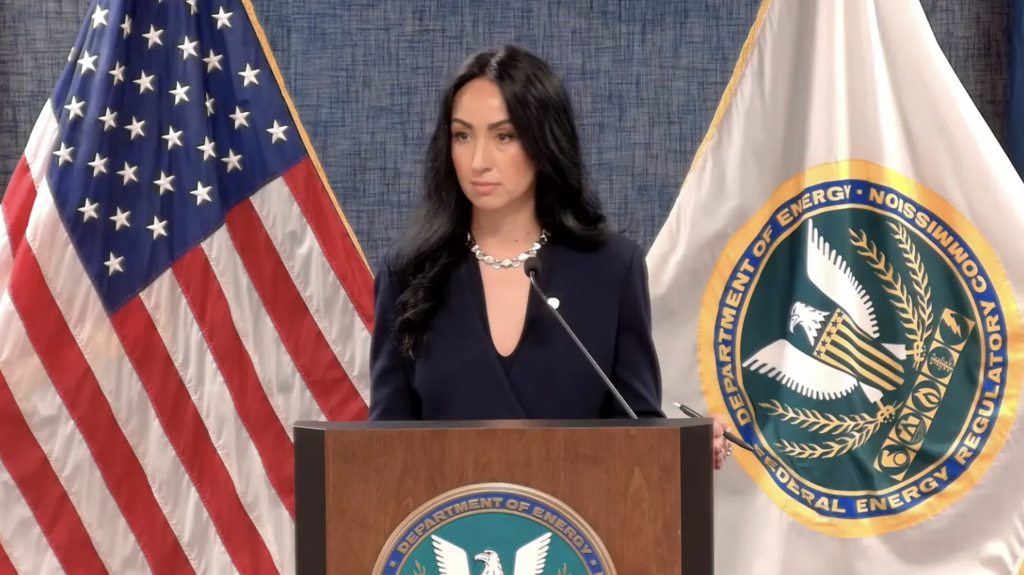
On Thursday, FERC pointed a legal cannon at the nation’s top-6 regional grid operators—PJM, MISO, SPP, CAISO, ISO-NE, and NYISO— ostensibly declaring current large-load rules as “unjust and unreasonable.” In its sweeping “show cause” orders, FERC demanded justification for tariffs and rules governing “large loads,” which it defines as “a commercial or industrial interconnection over 50MW peak load, interconnecting to the transmission system directly, not part of a co-location arrangement.”
Grid operators are naturally highly tuned to political mandates that put state governors and Public Utility Commissions on high alert. Though the FERC directive explicitly states its intent is to “not intrude on state rights” the carveouts have done little to abate fears about states’ rights. As Daniel S. Herder of Clark Hill Law Firm put it in a blog today, “FERC’s directives on accommodation of behind-the-meter generation and co-location arrangements are likely to reverberate at the state level.“
For one, drawing a clean line between a federal transmission line upgrade and a state-level retail data center connection is considered legally gray area – and gray is not the favorite color for RTOs looking to avoid legal backlash from state regulators (who believe it is in their jurisdiction to control rates for retail customers.)
FERC’s “Fast-Track” Timelines” are considered to be ultra-tight, with only 30 days to file comprehensive informational reports regarding resource adequacy and grid reliability; and 60 days to completely defend their existing rules or submit massive, complex tariff rewrites.
Interconnection tariffs usually take years to write, involving stakeholders from utilities, tech companies, state and legislative branches, advocacy groups, and others. That’s why FERC’s push for rapid response is causing some panic. As policy expert Devin Hartman wrote over the weekend, “Regional stakeholders have to rapidly diagnose deficiencies and identify reforms for issues that often take multiple years to develop remedies.” He believes FERC’s directive is “ambitious, timely, and politically and procedurally deft,” with the main limit being one of “not addressing the non-RTO footprints.”
Regardless of the fact industry heavyweights that want speed to power may welcome a push to federally regulate large load interconnections, state regulators and consumer advocacy groups may not be as thrilled. RCRTech will report further as this issue unfolds.

Susana Schwartz
Technology Editor
RCRTech
AI Infrastructure Top Stories
Orange flexes AI muscle: Orange Business AI chief Miguel Alvarez contends telcos are uniquely positioned to orchestrate AI safely at scale, even as inference shifts toward distributed edge infrastructure over the longer term.
Analyst Angle – orbital DCs: Vish Nandlall examines the push for orbital data centers, citing abundant solar power, but also severe constraints in terms of heat rejection, launch costs, congestion, downlink bandwidth and depreciation.
AI Today: What You Need to Know
‘Bubbles’ for cooling: Founded by MIT nuclear engineers and scientists, startup Ferveret’s Adaptive Phase Cooling produces much smaller bubbles at the surface of a server, detaching more frequently and accelerating the heat transfer process.
Microsoft – Chevron deal: Microsoft struck a 20-year agreement with Chevron’s Energy Forge One subsidiary to fuel a 2.7GW AI data center in West Texas. Project Kilby will run on an on-site, gas-fired power plant, without connecting to the grid.
Takanock eyes Strasburg, VA: An 87-acre, 2 million-square-foot data center campus is proposed in Strasburg,VA, with developer Takanock hoping to build a 180MW campus near Interstate 81’s Exit 296 and the Mercury Paper facility.
HVAC training facility: HVAC specialist Daikin Applied has started buildiing a $30 million training hub for developing HVAC skills needed for data centers and other critical facilities. The Solutions & Technical Institute will be located in Plymouth, MN.
SK Hynix surpasses Samsung: Driven by High Bandwidth Memory (HBM), SK Hynix surpassed Samsung Electronics to claim the top spot in KOSPI market capitalization. Is now the most valuable memory chip manufacturer in South Korea.
RCR Events
Quantum Safe Networks Forum, July 14th
Quantum Safe Networks Forum brings together telecom operators, cybersecurity experts, and industry analysts to explore how to build resilient, future-ready infrastructure in the face of quantum disruption. Register now
RCR Roundtables AI Infrastructure, October 21st, Dallas, Texas
Join 50 senior data center, energy and AI leaders at the Ritz-Carlton Dallas on October 21 for invitation-only roundtables on powering and scaling AI. Request your invitation
Industry Resources
Webinar, June 29th: Agentic RAN Management: Delivering OPEX efficiency and a path to 6G
Webinar, June 30th: Building the 6G Standard: Key developments to know
Webinar, July 7th: Noise-Figure Measurements with RFmx and PXI VSTs
Webinar, July 16th: NTN in motion — evolving standards, expanding services
Whitepaper: Powering sovereign AI at scale
Whitepaper: Scalable database design for 5G and beyond
Report: Scaling AIOPs from insight to action
Summit Access: GSMA Device Enablement Summit: How operators can fix device-network fragmentation
Whitepaper: Telco AI Enabler: Mediation’s defining role
Report: Securing telecom infrastructure for the quantum era
Report: Scaling optical networks for the AI and hyperscale era
