

Table of Contents
Early 6G standardization decisions point to a pragmatic migration path, while new work on spectrum, sensing and distributed compute could unlock fundamentally new use cases
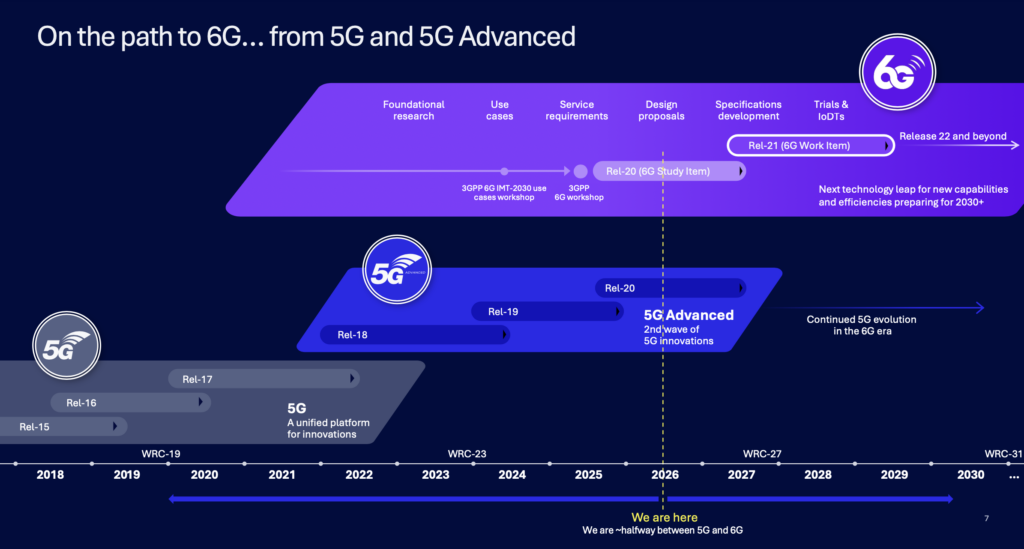
The path to 6G is increasingly clear, but it is not a clean break from 5G. In a recent webinar (available on-demand), Qualcomm Technologies VP of Technical Standards Juan Montojo laid out a grounded view of where 6G standardization stands today, why 5G Advanced remains essential to the transition, and how the next generation of cellular technology is being designed for a much broader role in the AI era.
The central message was that 6G is both evolutionary and potentially revolutionary. At the radio layer, many of the early 6G decisions are intentionally conservative. The industry is retaining proven 5G NR foundations, including OFDM-based waveforms, scalable numerology, existing modulation structures, and LDPC and Polar coding frameworks. The principle, Montojo explained, is to extend the system only where measurable gains can be demonstrated in spectral efficiency, energy efficiency or user experience.
That’s vitally important for operators. After the complexity of 5G deployment, operators are asking for a 6G transition that improves performance without forcing unnecessary densification or an overly complex migration path. “To me, 6G is about coping with increased data demand while lowering the operator cost of ownership,” Montojo said. That means reducing cost per bit through better spectral efficiency, improving energy efficiency and making it easier for operators to introduce new services.
The webinar also covered the current state of 3GPP standardization. Following the June 2026 3GPP RAN Plenary in Singapore, the Release 21 timeline is now defined. The 6G Work Item is expected in March 2027, followed by physical-layer functional freeze in September 2028, protocol-design freeze in December 2028 and final ASN.1 freeze in March 2029. For device and infrastructure vendors, that turns 6G from an open-ended research discussion into a more concrete planning horizon.
But the bigger story is what happens when 6G moves beyond connectivity alone. Qualcomm’s 6G vision is organized around the convergence of connectivity, compute and sensing. Connectivity enhancements, including wider channels in upper mid-band spectrum and Giga-MIMO, are designed to deliver more capacity and better consistency. Compute becomes distributed across devices, the RAN, the edge and the cloud. Sensing turns the network into a platform for perceiving motion, location and physical-world context.
That convergence points toward new use cases, including immersive and XR experiences, agentic AI user interfaces, digital twins, physical AI, wide-area RF sensing, satellite-integrated coverage, new wearable and device subscriptions, and operator-provided compute services. In other words, 6G is not just about faster phones. It is about making the network part of the AI system.
Montojo closed by emphasizing the importance of keeping both ideas in view. “New generations don’t come every day; they come every 10 years,” he said. An evolutionary path is important, particularly for existing bands and software-upgradable infrastructure. But he also cautioned against limiting 6G to what current hardware can support. The opportunity is to build a system that is “worthwhile” for the next decade of cellular connectivity.