

Table of Contents
Cisco bets that agentic AI will make routing, trust, telemetry and cost control inseparable
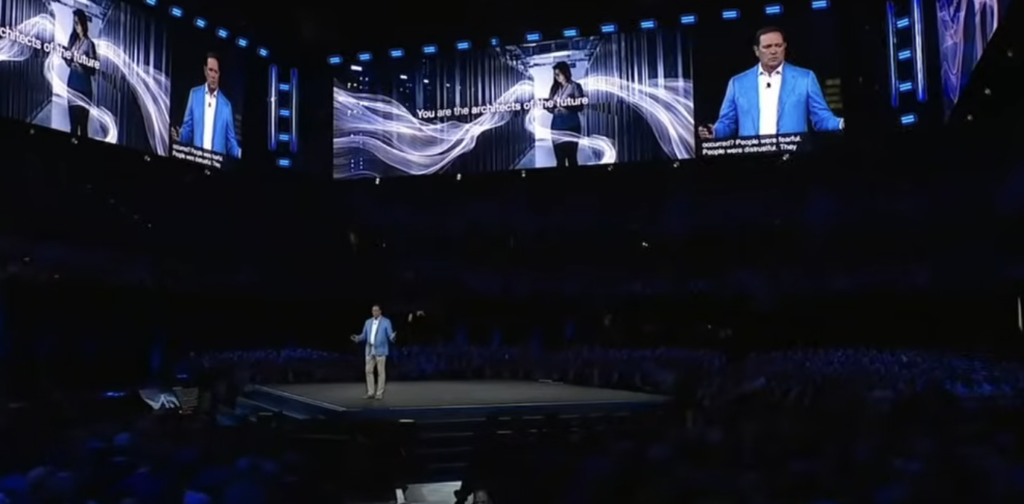
Cisco CEO and Chairman Chuck Robbins kicked off Cisco Live by recalling how company founders Leonard Bosack and Sandy Lerner developed a multiprotocol router to connect two computers. “The network is more powerful than the node,” Robbins said. And, in our current age of GPUs, models, inference, apps and agents, the axiom still holds true. “They’re all nodes,” Robbins said. “And they’re super powerful independently but they’re massively more powerful when they’re networked.”
The key theme I took away from the first day of Cisco’s annual marquee event was that industry discourse has moved past the argument that AI needs better networks. The idea now is that agentic AI changes what the network is for and, as an extension of that, how it is designed and operated. As AI evolves from human-prompted chatbots to machine-speed agents that act as digital co-workers, every action creates a routing problem, a trust decision, a telemetry event and, over time, a cost-management question.
To operationalize that idea, the company announced Cisco Cloud Control, a unified operating surface that joins together networking, security, observability, compute and collaboration into an agent-oriented but human-centered environment. The strategic bet is that if getting agentic AI right requires distributed infrastructure, non-human identity management, action-level authorization, real-time telemetry and closed-loop remediation, then Cisco’s breadth transitions from a portfolio-management exercise into a potential competitive advantage.
Cisco President and Chief Product Officer Jeetu Patel tracked the transition from gen AI chatbots to AI agents that serve as digital co-workers. He also called out a growing category of deskside AI computing used to host local or near-local agentic workflows, a shift that will reshape network traffic patterns and infrastructure requirements. “Humans click but agents swarm,” as he put it. The point was that enterprise adoption of agentic AI tools that work around the clock at “machine speed” means monitoring, control and security also need to work at machine speed. “As you move into the agentic world, we have to move from just plain access control to action control,” Patel said.
Networking is indispensable to AI. In recently published research on how AI traffic will impact wide-area networks, Cisco pointed to token-consumption data showing nearly 10x year-over-year growth, along with service provider measurements showing roughly 4x growth in AI inference traffic over eight months. The report also found that inference traffic flows are twice as long as typical web transactions, 9% of inference traffic flows carry more data upstream than downstream, and, in one agentic workflow test, an AI agent generated up to 450% more total traffic than a human performing the same task. The point is that there will be volume growth, but volume growth that behaves very differently from the types of traffic networks were optimized to carry.
That is where Cisco’s silicon and optics announcements fit. The Silicon One G300 targets AI Ethernet scale-out switching, while the P200 routing chip is designed for deep-buffered scale-across environments where data centers hundreds of kilometers apart need to function more like one AI system. Paired with new systems and 1.6 Tbps and 800G optics, the point is not simply higher capacity; it is creating deterministic, observable connectivity across distributed AI infrastructure.
More broadly, Cisco’s narrative is that scale alone is insufficient. If agents are going to operate across enterprise systems, cloud services, model endpoints, tools and data stores, then every action needs to be identified, authorized, observed and, when necessary, stopped. That is the logic behind the company’s emphasis on action control, non-human identity and agent observability. AI Defense is being extended for agents, Astrix gives Cisco a non-human identity story, and Galileo brings evaluation and observability capabilities for multi-agent systems. In this framing, security is a control function inside the agentic workflow rather than a perimeter function that surrounds AI.
Splunk is central to that control function. Cisco is positioning Splunk as the data and intelligence layer for agentic operations, with telemetry spanning infrastructure performance, application runtime, model behavior, agent behavior and token consumption. That last point is increasingly important because agentic AI turns cost management into an operational discipline. Put differently, the market is moving from tokenmaxxing — using more tokens because the model can — to token discipline, where model use, agent behavior and business outcome have to be measured together.
Cisco Cloud Control is the umbrella for all of this. It is positioned as a unified operational environment where humans and trusted agents can work from the same context across networking, security, observability, compute and collaboration. The distinction Cisco wants to draw is between passive visibility and governed execution. Cloud Control is meant to be the place where telemetry becomes insight, insight becomes recommendation, and recommendation can become action through policy, identity, approval and auditability.
Cisco has long been understood as a company of companies, with a broad portfolio built through decades of internal development and acquisition. Cloud Control is an attempt to make that breadth operate as a coherent platform rather than a collection of adjacent control points. Patel framed the goal as “simplicity without losing the sophistication of Cisco,” with Cloud Control eventually managing products across the portfolio and allowing operators to “operate at agent speed.”
That ambition also explains the important role of service providers. Agentic AI traffic will not stay neatly inside a single data center. Agents running in workplaces, branches, edge locations and cloud environments will need to communicate with models, tools and other agents across distributed infrastructure. For telcos, the near-term opportunity starts with bandwidth, but the larger opportunity is in assured connectivity, edge placement, secure AI paths, managed AI infrastructure and observability tied to inference experience. In that sense, Cisco’s enterprise, cloud and service provider footprint becomes strategically relevant again because agentic AI depends on stitching those domains together.
The caveat is maturity. Cisco has a coherent architecture for agentic operations, but not every component is at the same stage. Cloud Control is in controlled availability, some integrations have staggered timelines, and several claims still need customer proof beyond keynote demos and roadmap logic. The more defensible read is that Cisco is not declaring the agentic operating model solved. It is making the case that the network is where that operating model has to be built.
In the agentic era, Cisco’s view is that the network is evolving from where AI traffic moves to where AI behavior is routed, trusted, observed and controlled.
