

Table of Contents
With IMT-2030 requirements defined and 3GPP resolving foundational design choices, the industry is moving from 6G vision to specifying an implementable system
The 6G conversation is moving from vision-setting into engineering. After years of research projects, vendor white papers and debates about what the next generation should accomplish, the standards process is beginning to put hard boundaries around what 6G will actually be.
At the ITU, the IMT-2030 framework now includes 20 minimum technical performance requirements spanning six usage scenarios: immersive communication, hyper-reliable low-latency communication, massive communication, ubiquitous connectivity, AI and communication, and integrated sensing and communication. In June, ITU-R Working Party 5D also completed draft evaluation guidelines that define how candidate 6G radio technologies will be tested, including new factory and urban-macro environments for sensing. Candidate radio-interface submissions are expected between February 2027 and February 2029.
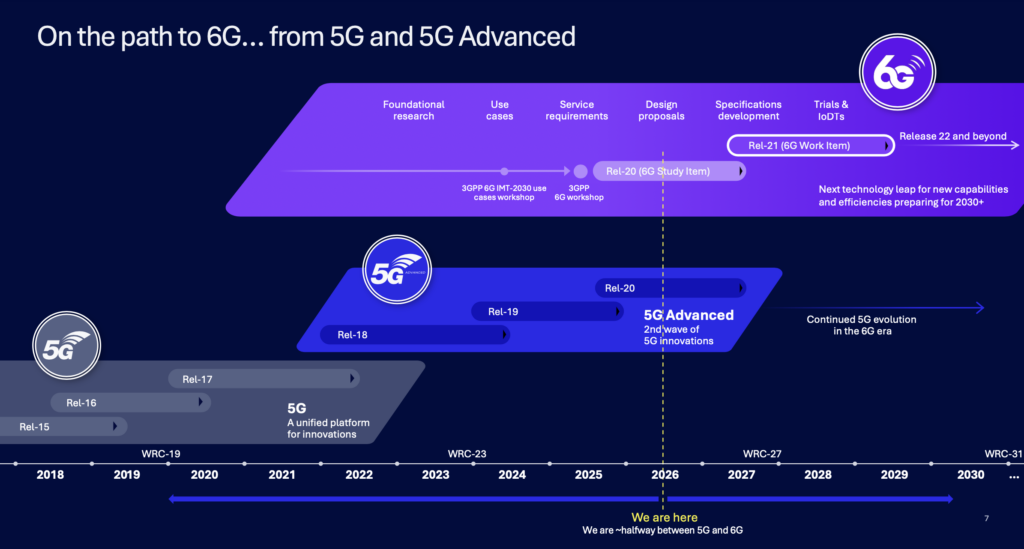
In parallel, 3GPP is turning those high-level requirements into an implementable system. Release 20 is the study phase for foundational 6G technologies; Release 21 will contain the first normative 6G specifications. Based on the timeline agreed in June 2026, technical studies should conclude across 3GPP groups during the first half of 2027, with specification work continuing through late 2028 and final review extending into early 2029. That puts first commercial systems broadly in the 2029-2030 window; the 2028 Summer Olympics in Los Angeles, set for July 14-30, will likely serve as a first-look at 6G trials.
More interesting than the dates, however, is what 3GPP has already decided. The emerging 6G radio is looking less like a clean-sheet break from 5G than early generational hype sometimes implied. 3GPP has selected CP-OFDM for the downlink, with CP-OFDM and DFT-s-OFDM supported in the uplink. Much of 5G’s channel coding will be reused. The basic radio-frame structure will remain similar to 5G, in part to make dynamic spectrum sharing between 5G and 6G practical. Supported system bandwidths are expected to range from 3 megahertz to as much as 400 megahertz depending on spectrum, while massive IoT is being designed into 6G from the beginning rather than inherited from an earlier generation.
The architecture is simultaneously being simplified. The baseline design assumes standalone 6G rather than repeating 5G’s initial non-standalone model, which tied 5G radio to the 4G core. 3GPP is also retaining flexibility around centralized and distributed RAN implementations: a higher-layer CU/DU split is supported, while a potential lower-layer multi-vendor interface between baseband processing and the radio unit would be defined in detail by the O-RAN Alliance. The goal is not to discard the cloudification and disaggregation work underway in 5G, but to carry it forward without making 6G dependent on a legacy radio architecture.
Where 6G does represent a more meaningful expansion is in what the network is expected to do. ITU’s inclusion of AI and communication and integrated sensing and communication (ISAC) as explicit usage scenarios is significant. Qualcomm now describes 6G as an AI-native platform combining advanced connectivity, distributed compute and wide-area sensing. Nokia similarly argues that AI-native design is becoming the industry direction, with AI used both to operate the network and supported as a workload across devices, edge infrastructure and cloud.
Capabilities including AI/ML, NTN, energy efficiency and sensing have been progressively developed through the later stages of 5G and 5G-Advanced. With 6G, the industry is attempting to treat intelligence, sensing, energy efficiency, resilience and a broader relationship between connectivity and compute as design considerations from the outset. Qualcomm, for example, expects terrestrial and non-terrestrial networking to be integrated from day one, while both Qualcomm and Nokia increasingly position distributed AI workloads as part of the 6G system proposition.
For operators, that evolutionary character may prove as important as the new capabilities. A commercially viable generational transition depends on preserving infrastructure and spectrum investments where possible while creating enough improvement in capacity, uplink performance, energy efficiency and automation to justify new capital.
None of that means the 6G standard is settled. Release 20 is explicitly a study phase, and major questions around spectrum, AI implementation, sensing architecture and commercialization remain open. The takeaway is that the industry is no longer primarily discussing what 6G might be; standards bodies are increasingly deciding what 6G will do.
For a deep dive into 6G, register for the upcoming 6G Forum virtual event.