

Table of Contents
Qualcomm has spent years taking its mobile tech into automotive, IoT, PCs and now data centers; agentic AI is the thread that connects those businesses
Qualcomm’s diversification strategy has historically been easy enough to describe. The move is to take technologies developed and scaled for smartphones (high-performance, low-power compute, AI acceleration, connectivity, sensing, camera, graphics, etc…) and apply them to adjacent markets.
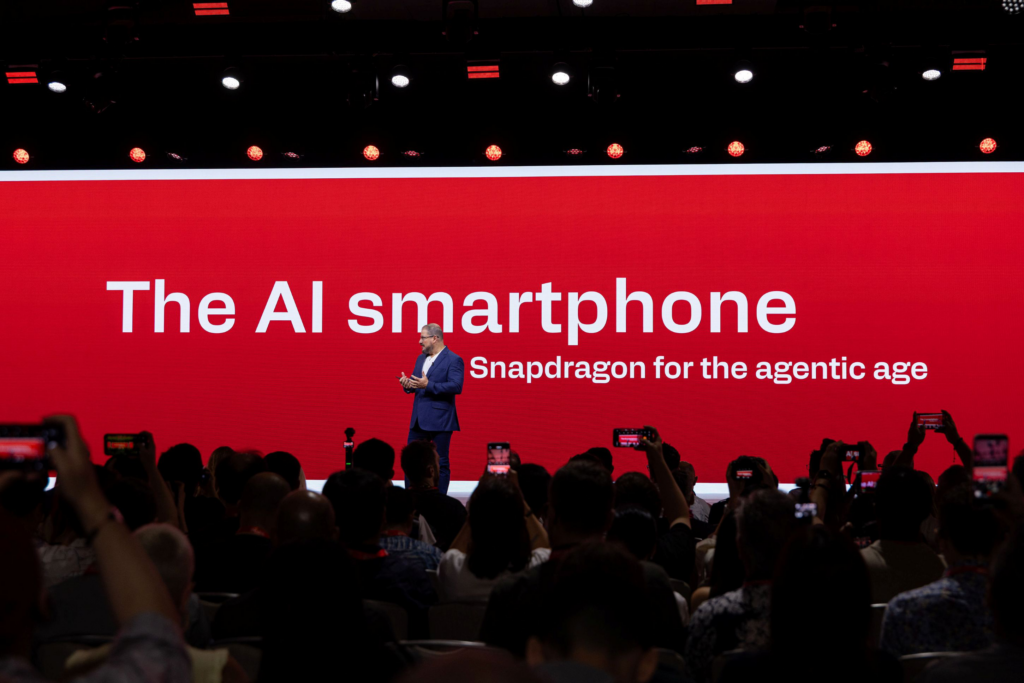
At its flagship event in Maui, Qualcomm articulated what looks like the next phase of that strategy. Rather than simply diversifying Snapdragon technology into more device categories, Qualcomm is positioning itself to provide the distributed computing architecture for agentic AI across those categories.
CEO Cristiano Amon, during the opening keynote, recalled the primary theme of the 2025 event as “the ecosystem of you and how, with AI, your experience is going to be personalized.” Fast forward a year, “And we are really at this point that we are going into this transition from what is a very phone-centric model to now an agentic-centric model for the new experiences. And the agents become the center of that experience, not the phone.”
In what the company has described as the “ecosystem of you,” increasingly intelligent and powerful smartphones anchor a multi-device experience that brings together Qualcomm’s various lines of business. As AI inference distributes into the world around you, agents need access to persistent personal context, and computing has to follow users across smartphones, PCs, glasses, wearables and vehicles, while offloading some processing to edge and cloud infrastructure.
At its Investor Day in June, the company set a fiscal 2029 target of $40 billion in non-handset QCT revenues and described a strategy spanning “every tier of the compute continuum.” In that model, diversification is about selling Qualcomm technology into different markets that are themselves endpoints in the same computing system.
The shift from smartphone-centric to agent-centric experiences.
The smartphone remains central to Qualcomm’s business and to its agentic AI thesis. Amon was explicit: “Your phone is not going anywhere.” What is changing is the abstraction through which users interact with computing. Applications currently sit at the center of the smartphone experience. Users identify an objective, select the appropriate application and manually execute a workflow. Agents invert that model.
The company envisions agents that understand intent and context, reason about a task, formulate a plan, maintain memory and take actions across applications and services. This reframes the smartphone as a hub for personal AI rather than the access point to a collection of applications. But it also creates significantly different computing requirements.
An agent cannot only operate when a user opens an application. It needs to maintain context, process information and potentially act throughout the day. Qualcomm suggested future devices could process as many as 1 million tokens per day locally while maintaining all-day availability. That makes power efficiency fundamental to agentic computing, and brings the discussion directly back to one of Qualcomm’s core competencies.
Snapdragon 8 as an agentic AI platform
Qualcomm introduced two flagship mobile platforms at the event. Snapdragon 8 Elite Extreme Gen 6 and Snapdragon 8 Elite Gen 6 are manufactured on a 2-nanometer process and combine Qualcomm’s Oryon CPU, rearchitected Adreno GPU and Hexagon NPU. Devices are expected from HONOR, iQOO, Motorola, OnePlus, OPPO, REDMI, RedMagic, vivo and Xiaomi.
The specifications are impressive. The newest Oryon architecture pushes mobile CPU performance to around 5 GHz, while the Hexagon NPU gets 50% more shared memory and additional acceleration for transformer workloads. Qualcomm also demonstrated the ability to execute a 30-billion-parameter mixture-of-experts model on a smartphone.
But the story is more expansive than a spec sheet. Focusing narrowly on TOPS, clock speeds or benchmark improvements misses the larger point. Agentic workloads are heterogeneous by definition. The CPU orchestrates tasks, the NPU executes AI inference efficiently, the GPU combines graphics and AI processing, sensing systems continuously collect contextual information, and connectivity moves workloads and information between devices and the cloud.
“Agentic AI is just not another feature to add to the device,” Amon said. “It creates an entire new kind of experience and device workflow. That makes, for companies like Qualcomm, a system-level design challenge and a significant innovation opportunity.”
The ecosystem is part of the architecture
The first day of Snapdragon Summit also highlighted the potential strategic advantage in Qualcomm’s ecosystem-led strategy. It doesn’t control the complete technology stack in the way Apple does. In that context, agentic computing therefore has to be a partnership exercise.
Google’s Rick Osterloh joined Amon to describe Google’s evolution from an operating system toward an intelligence system, with Gemini operating across local and cloud compute. Mastercard demonstrated how agents could eventually transact on users’ behalf, introducing identity, authorization and trust into the agentic stack. Motorola, Xiaomi and HONOR demonstrated how device makers are translating these capabilities into products.
Qualcomm explicitly acknowledges the role of partners. “To deliver a seamless, personal agentic AI experience — one that works across your life and your devices — it will require an ecosystem approach where everybody works together,” Qualcomm’s Clare Conley wrote in a blog post this week. Here partnerships are both a go-to-market mechanism and part of the product.
Qualcomm’s platform play
There is a strong continuity between what Qualcomm said at Investor Day and what it showed during the first day of Snapdragon Summit. In June, Amon described Qualcomm’s next chapter as an evolution into a “platform company,” with technology spanning edge devices through AI data centers. Snapdragon Summit begins putting an experience around that strategy.
The company is still fundamentally monetizing silicon, intellectual property and increasingly software. Smartphones remain enormously important. PCs, automotive and IoT remain distinct markets with distinct competitive dynamics. But agentic AI gives Qualcomm a way to describe those businesses as components of something larger.
The smartphone was the original proving ground for integrating compute, AI, sensing and connectivity within extreme power constraints. Qualcomm spent the past several years exporting those capabilities into adjacent markets. Now the company sees an emerging computing model that potentially rewards exactly that combination of technologies across all of them.
