

Table of Contents
Three key takeaways
- AI infrastructure returns increasingly depend on time to revenue. Power availability, utility deposits, construction schedules and permitting delays determine how long investors must commit capital before data centers begin generating income.
- Powered land and construction costs are raising the investment hurdle. DigitalBridge’s Brent Mayo said land premiums have reached $1 million–$2 million per megawatt, while First Citizens Bank’s Jeremy Wolfe cited turnkey construction costs of $12 million–$14 million per megawatt.
- Lenders are placing greater emphasis on tenant creditworthiness and execution risk. Hyperscalers, neoclouds and AI laboratories present different financing profiles, while refinancing exposure and community opposition add uncertainty to projected returns.
AI Infrastructure ROI Starts With Power, Permitting and Capital Commitments
AI infrastructure developers have plenty of prospective customers. The harder question is how much capital they must commit, and for how long, before those customers begin paying for capacity.
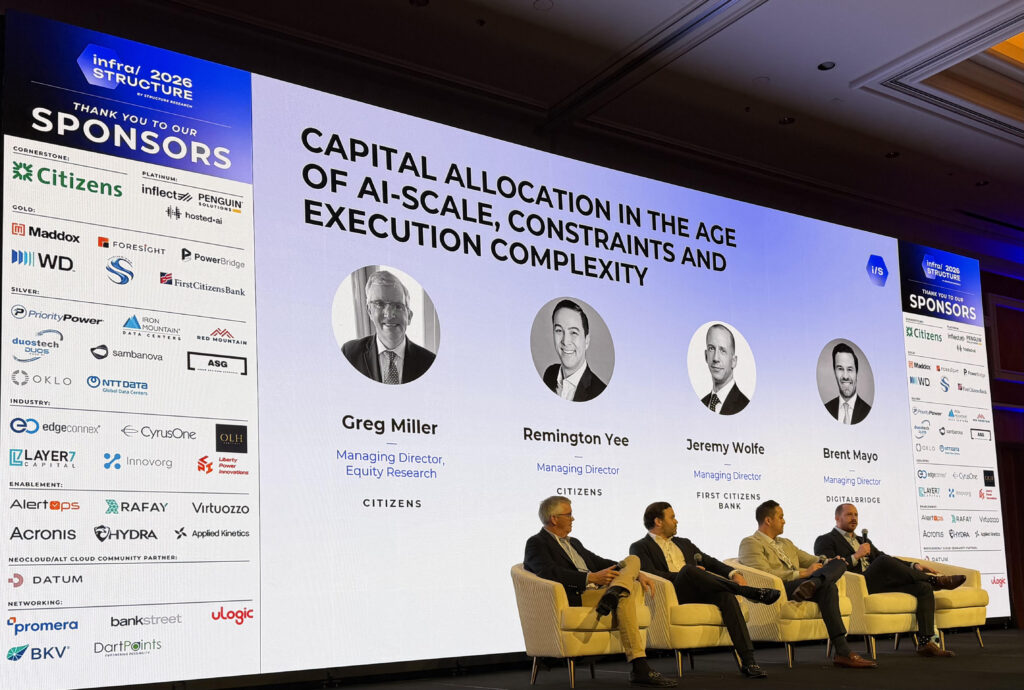
That distinction was central to a panel at Structure Research’s infra/STRUCTURE 2026 conference featuring Greg Miller and Remington Yee of Citizens, Brent Mayo of DigitalBridge and Jeremy Wolfe of First Citizens Bank.
Wolfe described utilities requiring larger upfront commitments to protect against stranded infrastructure investment. Developers may need to reserve power and fund preliminary infrastructure work before securing a signed lease.
Those expenditures increase capital at risk and extend the period before revenue begins. Delays can also increase financing costs and reduce the return on invested capital.
The constraint is consistent with RCRTech’s reporting on power availability and the projected $3 trillion data center capital expenditure cycle
For investors, time to power is becoming a financial variable, not simply a construction milestone.
Powered Land Premiums Raise the Cost of Reaching First Revenue
Mayo offered a measure of how much developers are willing to pay for speed to market.
He said land premiums that previously ranged from $300,000 to $500,000 per megawatt are now being quoted at $1 million to $2 million per megawatt.
These are Mayo’s observations of market pricing, not a standardized national land-price index.
Construction costs have also increased. Wolfe said turnkey data center development costs have risen from approximately $8 million–$10 million per megawatt in an earlier development cycle to $12 million–$14 million per megawatt today.
Together, these increases make speculative construction more expensive.
Panelists distinguished between horizontal development — securing land, power and permits — and vertical development, including the building and technical infrastructure.
Large AI training facilities present particular speculative risk because GPU architectures, cooling systems and rack densities continue to change. Developers risk completing facilities that no longer meet prospective tenants’ requirements.
Inference may support a different approach. Mayo described developers converting existing properties into smaller facilities ranging from 5 to 50 MW, sometimes ahead of committed demand.
The investment calculation depends on whether earlier availability produces enough additional revenue to justify higher acquisition and development costs.
RCRTech has examined the relationship between power access and changing data center development locations
AI Infrastructure Financing: Matching Capital to Revenue Timelines
The capital required to build AI infrastructure extends beyond the physical data center.
Panelists described an expanding financing market that includes high-yield project finance, asset-backed securities (ABS), commercial mortgage-backed securities (CMBS) and private credit.
GPU financing adds another substantial requirement. Depending on the deployment, compute equipment expenditures can approach the capital cost of the data center itself.
Financing structures therefore need to account for different assets, borrowers and revenue schedules.
Investment-grade hyperscalers can generally obtain financing on terms that differ from those available to emerging neoclouds and AI laboratories. Less-established borrowers may require additional guarantees, private credit support or other financial backstops.
An April 2026 transaction illustrates the scale of project financing. First Citizens Bank announced a $525 million facility for T5 Data Centers supporting construction and expansion in Chicago and Charlotte.
The transaction also illustrates the importance of financing identifiable infrastructure projects with defined development requirements.
For AI infrastructure investors, the objective is to align debt service, construction expenditures and capital commitments with the timing and durability of expected revenue.
Neocloud Credit Risk and Refinancing Pressure Threaten Investment Returns
Mayo identified emerging neocloud operators as a potentially attractive but challenging investment segment.
Some are well capitalized and securing substantial customer commitments. Their operating histories, revenue concentration and business models, however, differ from those of established hyperscalers.
Mayo suggested that certain neoclouds could eventually achieve investment-grade credit profiles. Investors able to assess that transition may find opportunities, but the outcome remains uncertain.
The panel also identified refinancing as a growing consideration.
Infrastructure debt originated during the current development cycle will eventually mature. Borrowers may encounter different interest rates, credit conditions and asset valuations when those obligations need to be refinanced.
That creates a second financial test beyond completing construction: whether operating cash flow and asset values can support future financing requirements.
For neoclouds, the analysis also extends to GPU utilization, customer retention and the economics of operating compute capacity.
RCRTech’s analysis of neoclouds and the race to cut Time to Token examines the relationship between deploying compute infrastructure and beginning revenue-generating operations.
Community Opposition Extends Time to Revenue for Data Center Developers
Local opposition has become another source of financial uncertainty.
Panelists described development delays, canceled transactions and litigation involving projects that had already received approvals.
Yee emphasized transparent engagement and investment in community infrastructure, including schools and public facilities, rather than relying primarily on tax incentives.
The panel also discussed concerns about electricity rates and water consumption. Some participants cited utility claims that data center investment had benefited local electricity customers, although such outcomes require project-specific evidence.
The underlying financial exposure is more readily measurable.
A project delayed by permitting disputes or litigation may continue incurring financing costs while land, utility deposits and development expenditures remain committed.
For developers and lenders, community engagement increasingly belongs in the initial project-risk assessment rather than being treated as a separate public relations issue.
Conclusion: From AI Infrastructure Capex to Revenue and Return on Investment
The Structure Research discussion described an investment market increasingly divided among powered-land developers, power-generation providers, data center operators and compute infrastructure businesses.
Each assumes different financial risks and operates on a different revenue timeline.
Those distinctions matter when evaluating the economics of AI infrastructure.
Time to power measures how quickly a project can obtain usable electricity. Time to operational capacity measures when the facility and its equipment can support customers. Time to revenue measures when those assets begin producing income.
None of these milestones, individually, establishes profitability.
For neocloud operators, sustainable returns also depend on GPU utilization, operating margins, financing costs and customer demand. For data center developers, lease economics, construction costs and capital structure remain central.
The broader investment question is whether accelerating development and revenue generation produces returns sufficient to justify the additional capital and risk.
For AI infrastructure investors, the defining metric is shifting from how many megawatts or GPUs can be deployed to how quickly that capital produces sustainable revenue and an acceptable risk-adjusted return.
Editorial disclosure: This article is based on the panel “Capital Allocation in the Age of AI — Scale, Constraints and Execution Complexity” at Structure Research’s infra/STRUCTURE 2026 conference. Participants included Greg Miller and Remington Yee of Citizens, Brent Mayo of DigitalBridge and Jeremy Wolfe of First Citizens Bank. Otter.ai was used to transcribe the session. AI-assisted tools were used to organize source material and prepare an initial draft. Financial estimates attributed to panelists reflect their observations during the session and are not independently verified industry benchmarks.