

Table of Contents
Can an assembly-line approach to high-density AI compute-in-a-box present a componentized answer to inefficient brick-and-mortar data centers?
In sum – what to know:
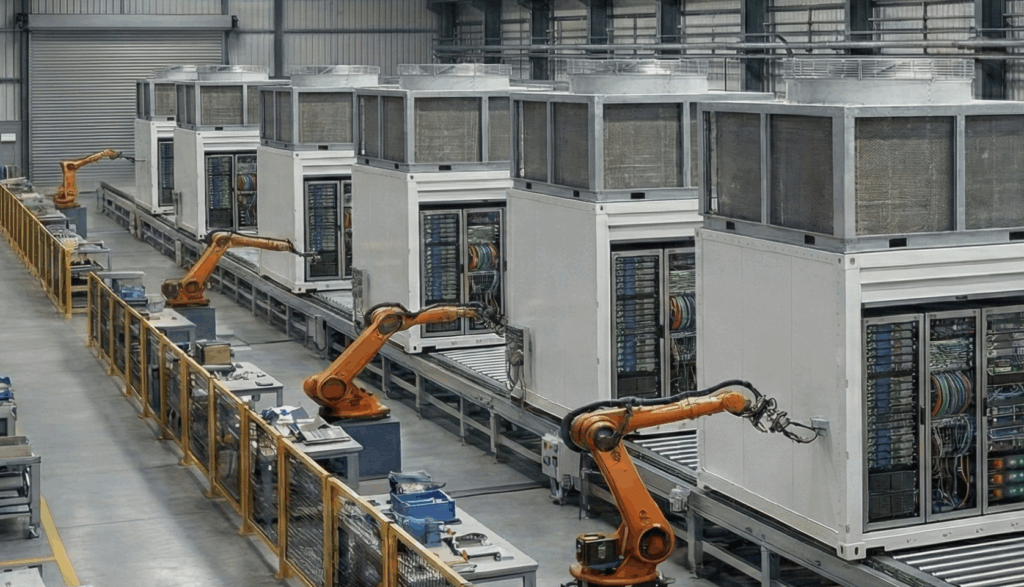
High-density AI cubes — Each cube offers ~0.6 MW of compute (500-600 kw per cube), with clusters of 4 – 6 MW, scaled to N.
Containerized structure — an integrated system of power, cooling, UPS/BESS, which allows rapid plug and play from time of transport to connection.
Reduce time-to-compute — Cut months or even years from data center projects, with 25% overall savings.
Some believe the AI race will be over in less time than the average transmission line project takes to reach operation in the US (10-15 years). To bend the cost-per-MW curve during the data center construction boom, there should be a shift toward iterative and repeatable designs that rapidly scale up to meet time-to-compute demands.
One inventor who specializes in mobile distributed energy resources and cooling modules for data centers is thinking out of the box, or better yet, in the cube, about how to shift data center design away from physical, site-constructed design to an assembly-line approach that enables rapid production and deployment of compute cubes. What began as a platform to move perishable produce through the global supply chain is morphing to meet the crushing demand of AI compute.
“In order to win the AI race, the U.S. must industrialize AI infrastructure at a speed that rivals wartime efforts, with data centers built the way aircraft, automobiles, and batteries are built — on assembly lines as opposed to solid, bespoke construction sites,” said Chad Caldwell, founder and CEO of Swarm Infrastructure, which manufactures containers that leverage decentralized cooling and decentralized UPS/BESS systems. The systems are designed to unlock traditional architectures from the constraints of brick-and-mortar envelopes and massive inefficient cooling systems.
“The U.S. must innovate to maintain its small AI advantage. Innovation beyond the AI hardware stack lies in the balance-of-system (BOS), which is crucial to maintaining a competitive edge against China’s manufacturing capabilities,” added Caldwell.
By omitting the data hall and traditional building primary water loop, Caldwell hopes to shift thinking from just construction-type projects to a product that can be repeated and iterated upon. That’s why Caldwell has spent the past few years building modular 8 ½ x 10 ½ ‘ high, decentralized cubes that can create hundreds of quasi-independent data centers — all working together as one larger, more efficient data center. The cubes can operate as a single cube on the edge of thousands of cubes in a centralized location. Each cube delivers high-density AI compute, with ~0.6 MW of compute (500-600 kw per cube), and clusters offer 4 to 6 MW as a building block. Data center operators can add and subtract cubes according to what they need, with all cubes in a cluster connecting to a common bus.
Each cube contains:
- Decentralized two-phase direct-to-chip cooling for GPUs like Nvidia Rubin/Vera
- Decentralized vapor-compression air cooling for secondary thermal loads
- Liquid-cooled busbars
- Integrated 400-800VDC battery topology for compute flexibility
- Centralized rectifiers/inverters
- Controls balancing compute, cooling, power and grid integration
Operators can align five servers inside each cube, and stack cubes three rows high on a Swarm charging block. As an example, an Edge data center would use one truck of three to five cubes, and a 1 GW data center would use ~1,650 cubes. “This is where the crucial element of ‘flexibility’ for servers comes in, as we drive the truck to the site, unload it, plug in the cubes, and you’re up and running. With a common power bus, you can wrap the cubes on a single charging block together,” said Caldwell, who contends there can be a 20% decrease in costs with each doubling of output.
Like a giant Yeti-type cooler’
To get a better idea of how it works, think of a high-performance, rotomolded cooler like a Yeti cooler, but bigger, and in multiple rows, dissipating heat between the rows. Each Swarm cube is its own “building envelope” encased in a 4-inch rotomolded cooler-type material. It’s made through biaxial rotomolding, with a roof-mounted heat rejection unit that is only 3’ from the direct-to-chip manifold.
“When you look at two-phase cooling, it’s essentially refrigeration—phase change vapor compression cooling, but a little bit different in that the chips are working as the evaporators, and you put the condenser on the roof [rather than a heat exchanger], expelling heat directly to atmosphere,” explained Caldwell.
By utilizing central rectifiers, Swarm Infrastructure moves the power conversion and associated heat loads outside of the insulated envelope. HVAC Compressors for secondary heat loads, as well as the UPS/BESS, reside outside of the insulated shell.
By shrinking the “envelope,” so to speak, Caldwell hopes data center operators will be able to dedicate all the space to their servers, with space in-between to circulate the air through very large evaporator coils, with direct-to-chip accounting for 75%-85% of the heat load, and then a 6’ axial fan (or four 3’ axial fans) to push the air for the secondary heat loads through the server racks, down through the evaporator, and back up to take care of the secondary heat.
Swarm, a name derived from drone swarms, represents a major change in thinking, as today, data center operators are building massive water infrastructure to remove heat from the data hall. Instead of using so much water to expel heat from a building, Caldwell believes the two phase direct-to-chip cooling loop that goes directly to the atmosphere air is a superior construct. “It offers more efficient cooling, and it heads off the impending obsolescence that is currently being built into data centers. Why place rapidly evolving and rapidly depreciating servers inside a brick-and-mortar dinosaur that will depreciate over 39 years?” he asks incredulously.
Because it’s difficult to imagine where compute will be in 30 or 40 years, Caldwell believes putting energy into assembly-line style manufacturing will do more to unlock rapid, iterative design. “Our system was born out of the transportation sector and we almost fell into data centers by accident.” He likens the approach to what Tesla is doing. “Tesla delivers pre-cast concrete pads with multiple, EV chargers, pre-wired and ready for use. They crane the pre-cast unit off the truck, land their final electrical connections, commission and energize.”
To learn more about Swarm’s efficiency concept and its liquid cooling, air cooling, and computational fluid dynamics, contact Caldwell on LinkedIn.