

Table of Contents
The 4.4 GW facility in Indiana County, PA, will be one of the largest, if not the largest, natural gas-powered data center campus in the U.S.
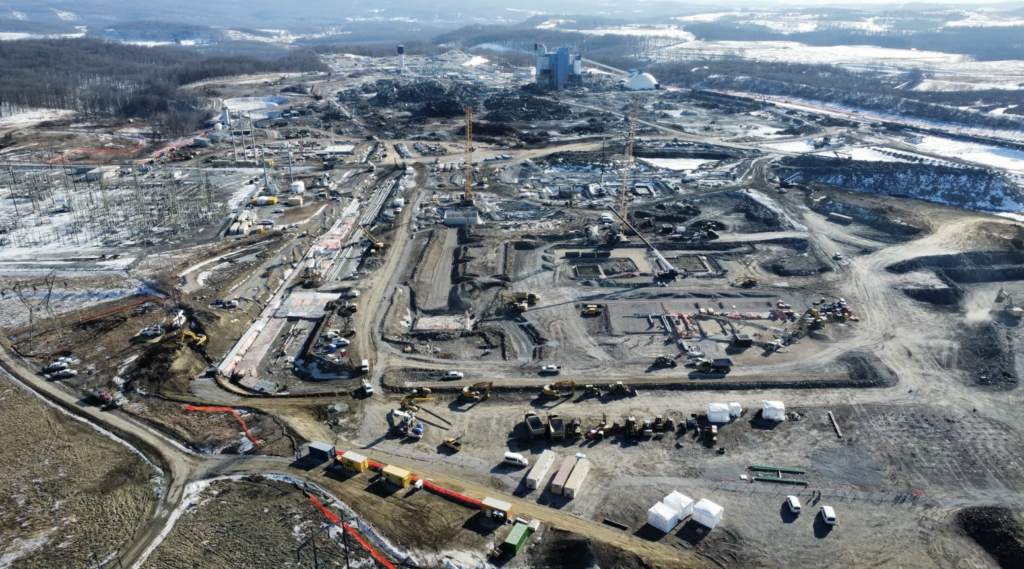
Homer City Redevelopment (HCR) is partnering with GE Vernova to build one of the largest natural gas-powered data center campus in the United States. The plan is to convert Homer City Generating Station – a decommissioned coal power plant – into a 3,200-acre campus for 4.4 GW of power.
GE Vernova will power HPC needs with seven high-efficiency 7HA.02 hydrogen-enabled, gas-fired turbines it is building on 30 acres in Homer City, PA. The facility is being built by Kiewit Power Constructors Co., one of the leading engineering, procurement and construction (EPC) contractors in the country. The first turbine deliveries are scheduled to begin in 2026, and the facility will be fully operational by 2027.
As older power plants retire, new ones will be slow to connect to the grid, so the conversion of a former coal plant into a facility designed to meet the HPC demands of America’s most innovative technology companies is of particular interest. In the Mid-Atlantic region, PJM faces a looming energy capacity deficiency by mid-2027. In a news release, PJM said more than one-fifth of its systems in the area will retire or reach the end of “useful life” by the end of the decade. With this project, thousands of homes will get electricity, as we examine below.
Co-location for behind-the-meter power
Because this project pairs AI infrastructure directly with local energy producers, it transforms existing infrastructure into dedicated, behind-the-meter power. That means grid constraints will be bypassed as existing PJM transmission lines and NYISO power grids are leveraged, not to mention existing substations and water access.
By using previously secured long-lead power components, the project will be able to serve multiple large data center customers. According to a public statement by William Wexler, president and CEO of Homer City Redevelopment (HMR), “We are fully committed to maximizing the unprecedented level of economic opportunity this project represents not just for Indiana County, but for all of Pennsylvania and the Mid-Atlantic region of the country.”
In addition to generating its own power, the facility will supply power to thousands of homes on the local grid, acting as a significant “peaker” and baseload plant for the region. Any power not used by the data center campus will be fed into the interstate transmission grid to support the broader PJM and NYISO systems.
To co-location advocates, this is an example of how power-constraint challenges can be met. For example, CEO Igal Feibush of Pennsylvania Data Center Partners said in an interview with Spotlight PA that the power needed to run all the new data centers is overestimated. “I’m not suggesting there won’t be challenges, but I believe that there’s enough time and there’s certainly enough money to address those challenges.”
Some say energy production at the new Homer City Energy Campus is one example of how innovative AI data center builds can help address the nation’s energy shortage, even as AI and HPC technologies flourish.
First steel threshold reached
In a statement to RCRTech, Homer City Redevelopment noted the commencement of vertical construction at the campus, pointing to an announcement of “first steel” at the Homer City Energy Campus, with completion of an “extensive underground foundation” shifting the trajectory of the gas-powered energy facility.
The first structure to rise from the site will be the Gas Insulated Switchgear (GIS) building, a steel-framed facility that will house the high-voltage electrical equipment connecting the campus to the PJM grid.
Next will be tank deliveries, heat recovery steam generator housings, and the assembly of turbine infrastructure for the seven 7HA.02 natural gas turbines from GE Vernova.
“As we begin vertical construction, today’s milestone sets us on schedule and continues the journey to delivering new economic opportunities to Indiana County, the state of Pennsylvania, and beyond,” said Corey Hessen, CEO of Homer City Redevelopment, LLC. “In this new phase, our neighbors and partners will begin to see the physical dimension and scale of our project.”
Brian Reinhart, vice president of Kiewit Power Constructors Co. said in a statement, “Beginning above ground construction work with the GIS enclosure structural steel signifies an important step toward successful project delivery. As our skilled craft professional numbers grow each day, our crews remain focused on maintaining a safe and reliable work environment.”
Remaining challenges
As reported by the Pennsylvania Public Utility Commission (PUC), demand for the state could double over the next five years, so ensuring the massive 4.4 GW power draw doesn’t lead to higher electricity bills or reliability risks for residential Pennsylvania ratepayers will be a focus for the PUC.
Additionally, the initial boom in construction jobs, said to be about 10,000 for this project, has led to questions about how many will be “permanent” for local residents.
Groups like Concerned Residents of Western PA (CROW) don’t want these jobs to be temporary, so they are examining what “legally binding” commitments can look like when it comes to permanent high-tech roles.
Additionally, the claim by developers that there will be a 60–65% reduction in CO2 per MWh compared to coal, has motivated environmental advocates to look into ‘upstream’ methane leakage from what may be about 250 new fracked gas wells that will feed the plant every few years?”
Water scarcity is also the focus for environmental groups worried about the millions-of-gallons of water needed for cooling within the data center. For now, a permit exists for drawing water from Two Lick Creek, but key details regarding the project’s impact remain unresolved:
These are issues RCRTech will follow up on for a follow-up story.
