

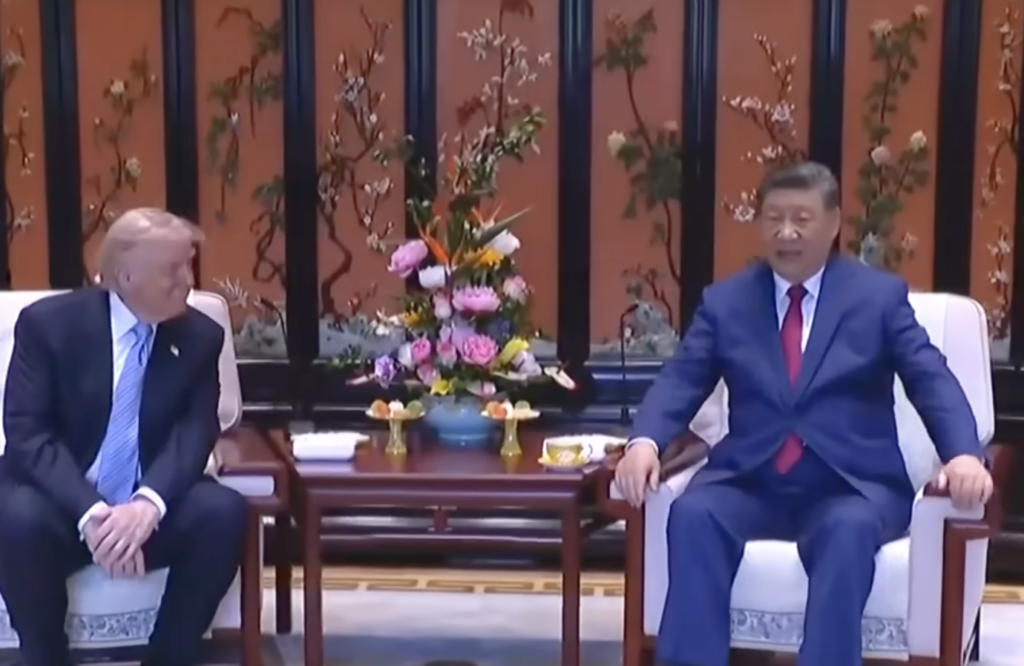
President Trump and Chinese President Xi Jinping held discussions on AI “guardrails” to prevent automated escalations between the two countries’ militaries. OpenAI and others proposed a joint global AI watchdog for both countries, with suggestions of a safety framework and oversight. Though there was no official comment on the proposal from the two leaders, Chinese foreign ministry spokesman Guo Jiakun did say that “China has always advocated that all parties jointly promote the development of artificial intelligence in an open, inclusive, beneficial and good-for-all direction.”
After meetings with Xi today, Trump reversed course on part of his chip ban, allowing the Nvidia’s H200 to be sold to major Chinese firms like Alibaba and Tencent. The emphasis was on the fact that the H200 relies on older Hopper architecture, and that it would be conditioned on a 25% remit of sales revenue to the U.S. government. Xi is weighing whether to accept the deal or push back against the U.S. revenue-sharing tax.
With U.S. export restrictions tightening, Xi is hoping Chinese firms like Huawei are able to soon develop chips that can compete with NVIDIA’s Blackwell or Rubin. As RCRTech wrote yesterday, current Chinese chips leverage massive clusters of homegrown chips and open-source AI models. As a result, Chinese chips, like Huawei’s Ascend, are less “brute force” and more finesse, but the U.S. still has a firm hold on raw compute power.
Many U.S. lawmakers reiterated their disapproval of opening chip access to China, with the bipartisan Match Act written to prevent Chinese companies from obtaining chip manufacturing tools they can’t themselves make. The bill also aims to ensure that companies based in U.S.-allied nations face the same restrictions as China. The bill advanced past the House Foreign Affairs Committee on April 22, and is moving through the legislative timetable with minimal internal opposition. A companion bill was introduced on April 13 by Senators Jim Risch, Pete Ricketts, and Andy Kim. Senate (S. 4281) has been referred to the Senate Committee on Banking, Housing, and Urban Affairs, where it remains pending initial review.
As a side note, Dina Powell McCormick, Meta president and vice chairwoman, was also part of the official delegation to China, raising questions about whether there were behind-the-scenes discussions about China’s ban of Meta’s $2 billion takeover of Manus, as well as continued bans on the company’s Facebook and Instagram platforms. Chinese advertisers are a massive source of revenue for Meta, reportedly accounting for roughly 10% of total revenue in 2024.
RCRTech will continue to follow the story and developments that stem from the Xi-Trump summit, which concluded today.

Susana Schwartz
Technology Editor
RCRTech
AI Infrastructure Top Stories
Cirrascale CEO David Driggers talks inferencing: Seek the “smallest ‘simple unit’” and push performance and memory as far down the tech stack as you can go, while meeting TTFT requirements and minimizing per-flop and per-MB costs.
The rise of modular, prefab data centers: Schneider Electric’s TJ Sarao says it’s possible to “bring capacity online months earlier” with modular, pre-engineered infrastructure that sidesteps two critical bottlenecks: time to power and time to build.
Alibaba CEO sees 10x DC growth: Alibaba CEO Eddie Wu says data center requirements in 2033 will be roughly 10x larger than what it operated in 2022, with Capex to exceed the previous 3-year, 380 billion yuan (approx. $53 billion) target.
AI Today: What You Need to Know
CBRE-top markets by DC inventory: The Atlanta data center market has grown the fastest with a 536% increase in inventory since 2021, followed by Chicago with a 192% spike, which CBRE says boosts employment for U.S. electrical services.
Cerebras IPO and OpenAI win: Cerebras stocks slid today after an 89% jump in yesterday’s market debut, achieving a $106.75B valuation on a fully diluted basis, and winning a $20B chip deal with OpenAI, who is diversifying beyond Nvidia.
‘Tokenmaxxing’ at Amazon: Amazon wants 80% of its developers using AI every week, tracking AI token usage via internal leaderboards. As a result, some are enaging in “Tokenmaxxing” to artificially inflate token consumption stats.
Meta profits high, morale low: Cutting another 8,000 employees (about 10% of its staff) amid record profits means spirits are reportedly low and protests growing over company policies like “mouse tracking” to train AI models.
McKinsey on $7T race to scale DCs: By 2030, data centers are projected to require $6.7 trillion worldwide to keep pace with the demand for compute power, with $5.2 trillion in Capex and IT applications requiring $1.5 trillion in Capex.
Moody’s $785B projection: Moody’s lifted its AI hyperscaler spend forecast to $785 billion for 2026, predicting $1T by 2027, with AWS, Microsoft Azure, and Google Cloud Platform making the biggest investments in AI infrastructure.
RCR Events
Test & Measurement Forum, May 19
Join the annual Test & Measurement Forum where industry leaders, innovators, and engineers come together to tackle the most pressing test and measurement challenges in telco today. Register now
Telco AI Forum, June 16th
Telco AI Forum brings together operators, vendors, hyperscalers, and academia to explore how the evolution of the industry and partnership ecosystems is laying the foundations for AI-native 6G networks and unlocking ROI. Register now
Quantum Safe Networks Forum, July 14th
Quantum Safe Networks Forum brings together telecom operators, cybersecurity experts, and industry analysts to explore how to build resilient, future-ready infrastructure in the face of quantum disruption. Register now
RCR Roundtables AI Infrastructure, October 21st, Dallas, Texas
Join 50 senior data center, energy and AI leaders at the Ritz-Carlton Dallas on October 21 for invitation-only roundtables on powering and scaling AI. Request your invitation
Industry Resources
Webinar, May 21st: Securing telecom infrastructure for the quantum era
Webinar, June 2nd: Scaling optical networks for the AI and hyperscale era
Report: AI in testing: Developing trust, delivering results
Report: Test, measurement and service assurance in the AI era
Whitepaper: Powering sovereign AI at scale