

Table of Contents
As AI moves from generating information to controlling machines, T-Mobile US regards low-latency wireless, edge inference and eventually 6G as creating a new role for the carrier network
We’ve covered at length in these pages that fiber is central to how AT&T and Verizon see themselves participating in the AI economy. T-Mobile US executives last week also made the rounds at sell-side conferences, and the company took a different tack.
As AI moves into robots, drones, autonomous systems and other physical applications, the problem a network is meant to solve changes. Intelligence has to interact with the real world in real time. Putting all of the required compute on a device increases cost and power consumption; sending every workload back to a distant cloud introduces latency. T-Mobile US has characterized the mobile network and distributed edge computing occupying the middle ground.
The opportunity is to turn the network from the transport layer for AI into part of the compute architecture itself. That is a much more ambitious AI ambition than simply expecting greater data consumption. T-Mobile US believes its 5G Standalone and 5G Advanced infrastructure, evolving toward 6G, could support low-latency edge inference while providing timing, connectivity and other network capabilities to physical AI systems.
At Citi’s 2026 Global TMT Conference, outgoing T-Mobile CFO Peter Osvaldik said networks could move “at the center of value creation around physical AI.” He went considerably further in sizing the potential strategic impact: “That could be even bigger than the entirety of the core wireless businesses today.”
Physical AI creates a different networking problem
The architecture T-Mobile US is describing starts with an inherent tradeoff in physical AI. A robot, drone or autonomous machine needs enough local intelligence to perceive its environment and act. But loading every device with advanced compute capacity adds cost, increases energy consumption and creates battery constraints. Moving the intelligence entirely into a hyperscale cloud solves the device-compute problem but creates a problem around latency.
Speaking at the Goldman Sachs Communacopia + Technology Conference, T-Mobile US CEO Srini Gopalan described robots colliding in factories because cloud round-trip latency is too high. His proposed alternative combines low-latency wireless connectivity with inference running closer to the endpoint.
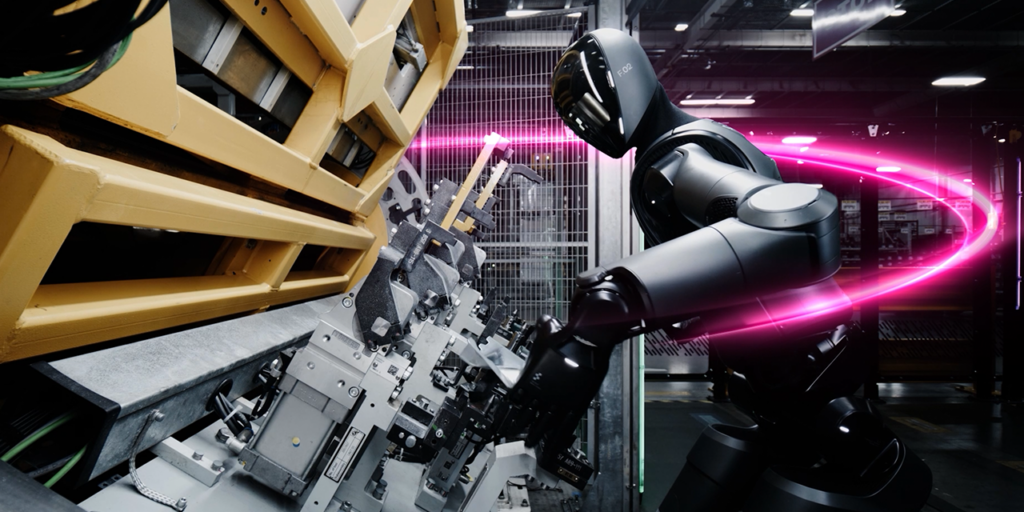
T-Mobile US has not yet seen AI fundamentally change wireless traffic growth, Gopalan acknowledged. What excites management instead is the potential new addressable market created by physical and edge AI. The carrier is already working with Figure AI around connecting humanoid robots over its 5G Advanced network and exploring how network-edge resources can support those systems.
Gopalan said, “I think this could be game changing in terms of the size of the opportunity ahead of us.” The idea here extends beyond robots as a new source of data consumption; the potential value comes from the network taking over functions that would otherwise have to reside on the robot itself or in a distant cloud.
From connectivity to distributed computing
Osvaldik laid out that model more explicitly at Citi. Physical AI devices could offload some processing to edge compute located inside the network, reducing the amount of GPU capacity required on the endpoint and potentially improving battery life. T-Mobile US also sees network timing as part of the architecture, pointing to what CTO John Saw calls space-time coherency that keeps distributed physical systems synchronized closely enough to coordinate real-world actions.
Saw elaborated on this last week at the Mobile Future Forward event in Seattle.
That aligns with a broader physical AI strategy the company has been articulating throughout 2026. Saw has distinguished the informational tokens used by generative AI from what he calls kinetic tokens — the data that carries the intent, context and timing required to trigger physical actions. In his formulation, those workloads require deterministic network performance, ultra-low latency, synchronization and continuous intelligence at the edge, rather than bandwidth alone.
This aligns with T-Mo’s AI-RAN work which includes delivering radio network efficiency and optimization, but goes further. In March, T-Mobile US and NVIDIA announced work with Nokia and physical AI developers to run AI workloads across distributed network infrastructure. The architecture puts accelerated computing at locations including cell sites and mobile switching offices, allowing those facilities to support edge AI workloads while continuing to run the mobile network. T-Mobile US described the objective as transforming wireless infrastructure into a distributed high-performance computing platform for physical AI applications.
In this model, the RAN and the AI infrastructure stack begin to converge. The network still provides connectivity, but it can also provide inference compute, timing and synchronization, quality of service controls and eventually sensing capabilities alongside it. Rather than requiring every physical AI developer to provision independent compute and communications infrastructure, a carrier could theoretically expose those capabilities as a distributed platform.
6G as an AI architecture
That also provides context for T-Mobile’s 6G strategy. T-Mobile US and Deutsche Telekom’s joint 6G Innovation Hub is explicitly organized around AI-native autonomous networks, sensing and positioning, and the convergence of connectivity with high-performance compute. Physical AI sits at the center of those workstreams.
This suggests T-Mobile US does not view 6G primarily as another generational increase in consumer broadband performance. The bigger opportunity could be creating a network architecture capable of coordinating large numbers of intelligent physical systems.
Gopalan made the connection at Goldman Sachs, arguing that low-latency 5G Standalone evolving toward 6G becomes critical once AI becomes “kinetic or mobile” and begins controlling things that move.
The evolution is potentially significant for the carrier business model. Beyond simply selling capacity against a particular service level agreement, physical AI creates the possibility that operators sell capabilities deeper in the application stack.
Connectivity could be combined with edge inference, deterministic performance, network slicing, synchronization and other services required to make machines work reliably in real time. The market will determine whether technical value becomes carrier value.
Edge computing has been discussed across telecom for years without becoming a major new carrier revenue pool, which Osvaldik himself referenced at Citi. What is different now is the workload. Physical AI could create genuine reasons to distribute compute because latency, energy consumption and device economics impose physical constraints that centralized cloud computing cannot always resolve.
But technical necessity does not guarantee that operators capture the economic value. T-Mobile US still has to establish how it monetizes edge inference, what developers are willing to pay for network-integrated computing, how much incremental infrastructure is required, and whether those revenues generate attractive returns. Advances in on-device accelerators could also move more inference back onto endpoints, while application architectures could minimize the workloads requiring carrier-edge compute.
The scale of the company’s ambition nevertheless stands out. T-Mobile US sees physical AI potentially expanding the addressable market of the network itself. That makes its AI economy proposition fundamentally architectural. As intelligence moves from generating information to controlling machines, T-Mobile US wants its network to become the connective tissue, synchronization layer and distributed compute platform those machines depend on.
