

Table of Contents
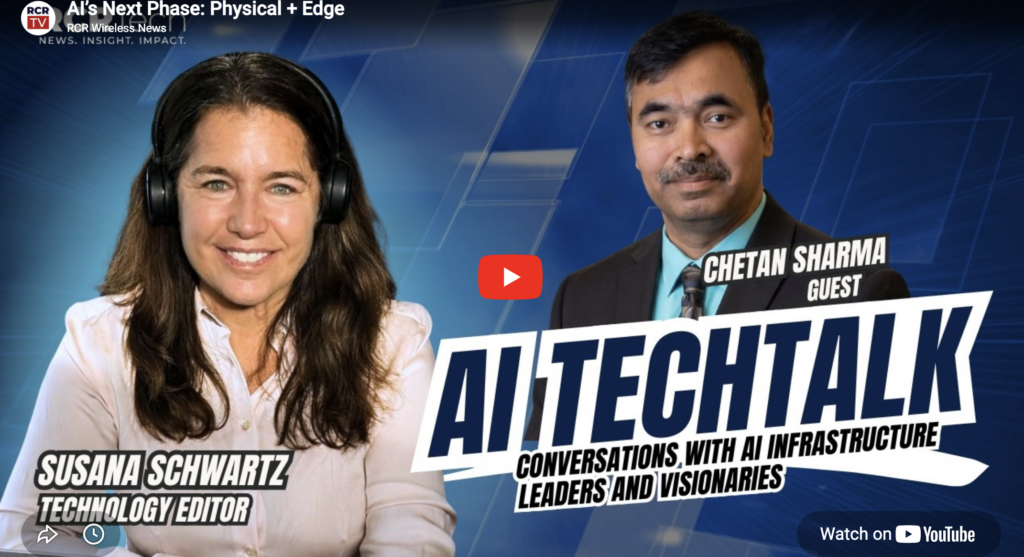
In this episode, Chetan Sharma describes the ‘Quantumverse’ and the synchronous S-curves of 5G Advanced, 6G, AI, robotics, and quantum computing that are creating emergent behaviors not yet instrumented or programmed into ecosystems.
In sum – what to know:
Synchronous S-curves: Traditional S-curves are giving way to multiple curves at once, with AI, 5G, quantum computing and robotics accelerating simultaneously, and then compounding.
Physical AI that makes a difference: Data gets produced, but not captured, so capturing the physical world data is what can really make a difference.
AI-RAN is the way forward: AI-RAN is about communications and other workloads running on compute, but timing will depend on ROI and the ability to scale.
Chetan Sharma of Chetan Sharma Consulting is an author and leading strategist for global mobile operators, hyperscalers, semiconductor companies, infrastructure vendors and enterprises. His Mobile Future Forward Summit, now in its 17th year, has become an industry-leading “working session” for the world’s visionary CxOs, chief architects, and strategy leaders, all of whom are navigating infrastructure shifts and moving toward what Sharma calls the “infrastructure way of thinking.”
The ‘Quantumverse’ – frontiers of emergent intelligence
There’s no doubt we are in a technological renaissance – a transformative era defined by previously distinct technologies that are now converging, such as AI, 5G Advanced, 6G, robotics, quantum computing, spatial computing, and synthetic biology. It is an era in which connectivity and human capability are being reinvented.
Sharma defines the “Quantumverse” as an era of quantum leaps, rather than incremental improvements, where things are evolving at a much faster pace. “Historically, the S-Curves would go fast, taper off, and then enter the next cycle, but with Synchronous S-curves, there are multiple S-curves happening at the same time and they have a pretty dramatic effect on the growth and absorption of technology,” explains Sharma, pointing to LTE, smartphones, and the cloud, which in the last cycle, were growing at the same time. In 2018 or so, curves were individually pulling up the other curves, with smartphones causing more traffic, and more traffic driving up cloud usage, and so on and so forth.
“Emergent intelligence comes from that notion of synchronous S-curves, where multiple technologies are emerging at the same time, and they have an emergent behavior – a behavior that we didn’t really program or instrument into the ecosystem. That emerges because 5G Advanced or 6G is interacting with AI, AI is interacting with robotics, robotics is interacting with quantum computing, and so on. He posits that when the number of technologies grows to 5 or 6, there’s a compounding effect of each of these technologies on one another other, “and that leads to emergent behavior, and hence emergent intelligence, which has an impact on all industries.”
Sharma has written previously that we are moving away from a world where intelligence is a “tool” and instead moving toward a world in which intelligence becomes a “property” that is enabled, constrained, and guided as an innate part of the system (rather than a feature that is turned on or off).
Physical AI for real-world benefit
As synchronous S-curves push intelligence to the edge in real time, networks will be transformed from passive conduits to active participants in decision-making and inferences. As an example, Sharma referenced a “Safer Signals” pilot program for the City of Bellevue Transportation Department in Washington state. The program uses AI in an effort to eliminate fatalities at road intersections where “vulnerable road users” – pedestrians that don’t have the protection of a vehicle to keep them safe – are at higher risk of traffic interactions with vehicles. With intelligence sensors and video analytics that detect people’s movements and speeds in real time, WALK cycles and signals can be dynamically adjusted according to the speed of the pedestrians, the proximity and the behaviors of vehicles near the crosswalks.
“When we talk of physical AI, it’s not really about humanoid robots running around, but rather, the data from the world and how we experience the world,” says Sharma, explaining that the challenge right now is that the data generally doesn’t get captured. “It gets produced, but not captured, which means it doesn’t get used to understand the world, especially from a machine point-of-view.” For example, he explains, when feeding LLMs textual data, image data, and video data, are we capturing the physical world data that can really make a difference, as in the case of what Bellevue’s pilot is attempting? He says it’s important to strive for real time ingestion of data and millisecond responses “to capture the data, to analyze the images, to leverage computer vision and then to respond.”
He says scaling physical AI in a cost-effective manner will be driven by the value of outcomes, and the economics of deploying intelligence to the edge: to the traffic lights, the base stations, the data centers, in the cloud. “Those are decisions cities, municipalities, state and federal governments will make based on the value of the outcomes,” says Sharma, noting that in manufacturing, factories and other sectors primed for physical AI, a combination of economic factors, ROI, and industrial efficiency will determine how AI will be integrated and optimized across networks, nodes, devices, workflows, services, and data centers.
Because the leaps of AI, 6G, quantum, and robotics are not centrally managed, it’s not yet clear how different industries or regions will fully optimize their impact.
“In general, these [technologies] grow independent of one another but with significant interaction and overlap in their growth cycles,” explains Sharma. “For example, the 6G cycle is natively AI – with AI in the radio, AI in operations, AI in customer service – so AI is embedded across the entire value chain of 6G.” Similarly, he says, 6G and AI can take advantage of the data being produced by the sensors that lead to physical AI. “Robots can take advantage of the connectivity available to them and there is a stitching together of solutions that weren’t possible before. It becomes possible because of these multiple technologies being available.”
Telco opportunity
For mobile operators and telcos, the opportunity is there for connectivity and beyond, according to Sharma. The key is creating valuable partnerships with hyperscalers and AI tech companies that need their network assets. “There was a misconception in the ecosystem that 5G was not good for operators. There were operators who did well like T-Mobile in U.S., Jio in India, and the three in China. It wasn’t evenly divided in terms of what the performance of 5G was in these networks, but the ones who were successful in 5G are now the ones looking at doing more than just connectivity, like AI grid or physical AI.” He points to the ways in which T-Mobile and Nvidia have partnered with Nokia and an expanding ecosystem of developers to bring physical AI applications over distributed edge AI networks, transforming wireless networks into next-gen AI-RAN infrastructure for distributed high-performance edge AI computing. It supports the aforementioned concept of vision AI agents understanding the physical world and turning networks into distributed AI computing platforms to unlock the full potential of physical AI.
“What does AI RAN really enable? Its communications running on compute platforms. I have no doubt in my mind that that’s the future of the industry: compute as a platform with communications and other workloads running on compute is the way forward. The question is how fast and under what economic circumstances do we get there?”
Chetan Sharma
In mature markets like the United States, China, South Korea, and India, Sharma believes embedding AI directly into wireless infrastructure will be the future of the industry, “but it’s important to step back and really ask “What does AI RAN really enable?” Sharma says. “Its communications running on compute platforms. I have no doubt in my mind that that’s the future of the industry: compute as a platform with communications and other workloads running on compute, is the way forward.”
He says the question is really how fast do we move and under what economic circumstances? “For any solution to work its way through scale, you have to make sure the economics of the solutions work. I think that’s where the industry is now. What is the right mix of the architecture to have it scale so it can be deployed widely.” With testing and trials for AI-RAN underway, he says “we have to just wait for the data to emerge to say how much time it will take, and how fast can it be absorbed by the ecosystem. But as a concept, I am fully on board that compute has to be a substrate for which communications can run.”
In terms of AI spend, Sharma believes this is a year of reckoning in that “infrastructure readiness, energy efficiency and operational complexity all have to come together,” since they are the limiting factors and constraints on ROI. To make the most of the hyperscalers’ AI infrastructure spend, “the application layer ecosystem has to develop on top.” Because application revenue is not commensurate with hyperscaler spend, Sharma says “the gap has to close” before the ecosystem thrives. “I don’t know how much time that is going to take, but that application spend has to exceed the hyperscaler spend.”
As for what excites Sharma about the upcoming year, “the whole notion of all these technology curves growing at a rapid pace…trying to understand and keep pace with them is exciting. The new AI models and the impact they will have. The agentic AI and how enterprises will embrace that, sprinkled with some geopolitics on top of that, and it becomes even more spicy.”
He says he will keep his eye on the three top markets for wireless and AI, as they are the indicators of what will happen and other markets will follow in terms of scale and capital expenditures.