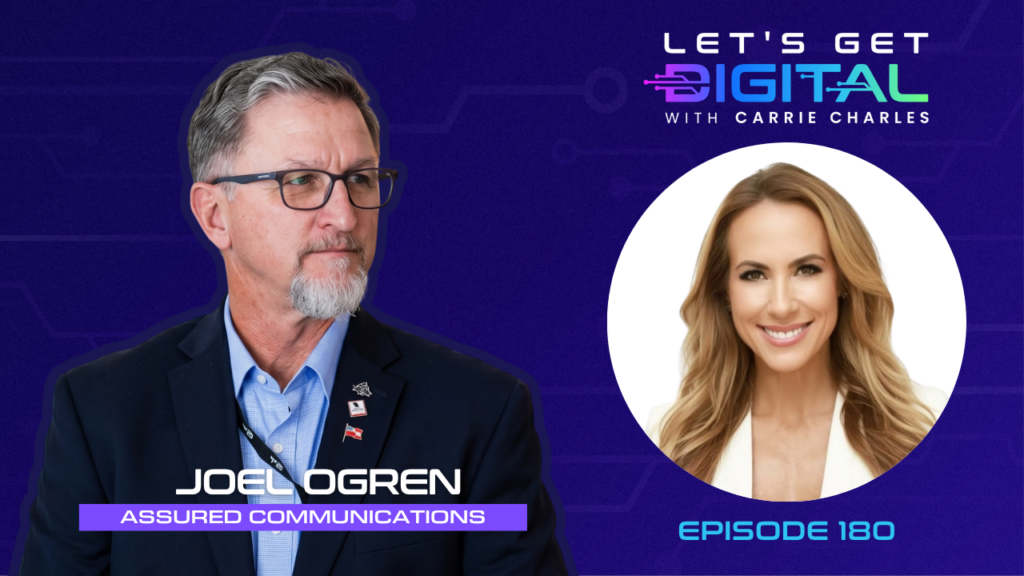
00:00 Ready to explore the cutting edge of digital infrastructure? I'm Carrie 00:04 Charles, your host of Let's Get Digital. Join me as we dive into the ideas, 00:09 technologies, and leaders transforming the way we connect. From wireless 00:13 telecom to fiber networks, [music] data centers, and beyond. Sponsored by 00:17 Broadstaff in partnership with RCR Wireless News. [music] Now, let's dive 00:22 in and let's get digital. Thanks for joining me today on Let's Get 00:28 [music] Digital. I'm Carrie Charles, your host. I'm glad you're here. My 00:32 guest today is Joel Oxgren. He is the [music] founder and CEO of Assured 00:38 Communications. Now, Assured Communications is a company that's 00:42 building critical communications infrastructure all around the world. 00:46 But, what I'm most impressed with and excited to hear about from Joel is his 00:51 Marine Corps experience because I was also in the Marines. So, Joel, thank you 00:55 for joining me today. >> Thanks for having me. 00:58 Great to see you there, Marie. >> Yeah, absolutely. Oorah. 01:02 >> Oorah. All right. >> So, uh Joel, talk about your path that, 01:07 you know, from the Marines and you know, what led you to Assured Communications. 01:12 Tell us about that story. >> Sure. It was, like many of us as we grow 01:16 up, the path where we are today was we had no idea, you know, when we were 01:20 young people coming out of high school, etc. So, I 01:23 enlisted in the Marines at the age of 17. 01:27 Uh few years later, I had uh put myself through college and got my double E 01:31 degree and was nominated to go to the platoon leaders course in the Marine 01:35 Corps. And what for people that don't know what that is, it's a 01:39 it's a way for enlisted personnel to be selected and transition into the officer 01:43 corps, another level of leadership in the military. So, I was blessed to be uh 01:48 selected into that program and became a communications officer about, you know, 01:54 5-6 years later into my uh Marine Corps career. So, that was that was great. 01:58 That's really where I started in that. Of course, back in those days it was 02:03 and I know you were in the communications field also, Kerry. 02:06 So, you understand you know, what we were doing back then. We were still 02:10 dealing with in the early '80s we were dealing with paper tape and IBM cards. 02:14 If you can if anybody remembers those, large floppy disks, 8-in floppy disks, 02:20 Dazzle D drums, all kind of silly stuff. And in the field we're still dragging 02:25 wire running wire around the field, you know, cranking phones, the old TA-1s and 02:29 everything like that. TA Prickset 25s, Prickset 77s. Now, we all before the 02:35 enhanced communications modes that we have today. So, that's where I got 02:38 involved in it. I had intended to do that for about 4 years and and then go 02:43 back and be a cattle rancher back in South Dakota where I grew up and 02:46 24 years later I had not made that transition. So, I stuck and stuck it out 02:50 through two and a almost two and a half decades. So, it was a great career. I 02:54 ended I retired uh 02:57 out of the White House and then entered into a second career. So, that was 03:01 great. That second career, by the way, I ran a communications program at the 03:05 White House. Uh went into John Hopkins Applied 03:08 Physics Lab. Spent it did another career there effectively. 03:12 I was I took a sabbatical from there to go over to DISA. So, that's the 03:16 Department of Defense's ISP and our global ISP. And I was asked to lead a 03:22 program which was known as the Center for National Nuclear uh command control 03:26 and communications. So, I had a very large very large budget that we executed 03:30 on, built a team, delivered a global capability and that 03:34 in communications, right? Critical communications, high assurance 03:36 networking. So, things that networks that are not 03:39 supposed to fail. And a lot of that is because we have redundancy built into 03:43 our networks and and our network partners out there all around the world. 03:47 And that's really how I kind of got my entry into to field that Assured 03:51 Communications is doing today and that's why I named the company Assured 03:55 Communications because there's such a focus on those high assurance, how do 04:00 you make networks not fail? What do you do? How do you Because they are going to 04:04 fail, that's the reality. No one should think I'm saying that there are networks 04:07 that are perfect and don't fail. They all fail for lots of different reasons. 04:10 And so what do you do to make sure that those critical nodes, critical 04:15 communications, whether it's voice or data, cloud content, whatever it needs 04:19 to be conveyed from point A to Z appropriately. That's what we focus on. 04:24 But it was a great background being in the military, frankly, because you get, 04:27 as you know, Carrie, it's the whatever it takes mentality. You have to do 04:31 whatever it takes to accomplish the mission. We bring that into this 04:34 company. The people that are here, I know we're going to talk about the 04:37 people later, but that's critical to this kind of business. 04:40 >> So Assured Communications has grown well beyond a consulting firm. And talk a 04:45 little bit more about just all the services you provide and the global work 04:51 that you do. >> Yeah, the joke I tell everybody is I I 04:54 really started this company to kind of semi-retire, just kind of do some light 04:59 consulting. Initially, I had a lot of recommendations from folks. I was trying 05:03 to make a decision on whether or not I was going to go back to Johns Hopkins 05:07 Applied Physics Lab or do something else. I started this, but things got 05:10 busy very quickly on a global scale. There's a lot of need out there, a lot 05:15 of projects and opportunity. So and that's where I 05:18 really started bringing on and just growing the company. It just happened 05:21 naturally. I learned the value of having key partners that you can trust, trusted 05:26 partners out there. That's absolutely critical for any 05:29 business and we also wanted to earn their trust, so that's two-way street. 05:34 So just the knowledge and the experience of 05:36 having worked globally and meeting those people, they might have been in uniform 05:40 also in a prior life, but they're still in the field just like I was. And so 05:45 already had a really strong series of relationships around the world. And you 05:50 know, you just keep bumping into those people out there. And they're good 05:52 people, they're solid. And my that network has grown significantly. There's 05:56 just a lot of great people in the industry, wherever they grew up in it, 06:00 that are out there making a difference. >> So Joel, you've really built a 06:04 reputation for of looking at infrastructure through a much wider lens 06:08 than just technology. So you see it through a lens of economics, politics, 06:15 regulation, risk. Why is it important to have such a holistic view? 06:20 >> It's a great question because this comes up so very often. In today's world, you 06:24 have to take in all of the you have to have a good solid base of understanding 06:29 of all of those because all of those topics are going to impact your projects 06:32 today. I think that if you don't if a company a customer doesn't have a team 06:37 that can look at that and that where you can fit in and participate in that, 06:41 you're going to have a lot of challenges that are going to come up. So 06:43 specifically when you get into the regulatory environment, what we have 06:48 from a regulatory environment here in the US is not doesn't mean it's 06:52 dissimilar anywhere else around the world any other country, but it is going 06:56 to be different. There's going to be a different timelines, different 06:59 requirements, different licensing requirements, you know, etc. Impact on 07:04 taxes, you know, all of these things that you really have to look at. How can 07:08 you be efficient across all of those when you're working in multiple 07:11 countries? So a lot of that comes from a good and some of the experience, but 07:17 when you I think there's a lot of communication that needs to happen. 07:21 Everybody knows this. When you get into a project to not only meet the 07:25 leadership of the communities that you're going to be in, but get out there 07:27 and meet some of the people. The world is full of disinformation due to our 07:31 social media platforms. And so setting the record straight early 07:35 and often uh helping people understand what you're doing, what you're not 07:39 doing, also. Right? The value of this, how this can help maybe their generation 07:45 or future generations and what the impact of that is. I think having good 07:49 positive conversations around that. And there are some tough conversations that 07:52 happen because these type of facilities, they take land and they impact power and 07:57 water and all of that. And those are those are all good conversations to 08:01 have. So, yeah, I think you need to understand the current state of the 08:03 politics, the regulation impact, environmental 08:07 permitting, historical, cultural, all of these things that you deal with in 08:11 developing projects and taking them to a successful conclusion. 08:15 >> So, your project spans subsea, terrestrial, satellite, policy. When 08:20 you're taking on something that is this complex, where do the surprises come 08:25 from? And maybe give an example of that, too. 08:28 >> If we've done a good job at the topic that we just talked about, that holistic 08:33 view, you should be well prepared coming in. Most of the surprises are coming in 08:38 to with when I have customers that are so risk-averse on a project that they 08:44 end up impacting the project negatively as we go down the line here. And what I 08:49 mean by that specifically is you may There's project risk, right? Permitting 08:54 risk, as an example. Permits and environmental approvals, they just take 08:57 a long time. It doesn't matter where you're at in the world these days. I 09:00 mean, you're looking at 18, 24 months, 36 months sometimes. I say quite often, 09:05 I can't wait to get to the part where I can put a shovel in the ground and go 09:08 build something. That's That's almost the easy part, you know, because I've 09:11 got you know, two law firms and a lobbyist maybe working on just trying to 09:15 get the environmentals and the permitting process through, along with 09:19 obviously coordination with the local communities. 09:23 But, the challenge that we face here is and the surprises are the fact that 09:29 people don't really understand that that's part of the path that we're on 09:32 right now. So, I think and maybe it's not it's an experience issue. They don't 09:37 believe it, that they're being told something else from someone somewhere 09:40 else down the line, they believe somebody else can do it faster, cheaper, 09:44 you know, etc. These things just take time. You've got to be a bit of a 09:47 squeaky wheel, you've got to know what you're doing, you follow the process. 09:51 The phrase I use a lot with my team, follow the process, the process works. 09:55 Right? And we adjust from that, but what's surprising is how much risk can 09:59 be put on a project by not making decisions in a timely manner, cuz that 10:03 costs money, it increases costs, products steal costs, a war kicks off, 10:09 right? And all of a sudden anything that has anything to do with the cost of oil, 10:13 lubricants, etc. all over there drives prices up. So, that puts a lot of 10:17 financial risk on the developers, it puts financial risk on project 10:21 implementation, the finance, the the budget of the whole project. So, moving 10:25 out smartly, executing a project, if you believe in it, you know, execute, cross 10:30 that line of departure. >> So, a lot of companies sometimes are 10:33 afraid to tell clients the the real hard truths. And you talked about when I I 10:38 think I met you at that conference in Metro Connect, you talked about stopping 10:42 a project before too much money is spent. So, what is this level of honesty 10:48 take or require from a leader? >> Well, I think you've this is part of 10:53 that trusted partner, you know, from the start, right? We have to have those hard 10:56 communications. And a good example of this this usually occurs there's a 11:00 series of I call it a as you're on the critical path to on the project, right? 11:04 So, that path is made up of many things. In the early days, 11:08 I have clients that want to tell me where 11:11 we should land a system or tell me where we should build something and they've 11:15 really not done a proper feasibility analysis, they've not looked 11:18 strategically at, you know, where is the power if we're bringing cables in from 11:22 offshore across the ocean, you can't just point at a place on the 11:25 map and say we're going to bring it in right there. There's a lot of stuff 11:28 going on offshore, we have to evaluate that and look at that, that takes time, 11:31 that requires resources. We have to wherever we're going to build 11:36 the facilities, that needs to be in proximity to that landing point. So, 11:40 there's a lot of things that have to be done right up front. And if they've 11:44 looked at a map and said, "We want to do something right here." Or they've 11:47 already purchased a piece of land, sometimes I usually been successful in 11:51 saying, "Let us look at a broader, you know, range on the map here." 11:55 And help identify that. It's just a lot of hard geologic engineering, frankly, 12:00 at the beginning to make sure that we can deal with that. You have to deal 12:02 with earthquakes, tsunamis, soil inundation, 12:06 soil liquefaction. There's a lot of things that can happen and make that 12:09 site untenable, and you don't want to be spending money and losing time, frankly, 12:13 in today's world by making by not being honest about that. In other words, if I 12:18 just accepted the truth or the location that somebody recommended without having 12:23 addressed all of those concerns, they still tell me to go anyway, we'll do 12:26 that, but I'll make, you know, we'll make sure that that risk has been 12:29 defined and outlined right up front. But sometimes there are reasons to stop a 12:34 project as you go along. And I think you can define that risk in your project 12:37 profile where it's worthwhile spending some money up front. It's not usually a 12:42 lot because you're not in the construction phase yet, but it's better 12:45 to to pause and regroup and perhaps look at another location that's more tenable. 12:51 Maybe we can get more power or better power or better access, etc., to 12:56 utilities. So, that's an example of that situation. 13:00 >> So, Joel, Assured runs with a very lean team, and you mentioned a couple times 13:05 that you lean on partners. So, how do you keep that quality, trust, 13:11 accountability high in this type of model? 13:15 >> Well, we hold each other accountable, for sure, but most of that comes from 13:19 these relationships that have been developed over decades now. And working 13:22 with people and having worked with them on other projects, you know that you 13:26 have a good working relationship, you know that you can work well together. We 13:29 know everybody understands delivery, the economics, and you know, and the risks. 13:33 We take all those risks together. We make sure that we understand them, and 13:37 we communicate well. So, understanding that project schedule, the economics, 13:41 and everything we have to do around project delivery is key. People that, 13:45 you know, understand the whatever it takes mentality. And that's not to say 13:50 that we're doing that, you know, and we're going to take a loss. We're going 13:52 to do anything like that. It's just being up front, communicating the 13:55 challenges as they develop and are defined to us, and executing together 14:00 with the team that knows how to get it done. 14:02 You solve problems, you know, and you execute, and as long as you walk into 14:06 that knowingly, I think it's been a good experience that way. 14:09 >> How much harder has global infrastructure delivery become as 14:13 geopolitical pressure, regulation, stakeholder complexity that all 14:20 continues to rise? >> It's hard because it creates risk in a 14:24 project, and there's different types of risk. Up front, everybody wants to 14:27 define the financial plan for the project, a pro forma, if 14:31 you will. What how much capital do you need to build this? What's it going to 14:35 cost to operate and sell, you know, etc. What's the valuations? What are the 14:39 returns? So, the financial risks are weighed very, very heavily. That creates 14:45 Then you have project risk during the development phase, the construction 14:48 phase, pre-construction and construction elements. And that's where all of those 14:52 permits, environmental work are being done. 14:55 So, if those things are taking longer than expected or longer than planned 15:00 because you didn't you weren't honest about how long it takes, or you were un 15:03 you weren't aware of it, or you just identify the fact that, hey, now it's 15:07 taking longer because of X, whatever that X might be, you have to look at 15:11 what the impact to that project is, you know, and is it a budgetary impact? Is 15:16 it impact on the customer? Customers often give you timelines and say they 15:20 They to be up and operational by X time and you know, and so we're all working 15:25 together to try to achieve that. So, I think it's mostly around certainty of 15:30 you know, and the risk associated with the finance project, you know, both 15:34 pre-construction and construction elements and then moving forward into 15:37 the operations and maintenance. So, that is getting harder across the 15:40 board because there's so many things going on that could impact your project. 15:44 You know, I gave the example earlier, impact on the war in Iran and impacting 15:49 cost of fuel and all cost of supplies, impacting the financial markets, you 15:54 know, etc. So, it gets everybody on their toes. 15:57 >> Do you think that the world is taking infrastructure resilience seriously 16:01 enough? >> I think unfortunately, sometimes it 16:04 takes a crisis for people to pay attention to things. 16:08 That's a little bit inherent in our psyche because there hasn't been if 16:11 there hasn't been a crisis for some time, people will stop believing that we 16:16 need to put some money into a budget to address things like resilience in your 16:20 network architecture or we haven't had any kind of seismic activity, an 16:25 earthquake, you know, in over 100 years. So, those 100-year charts, they're not 16:29 good. We're not going to build into any seismic capability into our design, 16:35 you know, etc. Even though we're in the we're due for something, right? You 16:38 don't want to claim doom and gloom, but you also want to be prepared and be able 16:41 to develop and design to the right standards and address these kind of 16:44 things. So, I don't think anybody sleepwalks into risk. I think that both 16:49 in the project development phase and a project implementation phase, all the 16:53 parties need to be able to have open discussions about those elements of 16:57 risk. Again, what we just talked about project financial, supply chain, you 17:01 know, all of those activities. When there's a strong partnership or a team 17:05 and approach to risk itself and you can have those open discussions, I find it 17:09 much easier to navigate the challenges as they present themselves. 17:13 >> You're expanding into Asia. What are you you're in that market that's really 17:17 important for your next chapter? >> There's just a lot of growth in Asia, 17:21 partly because AI is certainly driving everything 17:25 globally, but the cloud players, the neo cloud entries, there's a lot of new 17:30 entries in that space. There's just a rapid acceleration in growth and there's 17:34 and frankly what's happening in Asia, there are the Asian countries and 17:38 governments are taking advantage of these opportunities. They're identifying 17:42 uh significant amounts of power for particular areas they're trying to drive 17:47 GDP growth frankly through technology and to particular areas and they're 17:52 trying to manage it, which I think is great. They're trying to kind of put 17:55 some of these in like technical corridors, if you will. So, whether it's 17:58 data center or you know, any other kind of uh industries, they're trying to 18:01 group these a little bit and frame them up and make sure they have the right 18:05 resources both not only the land and the power and the connectivity requirements, 18:10 but also the regulatory pieces. So, everybody's really working hard to try 18:14 to have that growth occur within the 18:17 boundaries of their country, right? And then in specific areas as 18:20 they manage it. So, Asia in particular, it's booming. You have the largest 18:24 populations on the planet, you know, kind of very centralized around Asia. 18:28 So, that's where the basis for a lot of that growth and a lot of connectivity 18:32 obviously between each of the continents to connect into Asia and take on that 18:37 business. A lot of great people there. They're smart, they're working hard, 18:40 they're leaning forward over there and they've been great to work with as this 18:43 acceleration continues to ramp up there. >> With projects and missions this intense 18:51 globally, how do you build and maintain a culture where people want to join and 18:56 stay? >> It's a great question. I say this all 18:58 the time. I am really blessed to have the people on the team that I have. I've 19:02 got a very very diverse workforce here. They're willing to jump in and help each 19:07 other out. They're extremely experienced personnel from across the industry. 19:12 We're international now, we're on three continents 19:14 with these folks. Our headquarters in northern Virginia and we have a small 19:18 cadre of folks that come into the headquarters there, but we have people 19:21 in not only Virginia, but we where our headquarters is here, but we're we have 19:25 people in Texas, Florida, Colorado, Washington State, plus our European 19:31 headquarters in Sweden and our newest headquarters in Singapore in Asia. So, 19:36 many of these people have had multiple roles throughout their career. Sometimes 19:40 some of them started in sales, some of them started more technical, don't want 19:44 to be technical anymore, I get that. I love the technical side. But, you know, 19:49 one of the key things that I look for is not only bringing that experience to the 19:52 table that all of these folks do, but they have demonstrated their ability to 19:57 work both independently, especially if you're going to work remotely and be 20:00 part of a a team that kind of operates remotely. 20:03 Some companies operate 100% remotely, we're not quite there, but we often work 20:08 remotely, but they also have to be able to step in and work in a team 20:11 environment. So, the tools that we have uh cloud-based SharePoint where we can 20:16 get access to everything from anywhere securely, obviously, which is important. 20:21 We can share those with customers very easily using those tools, right? And 20:26 then the virtual meeting tools like we're using today, right? So, we use we 20:30 use Teams, we use Zoom and I don't know what this platform is. It says 20:34 Riverside. Riverside. Riverside. But, there's a lot of great tools just like 20:38 we're using for this interview that are out there that we take advantage of and 20:43 that helps. Flexible work schedules are key to allowing people to work remotely 20:48 because I think as long as you're getting everything done and you're a 20:52 team player and you're helping out, you know, you work your schedule. That fits 20:56 well with people, they like that. They like the flexibility. They also like the 21:00 autonomy that comes with that where, you know, you get treated like an adult, 21:04 right? You have expectations, you're supposed to deliver and if you don't, 21:08 you got to you got to talk to me. So, I think when everybody gets in that 21:11 groove, right, you kind of make it happen. And that's uh it's a beautiful 21:14 thing when you see that working well, and it's a beautiful thing for me here. 21:18 Got a great team. Like I said, I'm very blessed with it, but everybody gets on 21:22 board very quickly uh to that. And the people that have come here, they've 21:25 really they've expressed to me they enjoy this platform that we've developed 21:28 here. And it's and it's been through their input. I'm definitely not all the 21:31 brains here, so we have a lot of great input from everybody on this team, and 21:36 we take that seriously, and we try to build a a better mousetrap here on a 21:40 daily basis, so. >> So, let's talk about the future. What's 21:43 your long-term vision? >> Let me walk you through a little 21:46 history, right? So, I started I told you a little bit about how the company 21:49 started. So, it started as a consulting company. We very quickly built a 21:53 platform around service delivery and all of the elements from, you know, 21:57 feasibility strategy, desktop studies, if you will, right, all the way through 22:01 pre-construction, construction activities, operations, maintenance, and 22:04 sales. We added all of those because these were things that customers wanted, 22:07 and we built a platform around that. We've got the financial back office in 22:11 the back end to support, you know, the sales activity on behalf of the customer 22:15 that they really they've enjoyed. So, we wherever we've seen a pain point, we've 22:19 looked at it and seen if we can address that ourselves. We also have moved just 22:23 with the growth of the company to owning and operating some of our own assets. 22:27 So, we wholly own our asset in Europe. We're looking at adding more to our 22:30 portfolio. We're getting into more partnership where we have an equity 22:35 position, an ownership stake in projects that we develop. We like having skin in 22:40 the game. That's a phrase that we use as we participate. Sometimes that is not 22:44 the discussion in the beginning of the arrangement, but oftentimes when we've 22:48 proven our value and proven that trusted partnership, that's a good way to show 22:53 that we want to that we're here for the long run. We want to be here for the 22:56 long run, and we're going to continue to grow. So, that's our goal. 23:00 >> Joel, this has been wonderful. Thank you for coming on the show. I'm sure I will 23:04 see you again soon. >> I hope so. Appreciate it very much. 23:07 >> Yes, you take care. Thanks for tuning in to Let's Get 23:11 Digital. This podcast is powered by Broadstaff, a national staffing firm 23:16 specializing in digital infrastructure talent. Don't forget to subscribe, leave 23:20 a review, and join me next time as we explore more stories at the intersection 23:25 of technology, talent, [music] and transformation. Until then, let's get 23:30 digital.
No matching passages. Try another word.