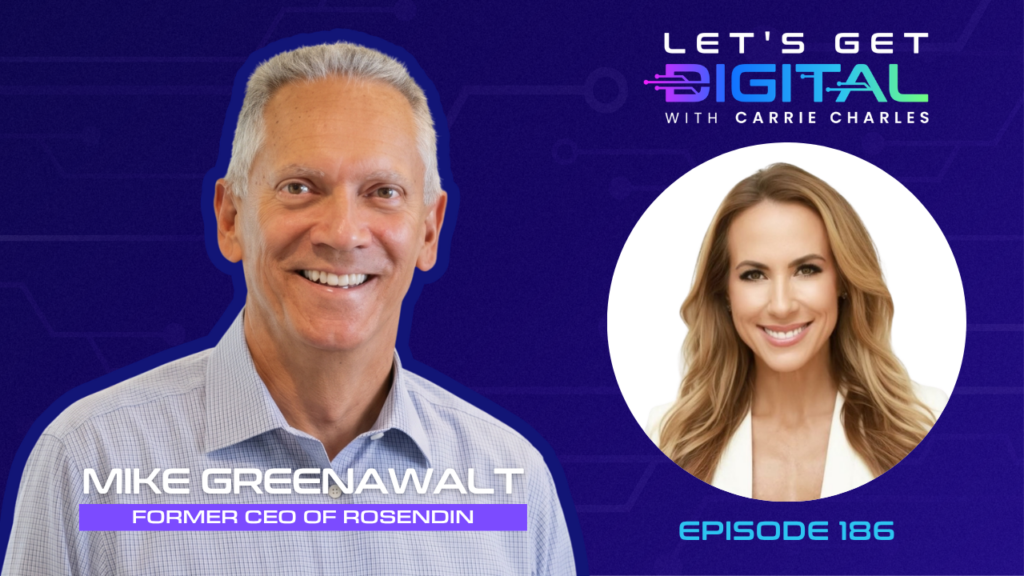
00:00 Ready to explore the cutting edge of digital infrastructure? I'm Carrie 00:04 Charles, your host of Let's Get Digital. Join me as we dive into the ideas, 00:09 technologies, and leaders transforming the way we connect from wireless telecom 00:14 to fiber networks, [music] data centers, and beyond. 00:17 Sponsored by Broadstaff in partnership with RCR Wireless News. [music] 00:21 Now, let's dive in and let's get digital. 00:26 Welcome to Let's Get Digital. I'm Carrie Charles, your host and I am so excited 00:32 about today's episode even more so than normal because this is a subject I am so 00:37 passionate about [music] and also I get to interview an icon in our industry. So 00:44 today's guest is Mike Greenawalt. He is the former CEO of Rosendin and founder 00:51 of the Greenawalt Foundation. So Mike started his career as an electrical 00:56 apprentice and he worked his way to the top of one of the nation's largest 01:00 electrical contractors. Now he's focused on creating debt-free career pathways 01:06 into skilled trades and building the workforce needed to power the future of 01:12 AI and digital infrastructure. Mike, so excited you're here. Thank you for 01:17 joining me. >> Well, thank you for having me. I'm 01:20 really really excited about this episode. 01:23 >> Yeah, so let's get into it and we will start with you. You know, you went from 01:29 electrical apprentice. What a story all the way to CEO of Rosendin. Take me back 01:36 to that young kid. What did the apprenticeship world see in you that 01:42 let's say the traditional education system didn't? 01:45 >> You know, it was not just the apprenticeship but some teachers along 01:49 the way. I was a kid that took everything apart. 01:52 If there was not a watch or a toaster that was safe, 01:56 summertime was hell for my mother because she knew my brother and I were 01:59 going take our bicycles apart, the lawnmower, anything to see what made 02:03 it tick. And that is that's something I think 02:06 that's instilled in many people. Their their mind is set that way. 02:11 You know, I'm going to call it a talent because 02:13 the ability to visualize things, the ability to take things apart, put it 02:17 together, and just the desire to learn, visually learn and physically learn is 02:22 what what looking back I realized that was 02:25 what I had. The apprenticeship 02:28 came along after I was, you know, forced down the high school you have to go to 02:31 college route. I was not happy. I was going to a 02:35 community college in an automotive tech program. Unfortunately, 02:40 eventually in an automotive tech program to get an associate's degree you have to 02:43 do these things called humanities, English 101. 02:47 >> Yeah. >> And it was like being back in school 02:49 again. Fortunately, a neighbor who was a union 02:53 electrician knew me, saw me working on cars, saw me 02:57 working around the house. I'd helped him with some projects, basically said you 03:01 need to be an apprentice. The apprenticeship, the second I walked 03:05 through the door and you're around everybody like you, adults, the teachers 03:10 were electricians. It was all about developing that talent, finding out what 03:14 you are. There in some of these apprenticeships there's, you know, 03:18 ex-math teachers, there's all kinds of different people in these programs and 03:22 they the apprentices are very good at extracting the talent, the god-given 03:26 talent that young men and women have. In in retrospect when I look back it's 03:31 like it was perfect timing, the perfect career path 03:34 for me at that time. >> So there's still this idea that college 03:40 is the successful path to take and, you know, skilled trades are 03:45 somehow an alternative. I know that's shifting a little bit now, but what do 03:50 parents, teachers, guidance counselors misunderstand 03:54 about what a career in the trades can actually look like today and in the 03:59 future? >> You know, it's been a long time. It's 04:02 been decades of parents and guidance counselors being basically force-fed 04:07 college as the only pathway to success in America. 04:11 What parents have to understand that every one of their kids are 04:15 different. Personally, I only have one child, but I know my brother and I were 04:19 drastically different. So one size doesn't fit all. 04:23 Parents need to understand that it's okay if their son or daughter does not 04:28 want to go to college. What I would like all parents to know is 04:32 they really need to focus on post-high school education opportunities like 04:36 apprenticeships, like the military, like there's all kinds of options that are 04:41 out there. That has to you know, something is going 04:44 to fit your child and it's not going to be the same as everybody else. 04:49 High school counselors since I can remember 04:52 they are programmed to send kids to college. 04:56 High schools are graded on they're graded on college placement. They will 05:01 brag, we have a 98% college placement. That is what high schools are all about. 05:07 The counselors need to understand that their job is to make sure these young 05:11 men and women have success after high school 05:14 and get to know them a little bit better instead of finding a college that fits 05:18 them or a financial program that's going to help them get into a college. 05:23 Get to know them better. I think we have too few counselors for the head counts 05:27 now. And the counselors are not well equipped 05:31 to learn about apprenticeships. Anything that's not Department of 05:35 Education seems foreign to them in my eyes. 05:38 >> Yeah. So AI as we know is driving just massive 05:42 waves of data center construction. We hear constantly about the shortages of 05:47 power and land, equipment, water, but we don't talk nearly as much about people. 05:53 What is the workforce problem that you think the digital infrastructure 05:57 industry is really underestimating right now? 06:00 >> You know, we have labor challenges in this country. 06:04 We knew this was coming. I can recall back in 2008-2010 06:10 having clients wanting to know how we were going to staff their projects. 06:14 This problem has been around. We could see the math. We all knew what was 06:18 happening with with skilled labor. Everybody like myself were aging out. 06:23 The journeymen were leaving and the kid the young adults were not coming in. So 06:28 we knew about this. The industry was struggling, but they 06:32 were addressing it. We were doing the best to expand our apprenticeships 06:35 across the country. The NCCR programs, the single employer 06:39 apprenticeships were growing at a rapid pace. We were addressing what we knew 06:43 was coming. We were far behind what we knew was coming, but we were trying as 06:47 hard as we could. When you look at it, you know, we had a already troubled 06:52 labor program in the country. We were working very hard to address it 06:57 again, expanding apprenticeships, expanding the reach. We were getting 07:01 into high schools and talking about the programs. But following right after 07:06 COVID, right during COVID, this AI boom starts creeping up on us. 07:11 And we've been building data centers. My entire career's been around data 07:15 centers. I built my first one in 1979. This thing was growing and then AI 07:20 explodes. It was kind of simmering underneath 07:24 and here it comes. So now we have an industry that was challenged. 07:29 We had an industry that was struggling to keep up and struggling to address it. 07:33 And then this huge demand comes. It's just boom. It is just out of this 07:38 world. And I think AI's changed the landscape 07:41 forever. If it's a bubble, 07:45 I think the change has happened that for the better 07:48 it's opened America's eyes that we need skilled trades people. 07:53 But everything we have right now is lagging the need, significantly lagging. 07:58 These jobs are getting built at record paces. 08:01 The apprenticeships lag in funding. All the funding for apprenticeships 08:05 comes from typically on the union sides. The 08:09 funding comes from the contractors on an hourly basis based on man-hours worked. 08:13 And the domicile contractors in the area will say we've got X amount of hours 08:17 booked for the next five years. We need so many apprentices. They do the math. 08:22 It's going to be a dollar an hour to train all of these apprentices. In drops 08:26 a Google in their jurisdiction and we need 3,000 electricians for the next 08:31 four years. It's financially impossible. It's 08:34 physically impossible for us to keep up. So AI has changed everything. I think 08:41 the the whole world is underestimating how big the labor problem is. They think 08:46 we're just going to magically get people and it's not working because we're 08:49 wearing them out. We're paying too much for them and they're retiring early now 08:53 because of the funds. So for the good, I think it's opened It's really 08:58 enlightened America and industry on how bad the challenge is and how much 09:03 investment is required financially. >> You talked about the C students who they 09:09 sometimes get overlooked in high school. What is broken about the way we identify 09:13 talent today and what should we be saying to that 17 or 18-year-old who's 09:19 smart and capable but just doesn't see college as the right path? 09:24 >> Yeah, and you know, it's back to my comment on the talents and who these 09:27 people are. I have to say if it wasn't for a crafts 09:30 class and auto shop, I would have had a hard time maintaining a C average. My 09:35 GPA was absolutely Listen, the counselor just when I went 09:39 in to see my counselor was like, okay, you know, I'll do my time with you, but 09:43 they they give up on us. Honestly, I think the high schools give up because 09:48 they're graded on college placement. They want to have everybody with a high 09:51 GPA. That's what high schools are developed to do. That is what the 09:55 Department of Education is building America on. You know, what they need to 10:00 understand is there are some kids out there, the 10:04 students that are struggling that need more help. 10:07 But kids like myself, and there's thousands of them, I've gone to some 10:11 high schools locally in Arizona where the council will bring in, I'll do four 10:16 sessions of 30 kids a day that are not going to college, 10:21 that are looking for a pathway. These young men and women are there, but very 10:26 few of these high schools are preparing and reaching out saying we need to find 10:31 a place for these young men and women. We're seeing out of all of a sudden now, 10:35 we're seeing apprenticeships growing, we're seeing trade schools popping up. 10:39 We've got some great VoTech, CTech programs or CTE going around the 10:44 country, but again, it's lagging. These things are not keeping up and they're 10:48 not really addressing it. So I think that the parents need to understand that 10:53 it's okay if they don't go to college. C students are not, you know, bad 10:57 students, they're just C students in the program that they're in. If you want to 11:01 turn an a C student into an A student, let them go work with their hands or do 11:06 what they're given to do, they'll turn into an A student really fast. 11:10 >> You know, Mike, I am one of those students. So I do not have a college 11:14 degree and I went the route of, it wasn't a trade school, but it was a 11:21 certification as a certified financial planner and I got into, you know, 11:25 financial planning, but I'm actually proud that I don't have a college degree 11:29 because of what I've been able to accomplish without it. So again, this is 11:33 an area I'm so passionate about and I never went back to get it because I did 11:38 want to be an example of what's possible. 11:41 >> Yeah. There's so many of us out there and I would love to see 11:46 at the junior high level, if there were a way 11:50 we take all these tests every year at junior high and and elementary school to 11:54 rank in the country. You take the had to fill in the dots, it was crazy, you 11:58 know. I would love to see a test somewhere in the junior high level that 12:03 identifies talents that can come back and say, you know, 12:07 your daughter thinks she's going to be a neurosurgeon and we don't, you know, 12:13 according to this, this might be a better pathway. 12:17 You know, I know there's got to be something out there, 12:20 but if we were just to sit down in junior high 12:23 and let these young men and women, their purpose is 12:26 probably already settled in their bride or their DNA. If we could just take that 12:32 and sort it and find their purpose in life at that age and then educate them 12:36 for that purpose, we would be miles ahead. But that again is beyond my 12:41 comprehension on how to do it. I may be speaking something completely that 12:45 Department of Education people are going to this guy, where did they find this 12:47 clown? But that's really I was cooked on what I 12:51 was going to do. I When I look back, the bicycles that got taken apart and 12:55 repainted three times in the summer because that was what I wanted to do, 13:00 what thrilled me. You know, I had friends that would read 13:03 books all summer long, talk about how many books. 13:05 You know, I was taking stuff apart. Things were different and I just wish 13:11 the C students had this opportunity to show their talents and be accepted for 13:14 what their talents are instead of what their GPA is. 13:17 >> I couldn't agree more, Mike, and I also believe that we need to start this 13:22 education process in junior high versus just waiting until high school. We need 13:28 to start earlier education and also I don't want to use the word recruiting 13:33 because that's not the word I'm looking for, but at least teaching students in, 13:37 you know, even starting in elementary school, right? There's another there's 13:40 other options out there. Would you agree with that? 13:44 >> Oh, I I can't agree more. I'm You know, it's not hard to date myself when you 13:48 look at my gray hair, but I had in junior high 13:52 the girls went to home ec and the boys went to shop class. 13:56 >> Yeah. >> In in seventh and eighth grade, I mean, 13:59 I worked we were using power tools in seventh and eighth grade. 14:03 We were soldering. We were building things. We had tools in our hands. I've 14:08 worked a lot in some pre-apprenticeship programs and we have 20-year-olds come 14:13 in that we have to they've never held a screwdriver or seen you know the 14:17 Phillips screwdriver's a plus and a flat blade is a minus 14:22 and these are 20 year olds that are coming in 14:25 and some of them are quite good they're quite talented after a couple of nights 14:29 of just basic training on hand tools just like it's exciting to see them 14:33 develop so fast but that's where we have to actually give these opportunities to 14:39 young men and women in junior high to let them before the competition is on 14:44 listen I know that by the time you're going to 14:47 high school when I walked into high school there's these kids were already 14:50 walking around with their college of choice jerseys on 14:54 you know I think I had a a Chevy Camaro shirt on 14:58 or something when I walked in and they're all walking around with UFA or 15:01 ASU and I'm like well 15:04 I don't think this is going to work out but I've got four years to go so 15:07 >> And you followed your passion and boy you've accomplished so much which again 15:13 we could talk about that for quite a while but I really really want to yes 15:17 >> anybody can do this any any there's so many young men and women 15:21 out there can do follow this path and we just have to open the door for them 15:25 >> Yes yes I want to hear more about the Greenwalt Foundation and let's make it 15:31 tangible so if I'm a student or let's say 15:37 I don't know I'm potentially part of an apprenticeship program that receives or 15:40 let's put it this way I'm a student or I'm an apprenticeship program that 15:44 receives money from you where does that money actually go and what outcome are 15:48 you trying to create so maybe the best way to answer this question Mike is to 15:52 first really give us some detail about the Greenwalt Foundation how you operate 15:58 how it's organized and then answer that question 16:02 >> So you know the the Greenwalt Foundation came about as I was contemplating 16:07 retirement and I was working a lot in the workforce 16:10 development side of my career at Rosen and I was privileged enough to travel 16:14 around the country and do a lot of remote jobs where I worked different 16:18 apprenticeships and different municipalities about 16:21 getting people to work and getting them in. 16:23 It really excites me to give these young men and women the 16:27 same opportunity I had. I'm retiring and I'm wanting to know 16:32 what to do with my life afterwards and I'm not done yet. And my wife and I sat 16:37 and she's done extremely well in business and and 16:41 she does not have a four-year degree either. 16:44 So we're talking about what we could do and we're talking about all the work 16:48 I've done with Grand Canyon University and different apprenticeship programs. 16:52 And we've looked at our investments and said what if we just moved some 16:56 investments over into a 501c3 with the intention on helping young men 17:01 and women, also people in need, people in transition as far as jobs and careers 17:07 get into registered apprenticeship programs. I've always talked about post 17:11 high school education. It doesn't have to be college, doesn't have to be 17:14 apprenticeship. You can go to college, you can go to an 17:17 apprenticeship, you can go to branches of the military. Just don't 17:21 leave high school and go out and get a job. 17:23 Go continue your education. And that's what I go to schools and preach. 17:28 Continue your education. So we started looking at we've got all of these C 17:33 students out there that I've met. We've met all of these people that are 17:36 struggling with college debt, people that are, you know, coming into the 17:40 apprenticeship program saying I've got to get a job because I got to pay off 17:43 the college debt because my job as an accountant isn't paying for it. 17:48 So we decided we're going to we're not a highly funded program, but we're a 17:52 well-funded program. That we're going to help as much as we can guide young men 17:57 and women into registered apprenticeship programs, whether it's electrical, 18:00 whether it's being a barber, being a nail tech, being a clean room 18:03 technician, any registered apprenticeship program. We're focusing 18:07 on high school seniors to give them an opportunity when they're sitting there 18:11 talking to their counselors saying well, you know, here's your FAFSA paperwork 18:15 and this is what you have to do to go in debt and this is what you have to do to 18:17 succeed. Hopefully we can get one of those young men and women so I would 18:21 like to go into an apprenticeship. So with that, 18:24 apprenticeships, the cost of the education 18:27 is predominantly paid for by the contractors or the employers, but 18:32 there's always a price of entry. A lot of programs are governed or tied in with 18:37 the community college, so there's tuition involved. So there's a cost. So 18:41 these apprentices once again they see cost or they see tuition or an 18:45 application or like wait a minute, no, we're I thought I was just going to go 18:48 make money and you know. So we're trying to guide them through and give them the 18:53 financial aid to get them from point A to point B into the program in the first 18:57 year. So that is our scholarship program. It's open to high school 19:01 seniors. They have to maintain this really difficult C average. They have to 19:06 they do have to fill out a one paragraph essay, which is pretty hard for them 19:11 sometimes and we'll coach them through just I want to work with my hands. 19:14 There's your essay, you know. So they have to do some steps to get it and then 19:20 the monies will go to the apprenticeship. So it comes in and the 19:24 apprenticeship will basically if there's a a book, the books cost money typically 19:28 not paid for by the contractor. So that would pay for their books that would 19:32 have to come out of the apprentice's pocket or it'll pay for the college 19:35 tuition to get college [clears throat] credits. So that will that is how the 19:39 scholarship programs work. We have what we call an industry grant and that's 19:45 where we're encouraging apprenticeship programs to send us a grant request, 19:50 greenwaltfoundation.org. It's very simple to ask for a industry 19:54 grant. We uh to the one of the electrical JTCs in Arizona, the Phoenix 19:59 Electrical JTC, we gave a very large grant for fire retardant shirts for all 20:04 of the apprentices. These shirts are expensive. It's something that we did 20:09 not have the privilege of when I was a young man. They are lightweight, they're 20:13 breathable, they're cotton, and if I was an electrician working in the field 20:17 right now, I would not leave home without one. So we gave a grant to that 20:21 JTC for shirts. We've recently awarded a grant to another electrical 20:26 apprenticeship in Arizona, Weca, and they have a large grant coming for 20:31 sponsor. I think we're going to sponsor 10 kids into the apprenticeship. 20:35 >> That's great. >> So that was an industry grant. They 20:37 filled out the paperwork and sent it in. And we have the community grant where 20:42 we're helping people that are you know there's a program in Arizona that women 20:46 that are incarcerated, they're looking for career paths. So helping them we'll 20:51 give them a grant, a community grant to help get these women into a place where 20:56 they can get some pre-apprenticeship training, get the boots they need, the 21:00 clothes they need, and go out and get a job as an apprentice and start an 21:03 apprenticeship somewhere. And there's several other community grants that 21:07 we've given, you know we've given some funds away to for guide dogs to Humane 21:13 Society, things that you know some of the pets that go into hospitals and 21:17 such. That's kind of our little part of our 501c3 we can just do good things 21:22 with that aren't really tied to apprenticeship, but we're mainly focused 21:26 on getting young men and women into registered apprenticeship programs of 21:30 any type in any state. We're based in Arizona, but we'll we're nationwide. 21:35 greenawaltfoundation.org you can go on and apply and that's kind 21:40 of where this whole thing came from. It's a lot harder than we thought it was 21:44 going to be. >> Isn't it always, right? 21:47 I'm just trying to do something good and help people and it is it does get 21:50 complicated. >> Yes, it it it's a great feeling, but I 21:53 really think you know we're in our second year now. We're getting some 21:57 traction, going out and meeting with these you know these families at high 22:01 schools, going out meeting. I have no idea. I mean it I'm just an electrician 22:05 that worked hard and had great mentors and extremely fortunate. And to have 22:10 people you know really asking me for advice, asking you know looking up to me 22:15 saying wow how did you do it? It's an absolute privilege. I don't mind you 22:19 know I'll give as much money away as I can as long as we can keep doing this. 22:23 >> So Mike I just have to throw this question in. So how did you do it? 22:27 Because there could be kids listening right now or, you know, people thinking, 22:31 I want to follow that path. How did he do it? I mean, can you give me like a 22:35 little reader's digest version of how you did it? 22:38 >> Well, you know, I was I've had this question to me and I kind of go back to 22:42 the Joe Montana quote that life is a team sport, mentors and listening. I 22:48 wasn't the best apprentice, especially in my early going. 22:52 I had journeymen that understood me, that saw my talents, that would coach 22:57 me. How I did it was with the help of others with every step of the way. I 23:01 could list names, what decade and where and when somebody said, 23:06 you know, I think you could be you'd do really well doing this. I went from 23:10 being an electrician and went into the office as an estimator. I didn't know 23:14 how to estimate. I just said I could. You [laughter] have to have the drive. 23:18 You have to have the self-confidence and you have to have a vision of where you 23:21 want to go in life. And I didn't develop that until I was a journeyman for about 23:25 three years going, well, is this as good as it gets, you know? You grow up. So 23:30 how I did it was with the help of others every step of the way, people believing 23:35 me and opening a door and giving me an opportunity. And the other thing I like 23:40 to talk about is taking chances. You know, Cody Johnson, if you got a 23:44 chance, take it while you got a chance, a country song. I love it because 23:47 >> Yes, I love that one. >> I get a chill when I listen to that song 23:51 because it has different meanings, but chasing dreams, you know, if you got a 23:55 dream, chase it because it's not going to chase you back. 23:58 I was people would look at me sometimes and think I was just full of 24:02 because I talked about what I wanted to do, these big vision picture things. And 24:06 then there's opportunities to take a chance. I my wife and I moved to Denver 24:10 in 1991 for jobs and I had never really left Phoenix. I was so uncomfortable. It 24:16 was the chance of a lifetime because I went to Denver International Airport and 24:21 worked this biggest job in the world at the time and I'm there in the middle of 24:26 it and my eyes opened up to how big this world is. And that's, you know, so I'd 24:32 say the help of others, you know, having a dream and chasing having people help 24:36 you and then take those chances when you've got the chance, you know, that's 24:40 about it. I it's not magical. I can't write a book on it, so. 24:43 >> You actually probably could, Mike. That's brilliant advice actually for 24:47 everyone, not just young people. You know, Mike, you mentioned that you 24:52 helped to build the pre-apprenticeship model at Grand Canyon University. Talk 24:56 about that a little bit about that model and also what would it take to replicate 25:02 that across the country? >> Recently, you know, kind of in 25:06 reflecting on life, we had these challenges in the industry and I've been 25:10 working with apprenticeships and we're struggling to get them in and 25:15 then we had this high we still have a high turnover rate in apprenticeships 25:18 because young men and women aren't prepared. They don't know what the job 25:22 is. They just think they're going to make a lot of money. Their uncle was an 25:24 electrician or a pipe fitter and so as a contractor, we are seeing these big 25:30 needs. This was about late probably 2019 2020. Dana Center market was booming 25:36 across the country. I was zigging and zagging from North Carolina to Texas to 25:41 every place working with the local unions, working local, trying to get 25:45 people in. And we were doing okay. But I was looking at the education side, 25:50 looking at how I talked about the financing of apprenticeships, how it 25:53 was, you know, lags. We couldn't the apprenticeship still can't they couldn't 25:57 then and they can't keep up with these rapid growth programs. 26:01 So I had this idea that we were going to start a school at Rosemont. And there's 26:06 a couple of programs out there that I was modeling after Quanta, one of our 26:10 big competitors, Quanta. They have a great lineman school. 26:15 And I basically said if they can do it, we can do it. And I went to the board of 26:19 directors of CEO in 2020 with this hair-brained idea about I 26:25 wanted to buy a for-profit trade school and let it keep making money teaching 26:30 welding or air conditioning, whatever it was. And then add on to it a school for 26:35 electricians, a pre-apprenticeship program. We could take our whole 26:38 training department. I had this big And they looked at me like eyes from outer 26:42 space. One of the board of directors said, I know somebody at Grand Canyon 26:46 University. And I thought, okay. 26:50 Oddly enough, my son, our son graduated from Grand Canyon University, so I was 26:54 familiar with it. I went in in September of 2021 with the 26:59 presentation, a room full of PhDs. I mean, I walked And they didn't know what 27:05 to do with me. They're doing this gentleman from the Colangelo School of 27:09 Business advisory board member a favor to listen to me. And I pitched it and I 27:15 told them in 2021 Rosen needs a thousand electricians in the next couple of years 27:21 in Arizona. We had TSMC starting in 2021, big chip plant, North Phoenix. We 27:28 had Intel firing back up. We I was being pretty selfish with this. We were just 27:32 starting a big meta data center in Mesa. We had other data centers around the 27:36 state. I'm looking at a a thousand person need in about 12 to 18 months. 27:43 And at at that time, the local union was only 1,800 people. And I'm looking at 27:48 them saying, here is the math. I had a whole bunch of charts and graphs 27:51 off the Department of Education on the growth in the industry, the growth of 27:55 apprenticeships, the need and all of this. 27:58 And I walked out of there confused saying, well, that went well. They 28:02 didn't laugh at me or throw me out. And I got called back to President Mueller's 28:06 office two weeks later, president of the university. And he had done the math. 28:10 And he knew all the charts and graphs. So I couldn't believe it because I'm 28:14 sitting there and he basically looked across the table and said, how do we 28:18 scale this? So we talked about scaling, talked about different industries, how 28:23 big this need was. And I'm sitting in a major university with the president's 28:27 office. And he looks across the table and I'm sitting next to Dr. Randy Gibb, 28:32 who's now the provost. At the time he was the dean of Colangelo School of 28:36 Business. And he looks at us and he goes, and this 28:38 was it would have been I think it was right before Thanksgiving of 20 been 28:42 like a month or so since I pitched. we want to have this up and running for 28:47 fall semester of '22. No curriculum. I had no idea. I had a line of bull crap 28:52 so what I dish. [laughter] 28:55 My company at the Rosendin invested heavily. 28:59 Rosendin came to the table with the investment needed. None of this was 29:03 eligible for student loans. I went to our largest non-union electrical 29:08 competitor and I invited them to my office in Phoenix and all my guys are 29:13 like, what are their trucks doing in our park a lot? 29:15 Well, you know, very so often you have to team up with the enemy here. They're 29:19 not our enemy. They're just taking a different path. So another electrical 29:23 contractor came in and said yep, and we funded it and we were able to get 29:29 another three or four contractors to help fund this. We funded it Rosendin 29:33 and the our partners uh in industry funded it for two full years, two full 29:37 years. But in those two years we were able to get all of the classes certified 29:41 by the Department of Education. So now their FAFSA you can get student funding. 29:45 This is scalable. We took this program. We had no idea what we were doing. 29:51 We were filling our need. Our first class was 40 people because again we 29:55 didn't have this proven. And Prez of dealer likes to scale big and I'm saying 30:00 just give us 40. We can vet this thing. We can sort this out. So we had a class 30:04 of 40. 37 finished the class and went to work. So here is what I did not 30:11 understand and where I learned so much about the Department of Education, 30:15 the high school programs, how this is all assembled. I learned about how 30:19 classes get accepted, how you get FAFSA, how you get the funding, how you put 30:23 students in debt. I learned all about that. 30:26 I learned about high school counselors, how they get ranked, how they what I 30:29 didn't know, the the magic button here is these kids that are leaving, let's 30:35 say Sunny Slope High School I went to high school in Phoenix. 30:39 When they leave to go to the Grand Canyon pre-apprenticeship programs, 30:44 high school gets college credit. They place a college student. They don't care 30:48 if they finish. They don't care if they're taking basket weaving. They went 30:52 to a university. That is a touchdown that repeats itself. 30:57 I'm getting a chill because I that light came on and I go, holy crap, are you 31:00 kidding me? No. So now we have high school counselors 31:04 pitching this. Now they're looking at those C students 31:07 going, hey, I got a place for you. We'll give it a try. So the other thing 31:12 I did not understand, I thought we're just going to get these kids, we're get 31:16 them a chance, we're going to get them a job. They told me I had to come to the 31:20 first graduation and speak. K? 31:23 40 students, 37 made it. I'm thinking in and out. 31:28 I'll drive over to campus. I'll be in and out in an hour. 31:32 And I'm walking in and the parking lot's full. 31:35 And there's about 200 people in this auditorium. 31:39 And they're carrying balloons, purple balloons for the Grand Canyon 31:42 color. Congratulations graduate. And I'm looking, they just went through a 31:47 12-week pre-apprenticeship program. There's multi-generations of families 31:52 with babies crying and grandmothers watching these students walk and get a 31:56 certificate that's going to hopefully get them a job and get them into an 32:01 apprenticeship program. So and we do have multiple companies and 32:06 programs pulling out of the Grand Canyon system now. 32:09 I honestly it had me in tears because it it's dawning on me when people are 32:13 wanting their picture with me going they introduced me, here's Mike, he 32:17 started this program. And the impact we have 32:22 when we give people an opportunity and we show them a path 32:26 and that's where the Greenwall Foundation can also help do this. So 32:31 last Wednesday, 32:33 I typically spend summers in Denver to stay out of the heat. 32:37 I was summoned back to Grand Canyon University, 32:40 and I've gone to most of the graduations. 32:42 Since we started the electrical program, McCarthy construction has come in and 32:47 started an entire construction program for all trades, pre-apprenticeship 32:51 program. McCarthy's sponsoring that. We have TSMC is sponsoring a 32:55 pre-apprenticeship program for clean room technicians for the TSMC 33:00 project, the big chip manufacturer in North Phoenix. 33:04 And we've expanded to a CNC machine tool program, 33:07 which is a whole Hopefully I get a chance to talk about how unique that 33:10 program is. They wanted me back because 33:14 I told them 1,000 people I needed. Last week the 33:19 1,000 students have gone through pre-apprenticeship programs. 33:22 So this program is scalable for any. The 33:27 private universities are going to be more apt to it than the public. I think 33:31 in 5 years you'll probably see all the state schools trying to do it. 33:35 It puts kids in the college that were never planning on going to college. 33:39 The beauty of it is we haven't had a high transfer program, 33:44 but they have a Grand Canyon University ID. They can go anywhere on that campus. 33:48 They can go eat in the lounge. They can go to basketball games with student 33:52 discounts. If they're in the undergraduate 33:55 electrical program now, they can live on campus with assistance. They are 34:00 students at a university and they never filled out an application or talked to 34:04 their high school counselor about doing this because the counselors didn't want 34:08 to talk to them. This is scalable. 34:11 We can do this anywhere in the country and universities can do it. 34:15 Grand Canyon again, they took the chance on the electrician that came in and 34:19 pitched. I was just my best sales pitch ever. 34:23 Best pitch, but I get excited about it. They took the chance. 34:27 They did it. We're successful and we can do this around the country. 34:32 So if I may digress to the CNC machine tool program, 34:36 a student at Grand Canyon University who started 34:40 the electric skateboard program. He invented those back in 20 14 I think on 34:45 campus. And they gave him space to start 34:47 building those things on campus back in electric skateboards. 34:52 He looked to what we were doing with the electrical program and he pitched a deal 34:56 to President Mueller on CNC industry is so in need of students and workers. 35:03 And Grand Canyon invested with some other industry partners. They put about 35:08 I think it's about a 30,000 square foot space with CNC machines in it. That's 35:13 the computer programming for making high-tech parts for the aerospace 35:17 industry basically in Arizona. The students go to school in the morning 35:22 and they work in the machine shop in the afternoon and those parts are sold to 35:26 industry. They're not just making stuff to go in the scrap thing. They're going 35:30 out into industry. And this people that were going that were working in the shop 35:34 in the morning they go to school in the afternoon. They swap it so the shop is 35:38 busy all the time and the students are getting 8 hours of education and they're 35:42 able to go to work. They're all spoken for before they even leave that 35:45 building. And they are functional. They can go out and make a living. You talk 35:50 about national security. They're making high-tech parts going into satellites 35:54 going into to wafer fab fab equipment. Grand Canyon University set that up and 35:59 they just recently expanded it. So that program, you know, is another scalable 36:05 program that can be done everywhere in the country and I know the need is 36:09 everywhere in the country for electricians, machinists. So yeah, I'm 36:13 pretty proud of it as you can tell as I get going on this topic but it's just an 36:16 idea, you know, and someone took a chance. 36:19 >> You know, Mike, there's so much need, so much opportunity, there's solutions 36:27 as as we're hearing right now. But you know, you can't do it alone, right? You 36:31 need help. You need funding. With the Greenwald Foundation, I mean, you know, 36:36 we have an audience listening right now. What does the Greenwald Foundation need 36:42 in order to, you know, make this all work at scale and really help us to 36:50 create the talent we need and also change lives, right? But what is the 36:54 Green Watt Foundation need? >> What it really needs right now the most 36:58 is financial help, funding. And we need partners. I would be so happy to go out 37:03 and work with other nonprofits. You know, it's not just give us money. We 37:07 Again, most of everything we give our funds to, the industry grants, community 37:12 grants, a lot of that is other nonprofits. All of my friends in 37:15 industry see me coming and they're going, uh-oh, he wants money from us. 37:19 [laughter] And they're right. >> Right. 37:22 >> But our biggest contributors right now are 37:26 common people that will hear this story and will get a thousand dollars drop in 37:31 on the website from a random person. Thank you for doing what you're doing. 37:36 You know, when you're dropping we're we're giving right now we're able to 37:40 contribute out of where we're at around two hundred and fifty thousand dollars a 37:44 year is what we can We're with our current, you know, cash on hand, what 37:49 the markets are doing, we're good for about two fifty. We would love to be, 37:54 you know, in the next five years in the five hundred thousand range. 37:57 But we need partnerships. We need people that can collaborate with us. 38:01 There's a lot of people out there that probably have a lot better ideas than I 38:04 do about it and there's probably people that are better educated on how to work 38:08 this education system and penetrate it because I'm learning every step of the 38:11 way. Every time I get into a high school it's a new learning step on what they 38:15 want to hear, you know. But funding is the number one thing. Partnerships, 38:19 other nonprofits that want to join with us. I am by gratitude to Grand Canyon 38:24 University for giving us a chance and giving those thousand students a chance 38:28 so far. But I would love for another university 38:31 somewhere in the country to say we need to talk. 38:34 We need to scale this thing. It is scalable. It is not hard. But everything 38:38 comes back to funding. And I find it so odd that we've got this industry that's 38:43 growing with billions of dollars and they're expecting the industry to 38:48 fund the growth that's need to support their growth. It's kind of lopsided to 38:52 me. I would love for one of these big funds that are building AI data centers 38:57 to say, hey, we're not just going to do it here. We're not going to do it for 39:01 ourselves. How can we do it for the entire country? 39:04 You know, how can we scale this? Right now, the union programs across the 39:09 country and any any skilled trades, they're trying, but they are they cannot 39:14 scale at the rate we're at. I don't know if anybody can. The only way we can 39:18 scale with the growth of AI is the AI the ownership of AI has to say, what's 39:25 it take for you to scale with us? Not we're going to help your association do 39:29 it, Rob. They need to take ownership of it. Green World Foundation be happy to 39:33 help with that, you know. >> Yes. 39:34 >> I'd love to see a lot more commas in the donations coming in, 39:38 you know. >> [laughter] 39:39 >> I'd say what about 5 million in 5 years instead of uh 500,000 or 50 million or 39:45 500, let's go. >> Uh I've I've always underestimated 39:49 myself. So, you know, that'd be great. I think it can be done, but we're real. 39:53 We're just looking at, you know, what we can 39:56 current trends, you know, what the math says right now and where we're at, where 39:59 we're going. That can change with one phone call or one email. So, 40:02 >> Yes. >> you know. So, if you're listening, 40:05 >> So true. >> greenworldfoundation.org 40:07 there's an email in there. I'm retired. I can fly anywhere and talk 40:10 about it. So, >> So, I have one more question about you'd 40:14 mentioned when we spoke about a really, I guess much bigger idea about putting 40:18 training programs right on major data center construction sites where 40:23 apprentices work full time, get paid, learn while the project's being built. 40:27 Paint that picture for me. How would it work? Can it scale? 40:30 >> Well, you know, again, we have great apprenticeships around the country and 40:34 some areas that over the past 50 years that have had high growth areas, LA, San 40:38 Jose, they've got these big beautiful apprenticeship training centers because 40:42 they've had big incomes forever. But I don't see anybody building a a 40:46 multi-billion dollar data center in Los Angeles County or Santa Clara County, 40:50 you know. They're building them in remote areas, 40:53 and they're expecting us to bring all of these young men and women in. So we're 40:57 able right now, the industry's able to staff these jobs, and it's not healthy 41:02 and it's not a long-term fix. We have a lot of travelers that go from job site 41:06 to job site, and one owner will say we'll give you a $20 over scale or $200 41:12 per diem a day or something. So these all move around. These are journeymen. 41:16 And the apprenticeship programs are usually local. So let's just say Cody, 41:20 Wyoming or Cheyenne, Wyoming, tiny apprenticeship, a tiny apprenticeship. 41:25 The apprentice is so small that the electrical apprentices have to drive to 41:29 Cody to take the test. To go test, to go to class they have to Cody, but they're 41:34 working overtime in Cheyenne. So this happens all around the country. And I go 41:39 back to the model that Brian Mueller set up at Grand Canyon University for the 41:43 machine tool. He told me, and he's told many people, he says, my dad worked for 41:48 Ford Motor Company right after the war. And when he came back from the war, 41:52 that's how they trained the workers. There was this massive need in the world 41:56 for cars and trucks, and Ford was building everything. And they had to 42:00 flip from building tanks to cars. And he says, so they set up these schools right 42:05 on campus, right on the manufacturing facilities where they went to school in 42:10 the morning and they worked in the factory at night and they flipped it. 42:14 They filled the need, they educated the people. The owners, Ford Motor Company, 42:19 General Motors, they both did this. They ran these programs well into the 1970s. 42:26 Into the 1970s they ran these educational programs for the factory, 42:31 not just for the university students going on to be engineers. The colleges 42:35 were taking care of that. But all of the leads, all the technical people that 42:39 were building things with their hands, they were educated for years by Ford 42:43 Motor Company. I know they still do it. They're still having to train, but it's 42:47 not as intense as it was. So that model has been used before. When I look what's 42:52 going on and say Cody, Wyoming and El Paso, Texas, we need thousands of 42:58 people. >> Yeah. 42:59 >> And let's just take if you started a job five years ago and you're building a big 43:04 data center in Cheyenne, Wyoming, if we would have put a school on that site, 43:08 let's just say a big social networking company, you know, so went in there 43:14 and they put a school. Let's say we did a couple triple wide trailers. We pay 43:18 the instructors a journeyman wage, the people that should be putting pipe and 43:23 wire in are in teaching. You do a class where they're training. So the 43:27 contractors get eight hours work for eight hours pay. They're not they're 43:30 different people, but they're getting a full day's work out of these young men 43:33 and women. They're on that site. These programs to build these big data centers 43:38 are four to five years long. >> Mhm. 43:40 >> At the end of a program, let's just say it was a Google site, at the end of five 43:44 years, Google could have, I'm just saying maybe four to 500 apprentices 43:49 that became journeymen on their job site. So now when Google says, and I'm 43:55 just using Google, this isn't a thing, I just that it's in my I'm looking at my 43:58 my screen says Google. Google says we're going to build a new 44:01 place in North Carolina, instead of giving $200 a day to show up to perfect 44:06 strangers, you give $200 a day for someone that has the Google ticket in 44:10 their pocket. You were Google trained. You might use it you could use as NCCER 44:16 curriculum or you could use the union, the local union curriculum. You could 44:19 you know, the local unions are going to have to adjust. But if we would have 44:23 started this program, and I kind of pitched these crazy ideas to another big 44:27 company in about 2012, and they looked at me like I was crazy. [laughter] Uh 44:32 just imagine, and this company keeps building. I mean, they're big and 44:35 they're still at it. They're enterprise type program. The the thousands of 44:39 electricians and pipe fitters and carpenters they could have that are 44:43 running around the country. By federal law right now, you have a one to one 44:47 ratio, journeyman to apprentice. One apprentice, you have to have a 44:50 journeyman. I'll bet right now if you looked at the ratio of workers around 44:54 the country, it's probably, I'm just guessing, it's probably closer They're 44:59 not hiring apprentices. I'm going to say 50 to 100 to one across the country is 45:04 how few apprentices are in the program compared to the number of people 45:07 working. >> Mhm. 45:09 >> We're not even challenging the system to train what we need. We're burning out 45:14 the journeymen to build these data centers. We're burning out the 45:16 journeymen to build these wafer fabs, and we're really falling behind on 45:20 educating. And the sad thing is is the systems that are in place can't scale 45:25 with the market. So 5 years down the road without some type of change on how 45:30 we're approaching this, and it has to be a global universal change on what we're 45:34 going to do, we're going to You know, right now for every two people leaving 45:39 the industry, only one's coming in in construction as a whole. 45:43 And these are the people like me that have got who have 30 to 40 years of 45:47 experience. By 20 I think 2034 the staff is going to be 60% of anyone over 50 45:56 will be gone. So the transfer of knowledge is a challenge right now. So 46:01 apprenticeships, apprenticeships, apprenticeships. We need to step up the 46:04 funding. We need to get aggressive on it. If you want to build data centers, 46:08 you want to build wafer fabs, you want to continue the growth of this country, 46:11 we have to invest in our youth. We can't just get sound bites that we gave $10 46:15 million to here and we're going to do 4,000 sound 46:19 techs over there or low voltage techs. We need tens of thousands of people in 46:25 the construction industry, carpenters, plumbers, concrete masons. We need them 46:31 go through an apprenticeship and get an education. We need them to be the next 46:34 CEOs of the country of the companies, you know. It can be done, but it's hard. 46:39 So and the Greenwalt Foundation, we're we're just the start. We're going to 46:43 keep trying, but >> Mike, it can be done and it is hard, but 46:47 it can be done with partners and it can be done with people and it can be done 46:51 together. And I just want to thank you, Mike, and your wife. what is your wife's 46:58 name? >> Dina. 47:00 D e r a. >> Dina Greenwald. I mean, the two of you 47:03 have dedicated your retirement to this and it's crazy. I've got tears in my 47:08 eyes literally. [laughter] I mean, we just, you know, this is just 47:11 something that goes well way beyond building data centers, way beyond. And 47:16 it's changing, you know, changing people's lives and, you know, there's so 47:22 many people who have been laid off, who are looking for what's next for me. 47:26 Anyway, I know we've gone a little long today, but this is such an important 47:30 topic to talk about. And I just want to say just God bless you, Mike and Dina 47:37 and let's do it, you know, let's make this happen. So thank you for coming on 47:41 the show. I would love to support you in any way I can. And maybe we'll do a 47:45 follow-up and talk about the success that you're having in, you know, a few 47:50 months from now or maybe a year from now. 47:52 >> Sounds great. Look forward to it. >> All right, you take care, Mike. Thank 47:55 you. Thanks for tuning in to Let's Get 47:58 Digital. This podcast is powered by Broadstaff, a national staffing firm 48:03 specializing in digital infrastructure talent. Don't forget to subscribe, leave 48:07 a review, and join me next time as we explore more stories at the intersection 48:12 of technology, talent, [music] and transformation. Until then, Let's Get 48:17 Digital.
No matching passages. Try another word.