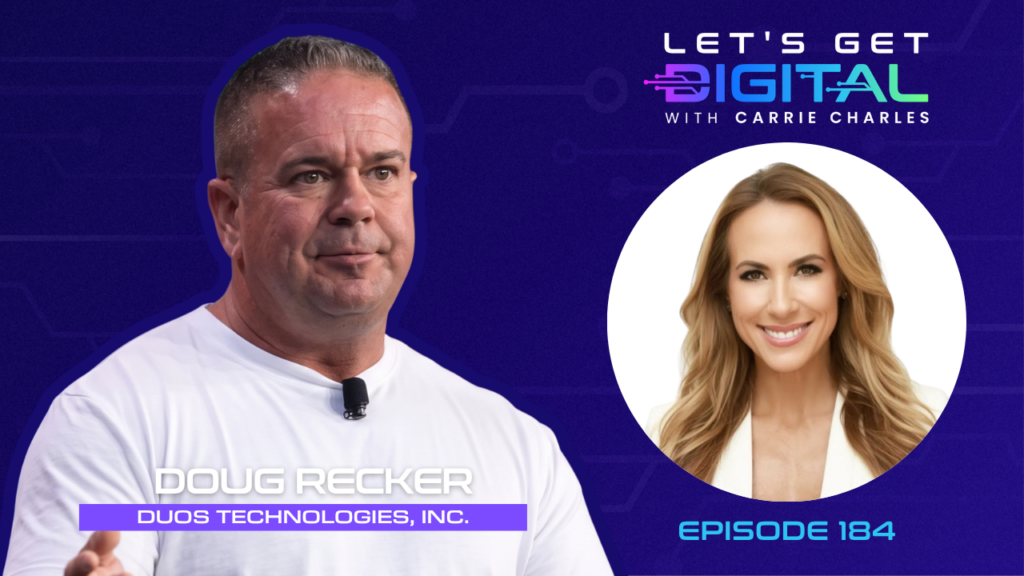
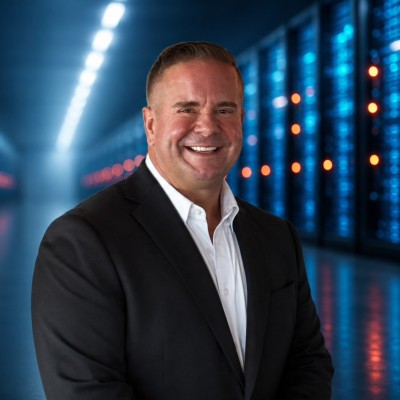
00:00 Ready to explore the cutting edge of digital infrastructure? I'm Carrie 00:04 Charles, your host of Let's Get Digital. Join me as we dive into the ideas, 00:09 technologies, and leaders transforming the way we connect. From wireless 00:13 telecom to fiber networks, data centers, and beyond. Sponsored by Broadstaff 00:18 [music] in partnership with RCR Wireless News. Now, let's dive in and let's get 00:24 digital. Welcome to Let's Get Digital. I'm Carrie 00:28 Charles and I am glad you're here. I have with [music] me today Doug Recker. 00:33 He is the CEO of DUOS Technologies Group and [music] he is going to tell us all 00:40 about that company and the companies that are under that umbrella and all the 00:46 exciting things that are happening there today. So, Doug, thank you for joining 00:50 me. >> Thanks for having me. I look forward to 00:52 this all month. So, I'm so glad I'm finally here. 00:55 >> I am so glad, too. But first, you were a Marine. 01:00 I was a Marine. So, that's what you are. I'm sorry. 01:03 >> You're just [laughter] old and ugly. That's all. Old and ugly. That's all. 01:06 >> I can't believe I said that because I'm not supposed to say that because I was 01:10 in the Marines. Once a Marine, always a Marine. Okay, let me rephrase 01:14 that. You are a Marine. I'm a Marine. So, 01:18 it's just >> [laughter] 01:19 >> I'm I'm kind of old, too. But that's okay. That's That's a whole other 01:22 podcast. >> So, yeah, the the good old days. That's 01:26 right. >> Yeah, yeah. And tell me about that. Tell 01:29 me about your journey and and how you got from there to where you are today. 01:34 >> Yeah, so basically, in high school, you know, I I wrestled and played football 01:38 in high school and since I was a young kid and I decided really my junior year 01:44 in high school that college probably wasn't for me. I was real big into 01:47 athlete that, you know, I was a athlete and I loved working with my hands. I did 01:51 in the summer times I work construction and did all that. So, my family was 01:55 like, "The best thing for you is to go into the military." So, I thought about 01:59 it and I I went to the recruiter's office and I said, "What is that guy in 02:02 the swamp that's coming out with that M-16?" At the time I didn't know what it 02:05 was, but what is that guy? I want to be that guy. And he said, "Oh, that's an 02:08 0311." And I'm like, "Put me down. I'm signing up for [laughter] an 0311." 02:12 Well, I found out later you don't want to be an 0311. I mean, you do, but 02:17 it's a lot different than being in the Air Force or anything like that. So, 02:20 boot camp was fun, you know. I'm kidding, but yeah, I went to Parris 02:23 Island. I'm not sure where you went, Carrie. Did you go to Parris? 02:26 >> Parris Island, I did. >> So, I went to Parris Island and did that 02:29 deal and I realized that I was in shape, but the mental part I wasn't ready for 02:33 that. But, it was the best thing that ever happened to me. So, I spent most of 02:36 my time down in Camp Lejeune. And then when I the most interesting part about 02:41 my story is when I got out, you know, when you get out of the the military and 02:45 you're an 0311, you're like, "Well, what am I going to do?" What, you know, I 02:48 could be a cop, I can do security work at the White House, whatever. Really, I 02:53 wanted to figure out how to get out of that and make money and use my My mother 02:58 always said, "You're a born salesman." So, that didn't work for me in the 03:01 military. So, I said, "I'm going to try this." So, I started my career when I 03:06 got out and gosh, this was '93, '94, going door-to-door selling long 03:10 distance, believe it or not. That's how I started my career was working for a 03:14 company called MCI. I don't know if you remember them, but right after AT&T, you 03:19 know, did the deregulation, I started work for MCI and nobody knew who MCI 03:23 was. I'd go to small towns selling like beauty shops and you know, the fire 03:28 department, all that this long distance because it was a long distance call just 03:32 to call down the street. So, I started doing that and I actually learned how to 03:37 sell going door-to-door because the company at the time I worked for, they 03:41 would only pay for your hotel, your motel that night if you sold X amount of 03:45 phone lines. So, it was a rough cycle in the first, I 03:49 would say, 3 weeks, right? So, living in my little Honda Civic, I learned how to 03:52 sell cuz I got tired of sleeping in it. Even though I'm only 5'5", I got tired 03:56 of sleeping [laughter] in that Honda Civic. 03:58 So, that's really where I picked up my skills selling, and then I sold a a very 04:02 large company, which basically was called Florida Travel Network that had 04:07 all these phone lines, and they did uh reservations for like Delta Airlines. 04:11 So, instead of selling one, I sold a couple thousand at one pop, and really 04:15 made a name for myself. And then, I started working for the fiber companies 04:20 like Intermedia, and then I finally ended up at a company called Telco, 04:24 which turned out to be Level 3. And when I was working at Level 3, I actually 04:29 moved down to Jacksonville, Florida, where I am today, like 25-plus years 04:33 ago. And I came across the building that was 04:37 an old building that used to be a data center for Bank of America. And I had a 04:42 sales rep with me at the time, and I said, "Let's go call on that building. 04:45 Somebody bought it. They're obviously going to turn it into a data center, and 04:49 they need fiber." So, I went out there, we cold called it, and there was two 04:53 gentlemen standing in the lobby, and they were ripping out all the raised 04:56 floor. And I asked the guys, "What are you doing?" They said, "Well, we're 05:00 Well, we bought this basically prison. It looks like a prison. It's got 18-in 05:03 walls, no windows, and we're going to turn it into $12 a square foot office 05:07 condos." I said, "Are you kidding me?" I said, "This is a bunker. This is a data 05:12 center." They didn't know what that was. And I said, "Look, hold off, stop doing 05:16 all this. I'll show you a business model where I'll get you $126 a square foot." 05:21 So, I said, "Give me 2 weeks to put the model together." So, basically, about a 05:25 a week later, I put the plan together, I pitched these two gentlemen, and they 05:28 said, "Let's give it a shot." So, I literally lived in that building in a 05:32 tent for 8 months. >> Oh my gosh, you did not. 05:36 >> Yeah, it is a 120,000 square foot building, and it had the bones, and it 05:41 did have three generators that were in there for years, and they still worked. 05:44 But, that raised floor was concrete filled. I had to put all the raised 05:48 floor back in, so it was about 5,000 sq ft of raised floor. I had to put that 05:53 back in. I did that myself. And then how I was funding the project, you'll get a 05:57 kick out of this. All the cabling that was in there, all the old Cat 5 that was 06:01 in there, just copper that was in there, I would take every day and take it to 06:05 the recycling plant, and that's how I lived every day off that. 06:08 >> Oh my gosh. >> I helped pay other people to help me rip 06:12 stuff out with that money. So, it was a great idea. So, I built my first 5,000 06:17 sq ft out, and it was a 120,000 sq ft building. 06:20 Long story short, I got my first customer in there. There was two guys 06:24 that were came in, weren't data center guys, and I needed more capital. So, I 06:28 went to a bunch of angel investors here in Jacksonville. They put a little bit 06:32 of money in, three or four million dollars in, which was a lot. We built 06:35 that facility out, got it to about 70% capacity, then I built a new one from 06:40 the ground up right outside of Tampa. And that was 2008. We sold it in 2014 to 06:46 Telogix, which was a big data center outfit, and did very, very well. So, it 06:51 was a great experience for me. I built two data centers from the ground up, 06:55 filled them, and basically with five or six employees, we did all that work. So, 06:59 it was great. Had a five-year non-compete because the people that sold 07:02 it were very smart, so they locked us up, but they paid us very well. And in 07:06 that five years, what I did is I developed this modular approach because 07:11 I knew the tier three and tier four markets eventually were going to be 07:15 where communication, where network is going to be more robust because 07:18 everybody is using their phone. At that time, the data on your phone, what I 07:22 call the eyeballs, is where the data is. So, I don't care if you're in a 07:27 Savannah, Georgia, or you're in Atlanta, you the people still use and want to use 07:31 the same amount of data on their phones and get access to better connectivity. 07:36 So, I built those out, started a company called Edge Presence. And Edge Presence, 07:40 when I launched that, we did a lot of the 5G rollout for Dish. 07:44 And then I ended up selling that about 3 and 1/2 years ago, 4 years ago now, to 07:48 Ubiquity Fiber. And I had a 1-year non-compete. And then that's where the 07:52 story begins. That's when, after that year was up, my old investor said, 07:57 "Look, you need to get access to public capital because this is big now. I mean, 08:01 you've proven you can do the modular thing, but you need access to 50 plus 08:05 million dollars to really do it right." So, what I did is I found a company in 08:10 Jacksonville that was close to being delisted from Nasdaq. What they did, was 08:15 called Duos Technologies. What they did is they had this train monitoring 08:19 software. And it just It's a great product. It just wasn't selling. So, the 08:23 stock was about a dollar 60, dollar 40. I came in and I said, "Look, we should 08:29 turn this business into a data center-centric business. AI is about to 08:32 blow up. And what I have is proven. I can show you it works. I've sold the 08:36 companies. I've been doing this 30 years. I know there's a need for this." 08:40 So, the investors and the board said, "Sure, we'll give it a shot." So, now 08:44 we're I think we're sitting at right around $12 a share, or a little over. 08:48 Actually, it was at 15. So, what we're doing now is the same model, but we're 08:54 going into tier three and tier four markets. We're deploying these pods, as 08:58 we call them, to create better connectivity in these rural areas. So, 09:02 what we do is we partner with the school system and the healthcare system in that 09:06 market and the local community, the local government. And we build these, 09:11 basically, interconnects. We put carriers together so they can peer, and 09:16 the connectivity is better in those markets. Well, as we were doing that, in 09:20 last July, we went out and raised our first 45 million dollars. To prove this 09:24 concept out, we were going to launch 15, basically, pods in these markets, 15 09:29 different markets. So, we deployed 90% of them in Texas. So, in towns like 09:35 Dumas, Waco, Lubbock, Amarillo, all the smaller markets. And we were proving 09:40 that you could actually do do a lot of good in these markets without bringing 09:45 the connectivity up cuz connectivity is terrible in those markets. So, as we 09:49 were building those out, and we did we did the 15 by the end of last year, 09:52 which is what we committed, but we were getting calls from all across the 09:55 country asking if we could do a megawatt. And we're like, well, we built 10:00 these out at 300 kW. These aren't These are small pods, right? And I'm like, why 10:05 would somebody want a megawatt in Corpus Christi? Why would you want that in 10:09 Dumas or Lubbock, Texas? Well, what we found out is these folks are sitting on 10:14 GPUs and they want to burn them. These Neoclouds, these smaller ones, they have 10:17 these clusters they need to burn. And they've been sitting on them. They can't 10:20 find two to three meg in data centers. The legacy data centers don't have it or 10:26 they're not selling it because they're waiting for the 10-15 meg clusters. 10:30 They're waiting for the bigger users, right? So, we just realized there's a 10:34 huge opportunity in the one to 15 meg. Huge. So, I went out and met with 10:39 Supermicro and we went to GTC, met with Nvidia, and met with one of our new 10:45 partners, which is Hydrohost. And they said, yeah, if you build two meg to five 10:49 meg in that area, there's a ton of opportunity. So, what we decided to do 10:54 is we went out and bought our own cluster. We bought 144 million dollars 10:59 worth of GPU, over 2,000 of them. And we wanted to show to the market that we 11:03 could deploy these in a modular environment and deploy them quickly and 11:08 at scale. We went out and raised capital in February. We raised 65 million to 11:13 basically to launch this product. And now that the overwhelming response, it's 11:18 been crazy about how there is a need for two, seven, 10 meg clusters and to grow 11:25 those. So, if we can build those quickly and go into these tier three markets, 11:29 we're killing two birds with one stone. What we're doing is we're building that 11:32 infrastructure out in that community, but now we're also bringing the somewhat 11:37 the AI workloads into those areas. We're not using water, and what we're doing is 11:41 we're going to where we call stranded power, where there's basically power at 11:45 that substation that they've built and they're waiting on growth and it hasn't 11:49 happened. So, we can actually bring revenue dollars there, we can bring tax 11:53 dollars there. So, it actually helps the community. And that's what we're doing 11:57 now. Like, prime example, we had our open house in Lubbock and in Corpus 12:01 Christi a couple weeks ago, and there were people there just all upset about 12:05 the water usage, right? We had to explain that. So, our new marketing tool 12:10 is, when we do an open house, we come out with $200 and we ask people, "You 12:14 get $200 if you show us where the water line is on this property." Cuz we don't 12:19 even have a water line. So, then they're like, "Oh." And then they walk away cuz 12:22 they don't understand what we're actually doing. They don't understand 12:25 what a closed-loop system is, they don't understand what DX is. You know, it's 12:29 just like a unit in your home. So, it's about an education right now, but it's 12:33 working and it's taking off. So, then the last piece is, just last week we 12:38 closed 55 more million, and that is to increase our basically our workload to 12:44 deploy these. So, now we're going into Columbus, Georgia, we're going into 12:48 Iowa, we're going into possibly up in New York. Uh we have two sites in Texas 12:53 that we're building out now, and these are at a minimum of 5 MW. And we're not 12:57 going further than 10 to 15 range cuz we're not going to build 50 MW or 30 MW 13:03 sites. That's not what we're doing, but we're building a lots of these little 13:06 clusters everywhere. Sorry about that data dump. I have a certain flow, so it 13:10 makes sense. >> Oh, it was great. I absolutely love that 13:13 story. Wow. 13:15 >> Yeah. >> So, before we move on though, you you 13:17 mentioned closed-loop system and there could be people listening that don't 13:21 know what that is. Can you explain what that is? 13:23 >> So, the basic way to explain it to people that don't understand is we keep 13:27 water in a system and it recirculates, right? So, we're not taking outside 13:32 water in. So, whether it's a mix of chemical or water, it's a closed loop. 13:36 So, basically means it it stays in that system. Very very little do you need to 13:41 add to it if any. It just depends. But, yeah, it doesn't use more than a gas 13:45 station would use. >> So, you I mean, explosive growth and 13:49 opportunity and I mean, so much has happened in such a short period of time. 13:54 Where do you see this thing going? Like, what vision are you running after? 13:58 >> Yeah, so the best way to put this is we know that data needs to compute locally, 14:03 right? And whether it's inference, whether it's for autonomous vehicles or 14:06 whatever, that data needs to be close to the user. So, you could look at these 14:11 and have all different shapes and sizes. They could be, you know, a a cabinet or 14:16 a pod of 15 cabinets or you could have a cluster of 30 or 150 or you could have 14:21 two. So, what we see is a huge demand for this at all different sizes. Our 14:26 focus is probably in the We don't really go by cabinets anymore. It's by 14:31 megawatt. Everybody judges by megawatt. So, the 1 to probably 15 megawatt is 14:36 really where our sweet spot is and we'll deploy these clusters all around. So, 14:41 our mission right now is wherever we can find stranded power where it's not 14:45 affecting the community and preferably in the tier three markets where it's 14:49 it's kind of like 60 to 120 miles outside the main areas where our main 14:53 pop is. Like, just right outside of Chicago or even Columbus, Georgia, which 14:58 is I believe only like 100 110 miles maybe outside of Atlanta. So, it's 15:04 somewhat close and you're still getting that two millisecond fast speed, lots of 15:08 internet, lots of fiber out there. That's really our niche and I think 15:13 you're going to see a lot of other folks jumping in the game. I mean, you see 15:17 like the great people that are great in the business like Caruso, right? They're 15:21 they're starting with the Spark model, which is you know, it's bigger than 15:25 ours, but it's the concept is the same and you'll start to see that whether 15:28 it's putting one behind every Walmart or at every distribution center for FedEx, 15:33 it all needs to be close to where the compute is. So, whether it's a small 15:38 device or big and our range is in that 1 to 15 MW range. 15:43 >> Which is the term deploying at the edge, right? 15:46 >> That's right. That's what we call exactly right. And here's another fact 15:49 for it. Here's an interesting fact. So, remember those data centers that I built 15:52 that are they're the bigger ones, right? Back then they were 2 to 3 MW and we 15:56 thought we were the big guy on the street, right? Cuz 15:59 MW back then was a lot, right? In 2012. But what's happening now is say my old 16:05 facility in Jacksonville, it's a beautiful facility. It just it's 16:09 landlocked, right? They can't add 10 more or 5 more MW to that facility cuz 16:13 there's no place to put the generators. There's buildings all around. So, you 16:17 can't do that. So, now the customers that are in there, they're switching to 16:21 AI workloads, they're like, "I'm at 15 KW cabinet. I need to go to 65 KW 16:26 cabinet." They can't do it. So, the new people that are building the 5 to 30 MW 16:32 sites or 15 MW sites, I think that's a huge market for enterprise and retail. 16:37 Absolutely. I think the market is not focused on that right now. They're the 16:41 big eye in the sky, the big prize in the sky is these huge gigawatt factories and 16:45 stuff. They're missing the fact that let's just say the let's say like a Blue 16:50 Cross or a Johnson & Johnson or a FedEx or somebody like that that is changing 16:54 their model, where are they going to go? They can't grow anymore in their 16:58 existing facility. So, I think those who come out of the market and start looking 17:02 at those are going to win. >> So, you also have a use case where 17:07 you're deploying at and helping farms, right? Like 17:10 >> What what they're what they're doing what they're doing like in these small 17:13 towns where there's farming, they want to go to drones. They want to go to 17:17 autonomous vehicles to actually study the water tables, 17:21 watch cattle behavior and all that. They can't do that without having compute 17:25 close. So, that's why they're looking at our facilities like in Amarillo. Those 17:29 big ranches and stuff, they don't have places on their ranch to cool this kind 17:34 of equipment. They don't want to mess with that. So, the third parties are 17:36 looking to collocate those. And why would you go all the way to Dallas, 17:40 which is say 300 miles away, when you can actually put it in the town that 17:44 they're So, that's those case studies that are happening now, which are going 17:47 to be very interesting. And it's pretty cool what they're doing. 17:50 >> What about security? How do you keep these pods secure? 17:54 >> So, basically on the smaller pods that we do, say the 300 kW pods, there's a 17:58 fence all the way around them. And then we have two knocks, network operation 18:02 centers, that monitor the cameras and the door access control from Amarillo 18:07 and here. So, we have two knocks, Jacksonville and Amarillo, that watch 18:10 that behavior all the time. And we can see who comes and goes. There's a lot of 18:15 alarms and everything. Every inch of the outside and inside is on camera. And 18:18 then we also have what we call an auditing standard on how you walk into 18:23 the pod. We actually have a patent that we got in September, which is very big 18:27 for what we do. And this is exciting. So, over the years when I built these 18:31 modular data centers, over time what happens is, you got to understand when 18:35 you walk into a modular data center, you open door, you're in the data center. 18:39 So, unlike a traditional data center, you go in, you go to the guard shack, 18:43 you walk down the hall, you go into the data hall. So, all that dust and 18:46 everything's filtered. Well, when you open the door, you've got basically 300 18:50 sq ft of just strong vacuum of AC, high pressure. So, there's only so much the 18:56 filter can take on that AC unit. The fans start picking up some of that dust. 19:00 So, what we noticed over the years is over a year or 2 years, those fans start 19:04 getting dust on them. So, I filed for a patent, which is called a clean room, 19:08 which have been around for years, but in like in labs and things like that, 19:12 right? But not for data centers. So, our patent is basically for a modular data 19:17 center. When you come up to the data center now, there's a room that's 19:20 attached to the pod or to the modular data center. You open that door, there's 19:24 two-level authentication. So, there's a a badge and a four-digit code. So, you 19:29 put your badge, four-digit code, you walk in, it releases the door, you walk 19:32 in. When that door shuts, the air curtains come on, the air filtration 19:36 comes on for about 30 seconds. Then the green light'll come on, the fans will 19:40 stop, and you do the same procedure to enter the door into the data center, 19:45 which is the five and four number authentication. Then you walk into the 19:49 data center. So, that mantrap or whatever you want to call it works as an 19:54 auditing standard, and it gets all the filters filters all the particles, 19:57 pollen, and what's interesting is I've been working on that patent for years, 20:02 but what we found out is GPU are extremely sensitive to dust and pollen 20:08 and all that. So, now we have that in place, it helps us deploy this cuz you 20:13 got to remember, I'm deploying $144 million of the GPU in that kind of 20:17 environment. I'm not going to risk it not having a clean room. So, that was a 20:21 big accomplishment for the company. So, we're excited about that. 20:24 >> Huge, huge. Now, you have a DUOS Technologies Group is comprised of two 20:28 companies? >> Yes, so DUOS Technologies Group, DUOT, 20:32 is our public entity. That's the public company that I run. Underneath there, we 20:36 have two companies, which is DUOS Edge, that's the deployment of our data 20:39 centers and our modular data centers. Then we have the DUOS Infrastructure 20:43 side, which is Infrastructure Technologies Group, and what that does, 20:46 and this is pretty cool, what that does is it sells actual infrastructure to 20:50 data centers. So, we sell anything from PDUs to cabinets to anything a data 20:55 center would need. So, actually that group is doing extremely well right now. 20:59 I think we've sold over $15 million of the product this year already. 21:03 >> So, Doug, your energy is off the charts. I'm so excited. I want to come work for 21:10 you. What Tell us 21:13 I mean, this is just so great. Tell me about the culture of your company, what 21:16 you're building, you know, how you hire. Let's get into the inner workings of the 21:21 company a little bit. >> Sure. So, you'll see a lot of the folks 21:24 that work for us now have worked for me in all my companies. So, and that's a 21:27 good sign. That means they like the environment that we create and we're all 21:31 a team here and we keep this culture where it's really don't have titles, 21:35 right? Everybody has a job to do and a prime example, this deployment we're 21:39 doing right now in Columbus, Georgia, we're 7 days a week, 24/7. So, we 21:43 actually had a meeting on Sunday on Father's Day and every It's voluntary, 21:47 you know, it's not like you have to do this. Everybody wants to do it. So, 21:51 we've created that culture and the families that they have have the same 21:55 culture. They've created that at home, too, which is amazing to see because if 21:58 you have everybody on board, things work better, right? The system chugs, it does 22:02 so well. So, we're excited about that. When we hire and bring people in an 22:07 organization, we kind of look for the same thing. We're a lot of us are 22:11 military, but it's more like team environment that we create. And when I 22:14 say team, I mean team. So, that means the family, everybody is involved with 22:19 this. So, we try to do things together all the time, but it's like we're 22:23 working together anyway. So, when you leave here, you don't want to be with 22:26 the people. But, it the culture that we bring is like me. They're excited. We 22:31 reward winning as a team and everybody wins. So, it's just like our 22:35 compensation plan. It's not individual based, it's team based, right? So, when 22:40 everybody does well, everybody gets compensated. So, and we try to keep 22:44 everybody on the same playing field. I mean, there's like I said with the 22:48 titles thing here, we have a chain of command, obviously, but it's open door 22:53 policy and we love having people in the office. We do have remote people, but we 22:59 love having people here, too, so we can feed off of each other. Like we have a 23:03 war room set up right now for two of our locations and I can't find anybody and I 23:07 walk down the hall and they're all in there. And that's comforting to me cuz 23:10 that means we're all all minds are working together and that's when you 23:14 win. It's great to have all these great minds together. So, that's the culture 23:18 really that we create. >> Speaking of great minds, are you having 23:22 challenges finding talent? I know it's really tough in the data center world 23:27 right now. >> Yeah, you know where we are where 23:29 actually having challenges is these sites. Prime example, when we go in and 23:33 we build like we'll use Columbus, Georgia again. Once we built this site, 23:37 it's hard to find the electricians and all that. But also once we get the site 23:42 built, it's actually hard to find people that are interested in working in the 23:46 knock and actually doing the actual rack and stack and things like that. But now 23:51 that the jobs are paying very well, we just need to get that out there, right? 23:55 Like prime example, my my stepson prime example, he's going to 23:58 be a electrician and that's the best thing for him. And I told him I said, 24:02 "Look, they're at $180 an hour some of them now. It's It is crazy. It's great. 24:07 It's great work too and it's a great career path. So, yeah, it is 24:10 challenging. >> So, last question for founders that are 24:14 listening, tell me the principles that you believe matter the absolute most 24:19 when you are building a company. >> The biggest thing is what I talked about 24:24 before is team. You have to have people that are willing to be a part of a team 24:28 and they have to I can tell when I talk to you if I'm interviewing you if you 24:32 have the passion that we're looking for, right? So, hire people with the passion. 24:38 When you're interviewing them and I tell people this when I coach them too about 24:41 interviewing like my son's friends and stuff. When you show the energy, 24:45 believe, study what you're going in to look to do and have the passion behind 24:50 it because people buy from you, people believe in you on what you're putting 24:55 out there, right? So, look at we've raised gosh, over 140 million dollars in 25:01 less than a year and it's not necessarily the product. Anybody can 25:05 create the product. What's raising that money is the team that we have, the 25:09 vision that we have and how we implement and we do what we say we're going to do. 25:14 That's the key. They're not giving us money because we have a clean room. No, 25:18 they're giving us money because they know the passion that we have and we see 25:21 that marketplace. We see that target and we're all headed towards it and it the 25:26 story doesn't change every time I get on the phone with my investors and this is 25:31 for people that run public companies, too. I've always owned private 25:34 companies. This is my first public company 25:37 and I've always talked to my investors because before I had to go to my 25:40 investors' living room and get a check, right? So, when you run a public 25:43 company, there's a lot of people that run public companies that don't feel the 25:47 money. They don't have a tie to it. I was brought up differently from my other 25:51 investors that I had. When you give me a dollar or you give me 5 million, I take 25:55 your call. Every investor, it doesn't matter. Take their calls, answer their 25:59 questions because they gave you money and they believe in you. Make sure they 26:03 still believe in you. That's the key. >> Doug, I just wish we had hours and hours 26:08 to talk. Thank you so much. I am just so revved up from this conversation. You 26:12 changed my life today. Thank >> No, but it's it's fun. It really is and 26:17 this is my third venture and you know, I try to keep that philosophy going 26:21 forward, but that is you know, if I ever write a book someday, that's what I'm 26:25 going to talk about is the difference between a private public company. If you 26:29 treat your public company like it's a private company and you look at 26:33 everything, you think about oh, I got to go to their house tomorrow and explain 26:37 why this happened, you're going to win. >> Brilliant, brilliant advice. We need to 26:42 rewind that and hear it >> That's my advice. That's my advice. 26:45 >> I know. I think it's brilliant. It's brilliant. 26:49 Doug, thank you so much for coming on the show. Thank you. 26:52 >> I look forward to doing this again hopefully soon. We'll have some more 26:54 good news. >> Let's do it. You take care. 26:57 >> You too. Thank you. >> Thanks for tuning in to Let's Get 27:01 Digital. This podcast is powered by Broadstaff, a national staffing firm 27:06 specializing in digital infrastructure talent. Don't forget to subscribe, leave 27:10 a review, and join me next time as we explore more stories at the intersection 27:15 of technology, [music] talent, and transformation. Until then, 27:19 let's get digital.
No matching passages. Try another word.