

Table of Contents
Understanding the NTN opportunity as D2D goes mainstream
As mobile network operators increasingly partner with the satellite industry to augment terrestrial network connectivity with non-terrestrial network (NTN) systems, the big question isn’t whether orbital connectivity can connect to mobile devices. NTN-based coverage expansion has been demonstrated at scale. The more consequential question is now around industrialization: who can manufacture, launch and operate enough capacity, at sufficiently low cost, to turn technically viable services into a durable mass-market business.
That transition is visible across the broader space economy. The Satellite Industry Association put commercial satellite-industry revenue at $303 billion in 2025, within a $429 billion global space economy. During the year, the industry recorded 325 launches, deployed 4,434 satellites and surpassed 10 million satellite-broadband subscriptions. Broadband subscribers increased 62%, although associated revenue grew a more modest 16%. This is driven by SpaceX’s satellite-based broadband business Starlink; Starlink has also partnered with mobile network operators like T-Mobile US for direct-to-device (D2D) services.
The divergence between subscriber and revenue growth is instructive. Satellite broadband is expanding rapidly, but much of that growth is coming through lower-priced services and into geographies where average revenue per user is comparatively limited. The market is demonstrating strong demand while simultaneously placing greater pressure on providers to lower the cost of capacity, customer equipment and service delivery.
To better understand the dynamics shaping the relationship between MNOs and satellite operators, RCR Tech sat down with Satellite Industry Association President Tom Stroup. The following Q&A is adapted from an interview with Stroup.
Q: The satellite industry is setting records across launches, number of satellites put into orbit and adoption of broadband services delivered from orbit. Can reflect on some of the fundamental changes in the economics and utility of satellites over the past few years that gotten us to where we are today.
A: The economics and the utility have changed substantially, and pretty much every sector of the industry has contributed to that. Starting with manufacturing, we’ve been able to take advantage of mass manufacturing techniques, automation, software-enabled design [and] configurable platforms to really drive down the cost of manufacturing…We’ve seen a dramatic decrease in the cost per kilogram of launch over the course of the last 10 years, and even much more if you go back farther than that. And much more availability. The cadence of launches has just picked up tremendously, so for anybody seeking to put assets into space, you’ve got much greater ability to be able to access launch. But it doesn’t stop there. The terminal sector of the industry has also seen a significant decrease in costs. Reflecting back on when I had first joined SIA, I was at an event where a terminal manufacturer was asked, “When am I going to be able to get $500 terminals?” and the response is, “When am I getting an order for a million terminals?” We’ve gone well past that. The cost of terminals is now well under $500. So we’ve seen just innovation across all sectors of the industry. The costs have come down and just in terms of the utility, much faster speeds, more capacity, especially as it relates to broadband services…it’s just a sea change from 10 years ago.
Q: With regard to D2D services, how significant do you think this will become over time? When do we move from D2D for emergency text services to something more mainstream and broadly applicable?
A: This is one of the most fascinating areas of the industry from my perspective, having spent most of my career in the terrestrial wireless industry and seeing the marriage of these technologies is wonderful…It wasn’t that long ago, probably about 10 years ago, there were real questions as to whether you could do it, whether it was technically feasible to be able to provide this service. But from the satellite carriers’ perspective, there is no market that’s comparable in terms of size with over 8 billion mobile devices. Even a fraction of that market greatly exceeds the customer base of any sector of the satellite industry…There have been various studies that have talked about willingness of mobile customers to pay extra for that service, and certainly there’s a variation from one report to the next…I think that probably those in underserved areas of the world see much greater utility than those people who live in cities as an example.But nevertheless, it’s a huge opportunity for the industry and and I think that part of it is just deploying the capacity to be able to expand beyond text and emergency messaging to be able to provide full broadband capabilities…It’s just a matter of being able to deploy the assets in space in order to make that happen.
Q: In the 5G cycle, NTN was put into the standard roughly half-way through. The vision for 6G is native inclusion of supports for NTNs, then in the future, a seamless convergence of terrestrial and non-terrestrial networks. In practical terms, what does that integration look like for the operator and the end user?
A: From an operator perspective, it’s not just the seamless capability of terrestrial and non-terrestrial. I think that being able to add in AI capabilities so you’ve got the ability to optimize your network, take advantage of more efficient utilization of spectrum, identifying when maintenance is required…Those are some of the things that I think they’re going to see with 6G. From a user perspective, obviously the seamless service that they’ll provide. But I think that one of the really fascinating opportunities for 6G is that we probably haven’t seen the applications that are really going to drive it. I mean, again, going back to some of the early days of the wireless industry, the applications for which mobile phones are used today couldn’t have been imagined just because we didn’t have the capacity. We didn’t have the digital throughput, we did not have the internet for that matter. I think that when it comes to the user experience, it’s going to be seamless for applications that haven’t even been invented.
Click here for the full interview with Stroup.
D2D needs a reality check on consumer expectations
D2) satellite connectivity has moved beyond the conceptual stage, but the industry risks undermining its commercial potential by allowing future performance targets to define consumer expectations today. That was the central message from Opensignal Principal Analyst for the Americas Fiona Armstrong-Mills; she described the emerging D2D market as being at an inflection point between standardization and real subscriber experience.
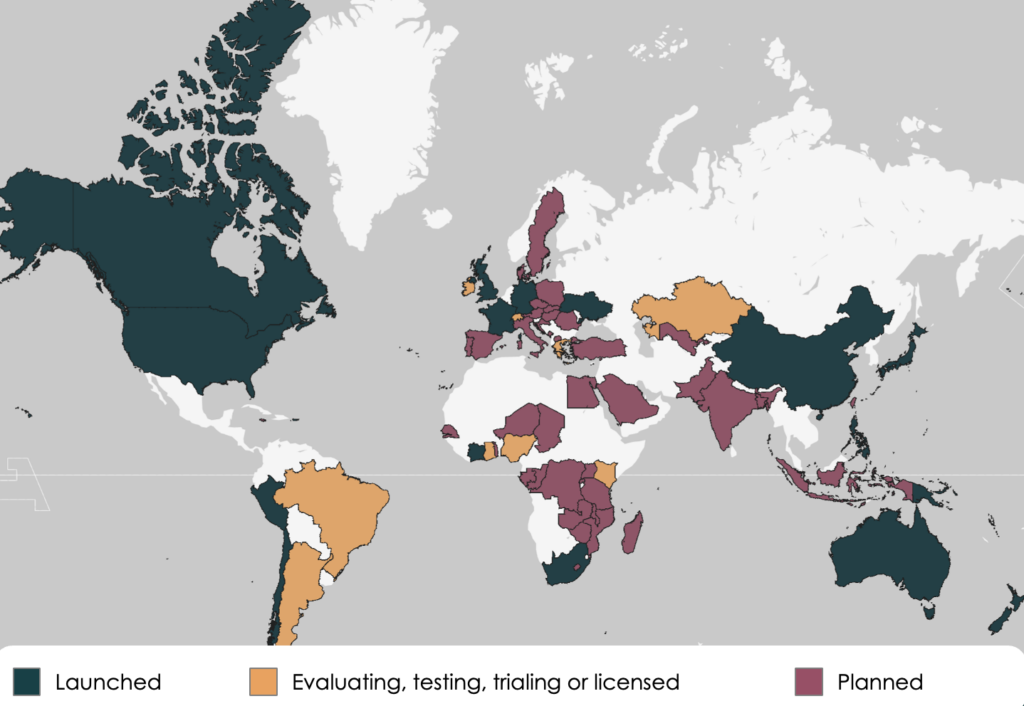
Approximately 45 mobile operators already have D2D services live or in trial, with many more evaluating partnerships, pursuing licenses or planning launches. That scale makes satellite-to-handset connectivity “an active test requirement,” rather than an issue that can be deferred until 6G or 2030, Armstrong-Mills said.
The immediate value proposition is clear. D2D can provide basic connectivity in rural and remote areas where terrestrial networks are unavailable or economically impractical. Even in developed markets, Opensignal users spend up to 1% of their time with no mobile signal.
But current satellite services remain constrained by limited capacity, line-of-sight requirements, moving satellites, handovers and variable connection quality. Armstrong-Mills recounted reports from colleagues who spent minutes “waving their phones in the air” to establish sufficient visibility to send a text.
That experience sits uneasily beside industry discussions of much higher future performance. Starlink has targeted D2D speeds of 150 Mbps by the end of 2027, while other providers are pursuing broader voice and data capabilities. Those ambitions are important for network planning, but Armstrong-Mills cautioned against applying the language of terrestrial LTE or 5G to services still primarily designed as a last-resort connection.
“Users are being primed by headlines, by launch announcements, by those 150 megabits per second numbers to expect a comparable service,” she said. “But that…shouldn’t be the true expectation. That’s not the true experience.”
The commercial stakes are significant. An Opensignal poll found that most respondents would use D2D if it were available, but only 47% were willing to pay more. Convincing consumers to pay a premium will therefore depend less on peak throughput than on dependable performance for the specific services being promised.
“We do need to get just a little bit closer to that reliability piece, that consistency of connection, before the monetization opportunity can come…I’m not going to pay for it if I don’t have a good experience even sending that text,” Armstrong-Mills said.
Opensignal’s proposed measurement framework begins with four principles: NTN constraints are physical realities; field conditions must define testing; terrestrial service remains the user’s reference point; and reliability is table stakes. Useful metrics may include connection time, message-completion rates, application success, availability and performance in rural or in-motion conditions.
“Users don’t reset their expectation just because the signal came from space,” Armstrong-Mills said. “The phone in their hand is the same. The apps are the same.”
To be clear, D2D is succeeding by many metrics, but the industry must define success accurately. Satellite connectivity can create substantial value by replacing no service with usable service. Establishing that value, and eventually monetizing it, will require measuring what customers actually experience rather than what the network may ultimately be capable of delivering.
NTN standards evolution on the path towards 6G
D2D services served by NTN connectivity is often discussed as though it were a single technology. In practice, the label covers both services that connect existing phones through largely unmodified cellular stacks and newer 3GPP-defined non-terrestrial network capabilities designed specifically for satellite links.
“The direct-to-device term is a bit overloaded,” said Obilor Nwamadi, senior product manager at VIAVI Solutions. Today’s unmodified systems can use existing cellular technologies without requiring the device to recognize that it is communicating through a satellite. That approach offers immediate compatibility with conventional handsets, while shifting responsibility for compensating for Doppler, delay and other satellite-link dynamics toward the satellite and radio network.
Release 17 changes that model. The handset becomes aware of the satellite environment and uses its own GNSS-derived position, together with information about the satellite’s location, to estimate and pre-compensate for Doppler and propagation delay. “The UE is now responsible for managing the dynamics of the satellite link on the service link,” Nwamadi said.
According to Nwamadi, making the device responsible for managing those conditions can improve the gain available from the satellite beam and provide a stronger technical basis for voice, messaging, data and IoT services such as tracking and monitoring.
Release 18 expands the standards framework toward broadband. VIAVI’s roadmap highlights wider channel bandwidths in Ka-band, support for very-small-aperture terminals and electronically steered antennas, and mobility enhancements covering terrestrial-to-NTN transitions, satellite switching and handover. Coverage improvements, including repetition and reference-signal changes, are intended to strengthen the challenging uplink from terminals to satellites.
Release 19 adds further spectrum and capacity options. Ku-band support can enable both direct-to-handset and terminal-based services, while a new 3 megahertz NR bandwidth gives operators greater flexibility in constrained mobile-satellite-service spectrum. RedCap support extends NTN toward lower-complexity devices, and additional uplink and downlink enhancements are intended to allow more terminals to share the same satellite beam.
The service progression is cumulative. Unmodified systems currently emphasize emergency communications and messaging. Release 17 provides a standardized foundation for IoT, voice and data; Release 18 moves toward fixed wireless access and true broadband; and Release 19 increases capacity, reliability and scale.
“6G will not do away with everything introduced in 5G advanced for NTN,” Nwamadi said. “6G will build on the technologies from release 17, 18 and 19.”
Potential 6G enhancements include GNSS-resilient operation, multi-satellite connectivity, carrier aggregation, spectrum sharing and satellite-based positioning, navigation and timing. AI-assisted channel compression and beam management could also improve how networks respond to changing link conditions.
The longer-term objective is a 3-D network combining terrestrial cells, low-Earth-orbit satellites and geostationary systems. The layers would deliver different levels of performance, but mobility mechanisms could move devices among them based on time, distance and predicted satellite position.
Managing that environment will require more than conventional optimization. “Digital twins become a really really important tool for optimizing this type of 3-D network,” Nwamadi said.
AI can then build on those models to coordinate moving devices, satellites, terrestrial cells and changing obstructions. The goal is not identical performance across every access layer, but a network capable of selecting and optimizing the best available connection as terrestrial and non-terrestrial systems progressively converge.
From D2D services to 3-D networks
NTN technologies are moving from the margins of the communications market into the strategic planning cycle for mobile operators, satellite providers, device makers and policymakers. The immediate catalyst is D2D connectivity, which has demonstrated that ordinary mobile phones can communicate through satellites and that NTN can be incorporated into mainstream operator propositions. But D2D is best understood as the entry point to convergence with terrestrial networks (TNs) in the 6G era.
The market today is defined by a gap between strategic ambition and operational capability. Satellite-enabled messaging and emergency communications can materially extend coverage, particularly in rural and remote areas, but current services remain constrained by limited capacity, line-of-sight requirements, spectrum availability and inconsistent performance. Around 45 operators have launched or are trialing D2D services, yet broad consumer interest has not translated into an equally clear willingness to pay.
As it stands today, D2D creates value by replacing no signal with usable connectivity, not by reproducing terrestrial 5G performance. Coverage extension should not be confused with performance equivalence. Near-term monetization will depend less on headline throughput than on reliability, message-completion rates and clear communication about what the service can deliver in the real world.
The competitive threshold has also shifted. Reaching a handset from orbit is no longer the decisive technical proof point. The harder challenge is industrial scale: manufacturing, launching and operating sufficient satellite capacity, at a sustainable cost, to support large numbers of users with predictable service. Lower launch costs, cheaper terminals, larger constellations and faster deployment cycles have created the economic foundation, but durable advantage will accrue to providers that can translate orbital scale into consistent ground-level experience.
Standards will widen the service envelope, although implementation will determine the pace. 3GPP Releases 17 through 19 progressively introduce satellite-aware devices, improved mobility, greater spectrum flexibility and additional capacity. Standards-based NR NTN can support a transition from emergency messaging toward voice, IoT, application data and broadband. But 6G will extend this foundation rather than replace it; meaningful terrestrial and non-terrestrial integration is already beginning through 5G and 5G-Advanced.
The strongest near-term economics may emerge outside mass-market consumer broadband. Utilities, transportation providers, logistics companies, public-safety agencies and other critical-infrastructure operators place a premium on resilience, reach and service continuity. For these users, satellite coverage is not an occasional convenience but an operational safeguard, potentially supporting more compelling business cases than consumers’ willingness to pay for intermittent backup coverage.
The longer-term opportunity is a unified 3-D network combining terrestrial cells, low-Earth-orbit constellations, geostationary systems and other access layers. These networks will not deliver identical performance. Terrestrial infrastructure will remain essential for dense capacity and indoor coverage, while satellite systems provide reach and resilience. Convergence means coordinating those differences so the appropriate connection is selected according to location, application requirements and network conditions.
That makes convergence fundamentally an orchestration challenge. Operators will need coordinated mobility, policy, charging, assurance and customer-support models across multiple providers and orbital layers. Digital twins and AI will become increasingly important for managing moving satellites, changing radio conditions, capacity constraints and handovers too complex for static rules.
NTN will have reached maturity when satellite connectivity is no longer treated as an alternative network. The defining 6G-era shift will come when users and applications no longer need to know which access layer is carrying the service, and when the system can consistently select the best available connection without dropping to zero.