

There was a lot in Vodafone’s investor day presentation yesterday (October 8), mostly about the minutiae of its jet-heeled integration with the old Three network in the UK. But alongside the talk about its site consolidation, spectrum deployment, and IT migration schedules, and its market gambit that it will create a more valuable operator entity from the depleted sum of its merged parts, it also provided a rare glimpse into the state of its bellwether business unit: Vodafone Business, which has its most advanced tech and most demanding customers. It even acknowledged in the intro – something like – that the division tends to be overlooked in such proceedings.
But the numbers in its slide deck are worth memorializing, here: Vodafone Business made £1.85 billion in service revenue 2025/26, about 27% of VodafoneThree’s total in the period. (As a point of note, the Three brand remains absent in its enterprise dealings, and one million Three business connections will be migrated-over, and cross-sold and up-sold.) It has 6.5 million mobile connections and 15.3 million IoT connections (which are surely owned, in some-way I forget, by Vodafone IoT); it is adding the latter at a rate of 11,500 per day, it says. No SaaS numbers, except that its SaaS service revenue grew 41% at last count. So big numbers, really.
More interesting, and more relevant to its strategy, is its enterprise segmentation, and the scores on the doors: small/home office (SoHo) firms, with a single site and fewer than 10 staff, make up 27% of its divisional revenue (and 20% of all UK business revenues); small/medium-sized enterprises (SMEs), with fewer than 250 staff and more than one site, make up 23% (and 30%, respectively); bigger private enterprises with even more employees and offices, make up 31% (and 27%); and public sector organizations, of all sizes, make up 19% (23%). “We’re strong in SoHo and private; we’ve got headroom to grow In SME and public,” said Vodafone Business director Nick Gliddon.
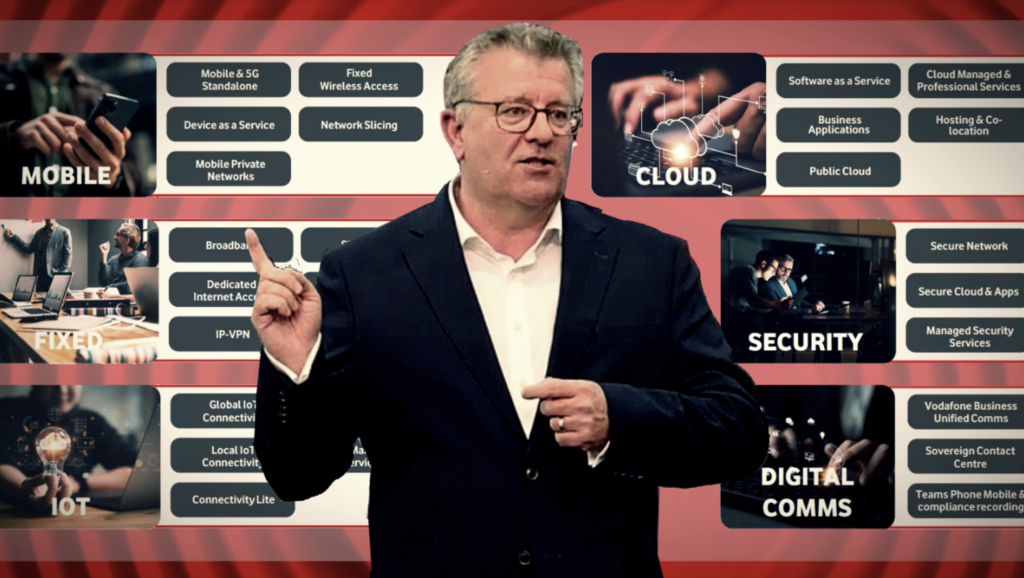
Some useful portfolio and market numbers, before we make a point. ‘Mobile’ (5G etc), as presented, comprises 50% of its service revenue; this includes private networks, FWA, and slicing. Note: this was the only mention of private networks in three and a half hours of presentations. FWA fared better; slicing was everywhere. The rest of its money comes from ‘fixed’ services (26%, broadband, private internet, VPNs, SW-WAN, Ethernet), IoT (just 6%; I mean, we knew it was tight, but…), cloud (8%; business apps, public cloud, pro services, hosting, co-location), security (7%), and ‘digital comms’ (7%), which covers unified comms and other bits.
For UK operators in the enterprise market, Vodafone is tops for mobile, it reckons (based on Analysys Mason et al): a 41% share, leading from BT/EE (30%), VMO2 (25%), and others (5%). For fixed, it trails BT/EE and a hode-podge of ‘others’ by a distance (14%, from 47% and 33%; VMO2 is even further back). Where are the opportunities? Gliddon had another slide, showing CAGR forecasts (to 2030) for every discipline: mobile will grow by 0.9%, fixed by 1.5%; slicing will jump (from nothing, let’s be honest) by 31%; FWA and SD-WAN will grow 14% and 13%, respectively. Beyond, there’s double-digit growth in cloud (14%) and security (10%). IoT rates are middling, at 6%.
So, what is our point here, apart from sharing rare and revealing figures? Well, you’ll have to catch us next week for that. We are out of room, and out of time. But think on the numbers: the clues are in those enterprise segments, plus its target industries (which reflect Nokia’s new private-networks rationale), and all its talk about slicing; plus, as well, in networks chief Andrea Donà’s comments about AI infrastructure and AI-RAN – which sound entirely pragmatic, if not a little – dare we say it – British, or just un-American. AI really didn’t feature much, but for some forced Q&A responses. In the meantime, the weekend beckons – and it’s a long one for Columbus Day (?) in the US, so we’ll catch you Tuesday.

James Blackman
Executive Editor
RCR Wireless News
RCR Top Stories
MNO ‘earthquake’: SpaceX’s deal for 800 MHz spectrum strengthens Starlink Mobile’s push into terrestrial wireless. But coverage is not capacity, and building a competitive nationwide network could cost tens of billions of dollars.
Telco AI $$$ TBD: Telcos are holding back on AI-RAN’s headline promises of edge AI revenue and shared compute, focusing instead on measurable gains in spectral efficiency and automation while demanding proof of customer demand.
AI works for DT: T-Mobile is using AI to target network investment, automate outage responses and manage event-driven demand, while parent Deutsche Telekom expects €1.1bn in AI and automation savings in 2027 and €2.5bn by 2030.
Subsea crunch: Transatlantic capacity is running out, prompting EXA to build a new 500-terabit subsea cable, the first of its kind for the industry in over decade, as hyperscalers keep back capacity for their own AI projects.
Wi-Fi 8 security: Wi-Fi 8 could give ISPs a new line of defense against AI cyberattacks, embedding inference hardware in residential gateways. Airties CEO Metin Taskin says operators must pair next-gen chipsets with the right software.

AI-Powered Telecom Infrastructure
Supermicro, in collaboration with NVIDIA, delivers AI-powered infrastructure tailored for telcos, enhancing operational efficiency, network management, and customer experiences. Explore now
Beyond the Headlines
Infra is all! Starlink’s regulatory approvals, Vodafone’s merger savings, and AT&T’s fiber investments reflect a market reshaping around scale and infra, and a grasp for control of higher-up AI services, as satellite and terrestrial converge.
DT on AI uplink: Deutsche Telekom says AI uplink traffic won’t force new radio-network spending. The cap-ex discipline may be bad news for RAN vendors chasing an AI upgrade cycle.
Verizon agents: Verizon is moving from scripted RAN automation towards agentic network operations, where AI reasons across domains, shares context and takes action – with the operator retaining control of intent, outcomes and guardrails.
AI-RAN hype: Deutsche Telekom and Turkcell agreed at Intelligent RAN Forum where AI-RAN pays off today: network operations. The new-revenue case for AI-RAN still needs a paying customer.
6GHz update: 6GHz Wi-Fi adoption is accelerating in the US, says Dean Bubley, with Ookla showing six-fold growth since 2024 and Cisco reporting 48% usage at BottleRock. More power, AFC and simpler access could push adoption further.
What We're Reading
Wi-Fi and 6G: Wi-Fi is essential to the 6G vision, says the WBA, and should be considered in the design of the connectivity framework from the start. Convergence should consider different network ownership and deployment models, it says.
Qualcomm vs Arm: Arm chief Rene Haas faced scrutiny over Qualcomm licensing negotiations, while the judge explored potential remedies and rejected setting royalty rates herself. Prakash Sangam was there.
Satellite IoT: floLIVE and Skylo are combining cellular and satellite for IoT deployments across Brazil, enabling devices to switch between. Local partners iuh! Digital and NLT will offer the integrated service.
Service creation: Beyond Now has launched an agentic revenue platform for telcos, combining AI agents, partner ecosystems, and commercial systems to automate service creation, selling, fulfilment and monetization.
SCION service: Colt has launched a managed SCION networking service across Europe, North America, and Asia, giving enterprises greater control over data routing, visibility, and resilience.