

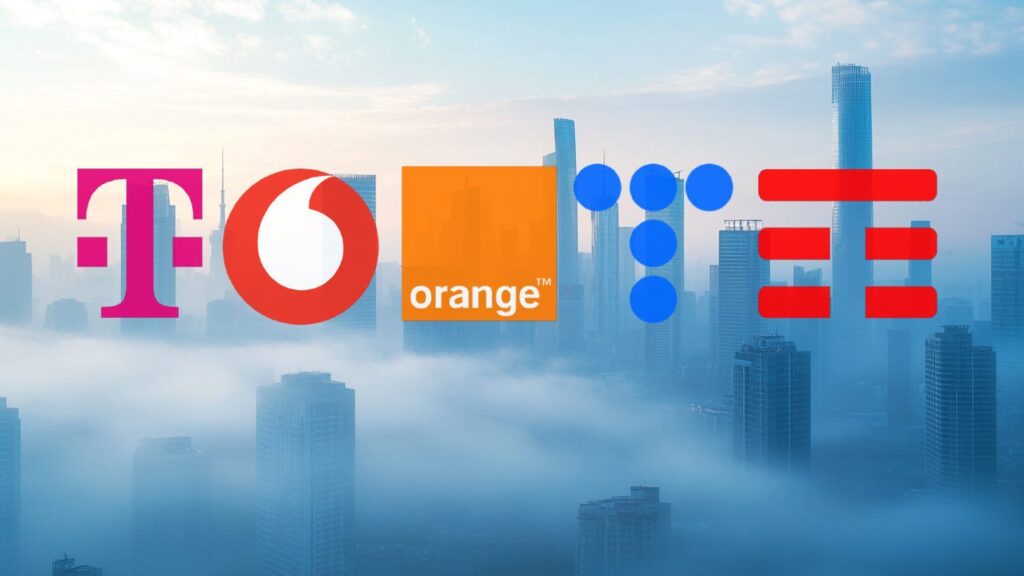
So, three things ahead of the the weekend – including two items from yesterday, about Cisco’s record results, discussed here with its axe-wielding, and the telco ‘dead-zone’ proposition in the US, as much a defensive move against the new D2D satellite powers, plus one from today, about Vodafone’s latest update on a new federated ‘edge continuum’ in Europe. Let’s go in reverse order, and re-sequence, starting with the newest ‘news’ – if that’s what to call it.
Vodafone says its work with Deutsche Telekom, Orange, Telefónica, and TIM to build a European telco-edge cloud is limbering up, promising a way to run AI and IoT on a “home-grown” platform via a domestic access portal, patched together as a “seamless” SLA-backed service on 5G slices and fiber waves. The project is part of the “push for digital sovereignty”, about weaning the EU off US big-tech. Which presents a rare chance for telcos to reassert some kind of mob-handed buoyancy in the gusty airwaves of the hyperscaler-controlled cloud.
Like the “dead-zone” proposal in the US, it might be read two ways: as a progressive customer-oriented telco-2.0 collaboration between regional incumbents, and as a defensive industrial scramble to stay relevant in local markets. The tension is the same – heritage telco brands attempting to reclaim influence in a tech stack that moved beyond their control during the cloud-era, now facing the AI era with both opportunity and risk. On one hand, digital sovereignty (and geopolitical nationalism) offers a route back in – and into a far richer stack.
On the other, there is this weird existential threat that they could lose it all, even the network layer itself – while billionaires with rocket ships seek to cover the whole planet with D2D satellite connectivity. Are we imagining this? Maybe so; but Pablo Tomasi at Omdia – good on private 5G, good on NTN – spied a “Starlink-shaped bogeyman” between the lines in the US press release yesterday, which is “forcing telcos to take a stance”, he said. Satellite take-up among T-Mobile customers is low, he noted. It might be “speculative”, but it “feels like a preemptive move”.
Tomasi also agrees with the commentary in Juan Pedro’s coverage today, courtesy of Dell’Oro: that AT&T, T-Mobile, and Verizon are most interested in D2D ecosystem-building, albeit on their terms. Meanwhile Leo Gergs at ABI Research – another old private networks expert, who has also moved to cover the AI infra game – notes something else about Cisco’s record quarter ($15.8bn, up 12%), which was not covered here yesterday. He points to the returns at neocloud provider Nebius, alongside: $399m in the quarter, up 684%, on a 45% margin.
He then expands the view to take in the Industry 4.0 market. “Those numbers don’t capture the part of the economy that hasn’t started yet: manufacturing, energy, utilities,” he says – where the AI might be good, but the networks are bad. “Cisco and Nebius are building the rails, but the money in the next cycle is one layer up – in the platforms sitting between the GPU cloud and the factory floor, where Siemens, Rockwell, Honeywell and a [new] generation are competing for a market the current AI capex narrative hasn’t begun to price.”
Which sounds like the same story, all over again – as told in the cloud, as told at the edge; where telcos miss out. Maybe the US and EU collaborations will shore-up some of the telco position in the AI era, at least around connectivity, orchestration, and sovereignty. Or maybe they are just attempts to stop the center of gravity shifting further – into hyperscale platforms, into industrial software, into orbit.

James Blackman
Executive Editor
RCR Wireless News
RCR Top Stories
D2D for dead zones: US telcos AT&T, Verizon, and T-Mobile plan a joint venture to expand satellite-based direct-to-device coverage, as analysts say the move could accelerate the broader U.S. D2D ecosystem and reshape connectivity economics.
Federated telco edge: Vodafone and other major European telcos are advancing a federated edge-cloud as a home-grown hyper-scaler alternative to support sovereign AI and IoT workloads – attached to SLA-backed 5G slices, and the like.
Nokia taps agents: Nokia is rolling agentic AI into its core fixed network platforms, with specific targets for helpdesk resolution rates, incident qualification, and field visit reduction.
Defense of CBRS: CalPoly University says any changes to the CBRS framework risk undermining the connectivity, experimentation, and workforce development that private wireless enables across in education, industry, and public services.
US vs China: Taking stock of the US/China tech summit: the US leads for GPUs and frontier AI, and outspends China 10-to-1 on tech; but China has closed the AI gap and it dominates rare earths and supply chains. No winner, it seems.

Powering Sovereign AI at Scale
AI is central to telecom and national infrastructure, but must be secure, compliant and sovereign. Read this white paper to see how AI Factories enable trusted scale and new revenue.
Beyond the Headlines
Inwit tower defense: Inwit said it remains confident in its legal position as it challenges early termination notices from TIM and Fastweb + Vodafone while continuing to pursue investment and tower-sharing opportunities in Italy.
AI Act compliance: The EU’s decision to delay high-risk AI Act compliance gives firms breathing room, but the clock is still ticking. Hexnode says companies must act now to audit AI systems and strengthen oversight.
4GHz sharing: The US must share the 4GHz band instead of clearing federal users. Flexible licensing could support 5G/6G innovation, protect government operations, reduce costs, and enable local AI networks – says Dean Bubley.
CPUs vs GPUs: T-Mobile, Nokia, and Nvidia weighed in on AI RAN at Connect X last week, as well as the debate between CPU and GPU in RAN infrastructure, and whether the industry will place the bets required.
Low-risk AI infra: Telefónica opened 2026 with steady growth, better profit, and lower debt, driven by a surge in Brazil and discipline in Germany. It calmed expectations about its capital exposure in Europe’s new AI gigafactory push.
What We’re Reading
Iridium buys Aireon: Iridium is to buy the remaining stake in aviation data provider Aireon for $367m, fully integrating its space-based aircraft tracking to expand aviation safety services and strengthen its satellite comms strategy.
Netcracker takes CSG: NEC has bought US firm CSG Systems. Its Netcracker business will take charge of the operations and integration of CSG, while NEC will support the combined organization. The fee has not been revealed.
Ondas skyrockets: Ondas has reported a record quarter with revenue of $50m, up more than tenfold year-over-year; it has raised its revenue forecast to $390m, citing strong demand for autonomous systems and defense and drone backlog.
Healthcare AI: Fujitsu and IBM have a healthcare collaboration to develop a sovereign cloud and AI medical data services in Japan to improve hospital efficiency, strengthen data compliancy, and support cross-institutional clinical cases.
Irish net inventory: Amdocs says Vodafone Ireland has gone live with its ‘network inventory’ platform, replacing legacy systems to automate network planning, streamline operations, and align inventory management.
Equinix geo zones: Equinix is expanding its Fabric Geo Zones globally to give enterprises stronger control over data sovereignty in hybrid and multi-cloud environments, ensuring sensitive data stays within defined geographic boundaries,
DE-CIX joins Mplify: DE-CIX has joined the Mplify Alliance as one of the first IX operators in the group, aiming to accelerate global standards for network-as-a-service, interoperability, and automated, AI-ready digital connectivity.
Private 5G gear: BLiNQ Networks has expanded its private 5G portfolio with new outdoor small cells, targeting enterprise, industrial, and smart city deployments with integrated Wi-Fi 7, AI-ready connectivity, and broader private-network coverage.
Smart IoT gas meters: LoRaWAN operator Netmore is working with Green Frog Asset Management and Sensational Systems to deliver AI gas metering solutions across the UK, combining IoT, analytics, and automated data validation.
Enterprise AI lags: Research by NTT Data says enterprise AI is constrained by legacy infrastructure, with privacy, sovereignty, and security as key barriers. While 95% value sovereign AI, only 29% prioritize it; confidence in cloud security is low.
Events
Virtual Program
Test & Measurement Forum, May 19
Join the annual Test & Measurement Forum where industry leaders, innovators, and engineers come together to tackle the most pressing test and measurement challenges in telco today. Register now
Telco AI Forum, June 16th
Telco AI Forum brings together operators, vendors, hyperscalers, and academia to explore how the evolution of the industry and partnership ecosystems is laying the foundations for AI-native 6G networks and unlocking ROI. Register now
Quantum Safe Networks Forum, July 14th
Quantum Safe Networks Forum brings together telecom operators, cybersecurity experts, and industry analysts to explore how to build resilient, future-ready infrastructure in the face of quantum disruption. Register now
CCA’s 2026 Mobility & Connectivity Show
Join industry stakeholders and innovative leaders in the communications service provider community this spring at CCA’s 2026 Mobility & Connectivity Show, April 14-16 in Louisville, KY. Register now
RCR Roundtables AI Infrastructure, October 21st, Dallas, Texas
Join 50 senior data center, energy and AI leaders at the Ritz-Carlton Dallas on October 21 for invitation-only roundtables on powering and scaling AI. Request your invitation
Industry Resources
Webinar, May 21st
Securing telecom infrastructure for the quantum era
Webinar, June 2nd
Scaling optical networks for the AI and hyperscale era
Webinar, June 9th
Agentic RAN Management: Delivering OPEX efficiency and a path to 6G
Report
AI in testing – Developing trust, delivering results
Whitepaper
Powering sovereign AI at scale
Whitepaper
Scalable database design for 5G and beyond
Report
Test, measurement and service assurance in the AI era
Summit Access
GSMA Device Enablement Summit: How operators can fix device-network fragmentation