

I used to work at Huawei – about 15 years ago, when the firm was on an LTE tear-up in Europe. I was not particularly senior, and I was western; hardly very close to the action. I’d taken the PR shilling, and the corporate dive, and didn’t last long. But it was amazing. My memory is of a business that was teetering on the brink with each delivery project – and which, through force of will and depth of resources, got it over the line every time. Frustration turned to delight, and customers returned, and took more. Until the UK government put a kaibosh on it. But I’d gone by then.
Briefly, they were Huawei’s salad days as a global vendor; it was the brand to beat. It still is, of course; it’s just been made into a parochial player again by geopolitics, operating mostly in its own back yard, plus non-western territories. The thing is, its back yard is China, the biggest mobile market in the world – and the biggest market on any number of scores. And its awesome innovation matters equally, and probably more because, one way or another, it is its home country’s house brand to connect its own AI revolution. Which is being measured against America’s.
So when Huawei makes a presentation about a new ‘scaling law’ for chips at a big international IEEE event about ‘circuits and systems’ (ISCAS 2026, in Shanghai), then there’s all kinds of stuff to consider. So let’s try. The semiconductor industry can’t just rely just on smaller transistors anymore, it says – per Moore’s Law (smaller transistors mean more transistors, meaning faster and cheaper chips). Modern chips are approaching atomic-scale limits, and shrinking them further is expensive, difficult, inefficient, and dependent on EUV lithography tools.
Which China doesn’t have easy access to because of US export controls. Huawei reckons the chip industry can achieve the same ends (better compute) by shrinking time, as it were, and not just geometry. There are gains to be had, it suggests, by optimizing on-chip interconnects – in latency delays, energy usage, transistor density. Huawei proposes a new scaling ‘law’ – called Tau (τ) Scaling Law, based on the electronics formula for the time constant of a resistor-capacitor circuit (τ = RC, where Greek-letter τ is signal-propagation time, R is resistance, C is capacitance).
So it’s about on-chip connectivity, in line with Huawei’s heritage expertise. It follows the same principle as the scale-up, -out, and -across disciplines to optimize connectivity in GPUs racks, clusters, and clouds. It just puts a shrink-ray on it. And chip designers have always cared about propagation delays, RC delays, wire lengths, critical paths, everyday system-level optimization – just consider the on-chip interconnect engineering already used in CPUs, GPUs, NPUs. (Nvidia’s advantage is partly its system architecture.) So there’s some good marketing here.
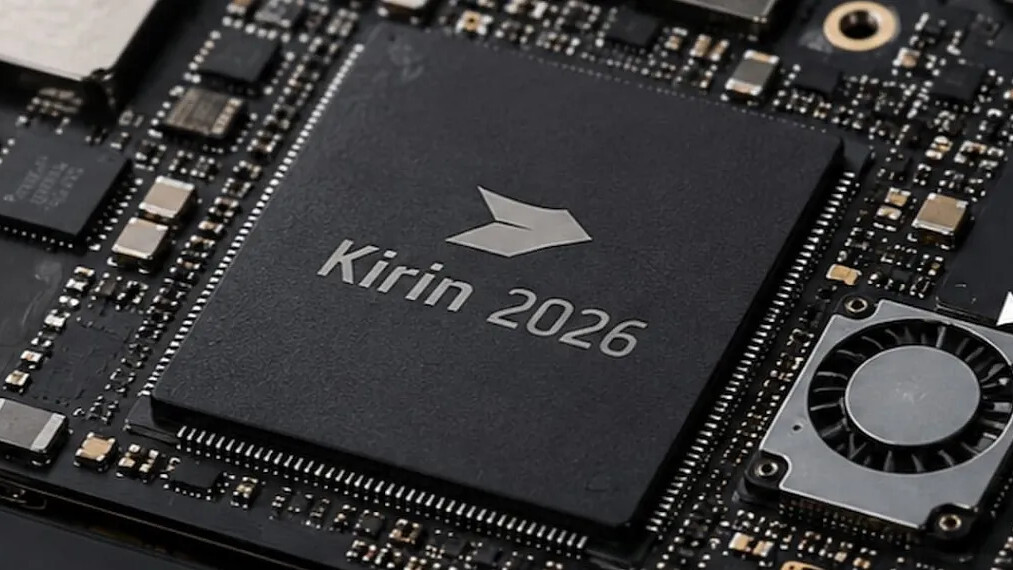
Huawei is elevating those practices into a post-Moore’s-Law design philosophy. It has a new layout/architecture methodology, called ‘logic folding’ (LogicFolding), which involves denser 3D placements, shorter wire paths, tighter hardware/software coupling. It has already “mass-produced” 381 chips in six years based on the τ Scaling Law, it says. Its new Kirin line of processors, launching later this year, will be the first to use the ‘logic folding’ architecture. By 2031, it will have high-end chips with “transistor density equivalent to 1.4 nm processes”, it says.
Which does not mean Huawei will manufacture true 1.4 nm chips – like TSMC, Samsung, Intel. Just that, at some point soon-ish, it will make lesser chips that pack the same punch. Which is the breakthrough claim here – not that Huawei can ignore manufacturing constraints, but that it can narrow the gap through system optimization, even without the same access to lithography vendors, EDA software, specialty chemicals, advanced materials, packaging companies, IP libraries, inspection tools, metrology systems, talent, and supplier relationships built over decades.
Don’t bet against Huawei getting over the line.

James Blackman
Executive Editor
RCR Wireless News
RCR Top Stories
Premium Indian 5G: Indian operator Bharti Airtel’s new 5G slicing service could support 5G monetization efforts in the Indian market and increase competition around premium connectivity and differentiated customer experience.
Tough telco math: Vish Nandlall breaks down carrier finances with a lemonade-stand analogy and some 2025 operator numbers, and argues that the problem isn’t a lack of ambition or vision, it’s basic economics.
Broadband wars: The US broadband duopoly between cablecos and telcos is fading as FWA, NTN, WISPs, and fiber overbuilders expand rapidly. Increased competition and alternative providers is giving consumers more choices.
Off-grid AI DCs: Grid interconnection delays and rising AI power demand are pushing hyperscale developers toward behind-the-meter and off-grid generation, according to Wärtsilä Energy executive Sean Hughes.
Cloud RAN future: CSPs face pressure to boost edge performance without ripping out existing infrastructure. Dell’s newly shipping PowerEdge XR8720t, a 2U sled for cloud RAN, is one answer to that squeeze.

Powering Sovereign AI at Scale
AI is central to telecom and national infrastructure, but must be secure, compliant and sovereign. Read this white paper to see how AI Factories enable trusted scale and new revenue.
Beyond the Headlines
All AI bottlenecks: Texas energy infra company Fermi says AI demand remains strong, while power availability, permitting, and tenant agreements are central issues shaping hyperscale data center and private power deployments.
Sovereignty builds: Germany’s sovereign cloud push is advancing with Deutsche Telekom and SAP winning a BMDS AI platform tender and Thales expanding its Google Cloud model; STL Partners also has a good review of the state of things.
SpaceX – want in? SpaceX’s IPO filing reads like a techno-futurist manifesto – but then its his business: a vertically integrated empire of rockets, satellites, and AI infrastructure to scale intelligence globally.
Dell on enterprise AI: As enterprises go from generative AI advisor to agentic AI operator, Dell is positioning storage, compute, cyber resilience, private cloud and automation as the enterprise control plane. Sean Kinney has the analysis for RCR.
“Poor” and “cynical”: The GSMA and CTIA have misrepresented early 6GHz Wi-Fi adoption data to justify reallocating spectrum for mobile use, arguing the tech remains in a normal growth phase with good long-term value.
What We’re Reading
New chip scaling law: Huawei has proposed a new Tau (τ) Scaling Law to shift chip design from transistor shrinking to system-level efficiency by reducing signal delay. It aims for 1.4nm-equivalent density by 2031.
Ericsson moves house: Ericsson will relocate its Stockholm headquarters and operations from Kista to Hagastaden, starting in 2028 over several years, creating a major new campus with leased modern offices.
US, Korea to lead 6G: Juniper Research says the first 6G will arrive in 2029, with the global number of 6G connections reaching 4.1 million that same year. The US and South Korea will lead early 6G commercialization in late 2029, it reckons.
Alibaba agent upgrade: Alibaba Cloud has upgraded its agentic AI offer, including new foundation models (like Qwen), upgraded cloud infra, AI chips, and agent platforms to help enterprises build and deploy autonomous AI agents.
Subsea contracts: Indigo Telecom has a deal with Trans Pacific Networks to deliver NOC support for its Echo cable system connecting Singapore, Indonesia, Guam and the US, plus its stake in the Tabua system between Australia and the US.
Events
Virtual Program
Test & Measurement Forum, May 19
Join the annual Test & Measurement Forum where industry leaders, innovators, and engineers come together to tackle the most pressing test and measurement challenges in telco today. Register now
Telco AI Forum, June 16th
Telco AI Forum brings together operators, vendors, hyperscalers, and academia to explore how the evolution of the industry and partnership ecosystems is laying the foundations for AI-native 6G networks and unlocking ROI. Register now
Quantum Safe Networks Forum, July 14th
Quantum Safe Networks Forum brings together telecom operators, cybersecurity experts, and industry analysts to explore how to build resilient, future-ready infrastructure in the face of quantum disruption. Register now
CCA’s 2026 Mobility & Connectivity Show
Join industry stakeholders and innovative leaders in the communications service provider community this spring at CCA’s 2026 Mobility & Connectivity Show, April 14-16 in Louisville, KY. Register now
RCR Roundtables AI Infrastructure, October 21st, Dallas, Texas
Join 50 senior data center, energy and AI leaders at the Ritz-Carlton Dallas on October 21 for invitation-only roundtables on powering and scaling AI. Request your invitation
Industry Resources
Webinar, June 2nd
Scaling optical networks for the AI and hyperscale era
Webinar, June 9th
Agentic RAN Management: Delivering OPEX efficiency and a path to 6G
Report
AI in testing – Developing trust, delivering results
Whitepaper
Powering sovereign AI at scale
Whitepaper
Scalable database design for 5G and beyond
Report
Test, measurement and service assurance in the AI era
Summit Access
GSMA Device Enablement Summit: How operators can fix device-network fragmentation