

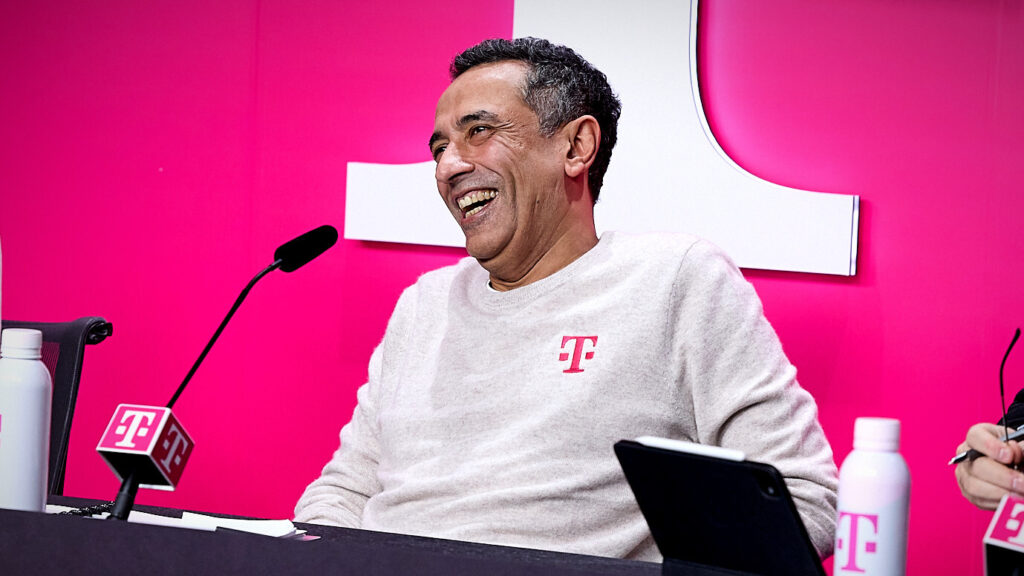
Another US operator has posted another strong quarter; this time, T-Mobile has beaten city forecasts on both its earnings and revenue, and promptly raised its full-year guidance. Of interest besides, Bloomberg News has reported that Deutsche Telekom has put the brakes (momentarily) on a formal bid to acquire its US subsidiary outright, citing opposition from its works council and worries about diluting the German government’s stake in the parent company. The German firm’s shares traded higher on the report. The financial press has done a fine job with T-Mobile’s scores, as usual; so they are hardly worth dwelling on here. Instead, the real talking points, buried deep in its earnings call, are about spectrum and physical AI – that T-Mobile will spend more on spectrum in 2027/28, and will make money from physical AI by taking a cut from lower device costs, as compute is offloaded to the edge.
By 2035, and possibly sooner, “millions of robots, drones, [and] all sorts” is “kind of a given”, said Srini Gopalan, chief executive at the firm. He has some choice words for SpaceX, as well – reflecting the views of the tier-one telco community in the US, facing down the noise and excitement about a new terrestrial entrant led by a barrel-chested trillionaire. T-Mobile remains open to commercial resale arrangements, as with its T-Satellite broadband set-up (with SpaceX), but draws a clear distinction with an outright MVNO, whether for consumer or physical AI applications. Gopalan responded: “We see ourselves in the lead in terms of those capabilities, and we see no space for an MVNO here because what additional capabilities does it give us?” Straighter two-way trades on edge compute might work, he said. “If we’re talking about SpaceX as a customer or [vice versa], that’s a purely-commercial agreement.”
Highlights, and further discussion can be found here.

James Blackman
Executive Editor
RCR Wireless News
RCR Top Stories
Edge 5G AI payouts: T-Mobile has raised its full-year guidance, and also pointed to bigger bets ahead: more spectrum spending, edge compute economics, 6G firsts, and AI-driven network efficiency – as it, again, rejects a SpaceX MVNO deal.
Telia pushes SA: Telia is expanding commercial 5G SA capabilities while preparing a joint radio-network operation with Ice in Norway, combining two major wireless developments discussed during its latest earnings call.
R21 6G update: 3GPP has advanced Release 21 6G work, agreeing on 1024-QAM uplink modulation for FWA and initial reference-devices. Decisions on 5G-to-6G migration are unresolved; ‘constellation shaping’ stays out of the first release.
NTN deals, 6G Qs: Amazon Leo’s $11.5bn Globalstar deal intensifies the D2D race, while Bell Canada’s tower valuation highlights infrastructure’s appeal. But as 6G approaches, will telcos capture value from connectivity or leave it to others?
Anthropic IPO: Anthropic’s IPO prospectus highlights surging revenue but also $475bn-$500bn in commitments to Amazon and Google, whose investments and infra deals raise questions about customer concentration and circular financing.

AI-Powered Telecom Infrastructure
Supermicro, in collaboration with NVIDIA, delivers AI-powered infrastructure tailored for telcos, enhancing operational efficiency, network management, and customer experiences. Explore now
Beyond the Headlines
6G money making: 6G revenue will start rolling in with ISAC and physical AI – not speed, said a panel comprising BT, Ericsson, and Keysight at 6G Forum. Business cases come before the build – and Release 21 will land after LA28.
Urgent 6G rethink: Verizon CTO Yago Tenorio says 6G needs an architectural rethink to handle AI-driven uplink demand, avoid repeating 5G’s mistakes, and embed autonomous network operations and commercial use cases from the outset.
Boldyn’s big bet: Value comes from controlling infra – cables, sites, power – and not by betting just on wireless tech, says Boldyn. The firm is prioritizing owner-funded converged networks, and is cautious on private 5G, open RAN, NTN.
Quarterly questions: Orange, AT&T, and Verizon are improving earnings via commercial growth and cost discipline, while telcos place bets on AI infra and physical AI. But will today’s gains translate to tomorrow’s growth?
Network economics: AI agents will shift work from customer devices to distributed computing networks, changing where data travels, how capacity is used, and which providers control routing, connectivity, and the economics of AI infra.
What We're Reading
DT pauses pursuit: Deutsche Telekom has paused plans for a formal bid to merge with T-Mobile US, Bloomberg reports, citing resistance from its works council. The deal could be revived later, despite opposition from activist investor Elliott.
Sovereign shared D2D: Space42, Viasat, and Terrestar are to develop an open framework linking the Equatys platform with Terrestar’s CaStar constellation, combining shared D2D infra with national control of satellite assets and customers.
AI FWA installs: Federated Wireless says its AI planning platform helped fixed wireless provider Element8 raise installation success rates in Texas and Oklahoma from around 80% to over 90% in five weeks, more than halving RF-related failures.
Building agentic RAN: Viavi has outlined tools for testing AI-driven RAN systems, spanning digital twins, scenario generation, and app validation. Its white paper examines how these could accelerate deployment of AI-native networks.
DE-CIX Thai IX JV: DE-CIX and Thailand’s IGC are forming a JV to launch DE-CIX Bangkok in mid-2027. The IX will connect Thai networks directly with five other Southeast Asian markets through DE-CIX’s regional interconnection platform.
Latest RCRtv Interviews
Events
Industrial Wireless Forum, November 10th, Virtual
From private 5G, Wi-Fi and public cellular to edge AI, spectrum, next-generation IoT and sensing, the forum examines the infrastructure choices and practical challenges shaping the future of industrial operations. Register now
AI Infrastructure Forum, December 8th, Virtual
Join RCRTech’s AI Infrastructure Forum to explore how telcos, hyperscalers and data centres can compete or partner as AI shifts to inference, and who captures the value when every token counts. Register now
Industry Resources
RCRTech Trend
Rise of Non-Terrestrial Networks (NTN)