

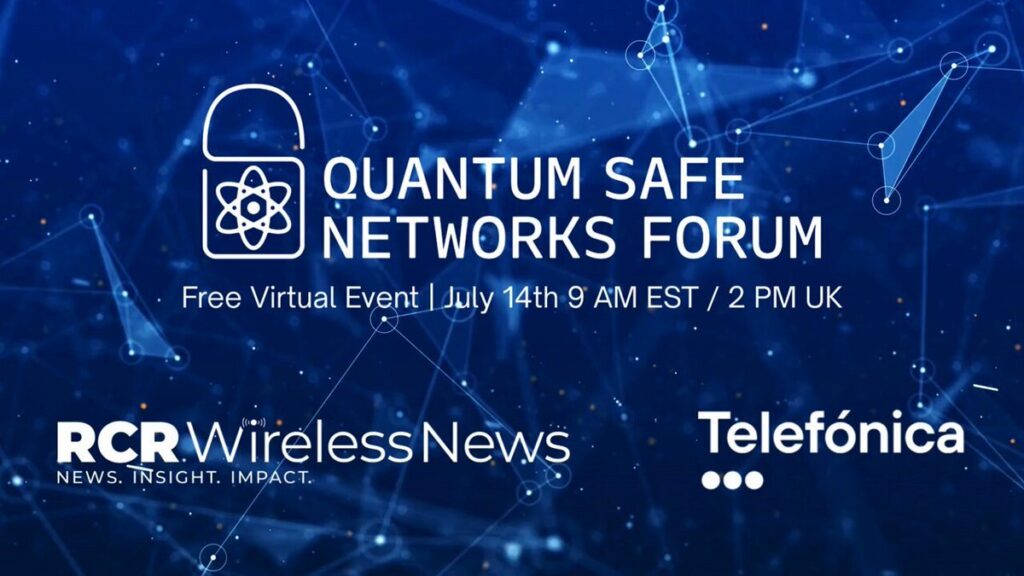
A timely event reminder that the Quantum Safe Networks Forum is next week (July 14) – and you should be there. Because Q-Day, when quantum computers can crack today’s standard encryption, is around the corner, some time after 2028. The telco industry is at the centre of the scramble to manage the response. This is not theoretical; encrypted traffic being harvested today could be decrypted tomorrow, turning long-term data security into a live infrastructure problem.
Which is why operators are increasingly exploring quantum-safe networks as a service – not just to shore up existing defences, but to build a new security layer into the fabric of connectivity itself. Telefónica is at the forefront of that push and will be a host partner at the forum, alongside speakers from AT&T, MetTel, Singtel, Orange Business, and others – all bringing operator realities into sharp focus, around how to migrate carrier-grade networks without breaking them.
The agenda cuts to the heart of it: post-quantum cryptography for telecom infrastructure, 5G vulnerabilities, migration strategies, and the harder question of standards alignment across a fragmented global ecosystem. Add in updates from R&D programmes and early deployment case studies, and the forum becomes less about future speculation and more about operational readiness. Quantum may feel somewhat distant – but it is closing fast, the telco clock is ticking.

James Blackman
Executive Editor
RCR Wireless News
RCR Top Stories
Agentic RAN: Qualcomm’s new agentic RAN management service links short-term op-ex efficiency with long-term 6G autonomy, using agents and digital twins to optimize RAN operations – and preserve deterministic reliability and operator trust.
6G takes shape: More from Qualcomm: early 6G standardization decisions point to a pragmatic migration path, it says, while new work on 6G spectrum, sensing and distributed compute could unlock fundamentally new use cases
KDDI AI RAN: KDDI has completed a live 5G SA trial of Samsung’s AI-powered RAN Speed Optimizer, achieving average downlink throughput gains of 31% and peaks of 52% – demonstrating AI for per-cell optimization and performance.
The future telco: Huawei says AI will reshape telco monetization by changing how operators build networks, combining connectivity and computing, while prioritizing low latency, uplink capacity, and AI-oriented transport architectures.
MDU M&As: Buying doors is easy; integrating networks is not. Consolidation in the MDU connectivity space might create scale on paper, but good service depends on whether networks can operate as one. Maravedis has more.

AI-Powered Telecom Infrastructure
Supermicro, in collaboration with NVIDIA, delivers AI-powered infrastructure tailored for telcos, enhancing operational efficiency, network management, and customer experiences. Explore now
Insights and Opinion
SKT scales AI: SK Telecom plans to build up to 15GW of AI data center capacity across South Korea, betting large-scale computing infrastructure will strengthen the country’s role in Asia’s rapidly expanding AI economy.
Telco imperative: Sean follows up his DTW Ignite narrative with a second viewpoint, based on the same idea, plus the above-linked Qualcomm write-up: how to safely delegate to AI inside systems that were not designed for probabilities.
Agentic proofs: Tencent Cloud claims zero-downtime migration of XLSMART’s 1,200 microservices using agentic AI tools, positioning a reusable, AI-driven cloud migration platform that compresses digital change timelines.
Indosat AI grid: Indonesian telco Indosat reckons its nationwide 5G network will power an AI grid supporting Sahabat AI today while preparing Indonesia for Vision AI and Physical AI applications.
AI proof for IoT: LoRaWAN’s minor charge looks modest next to cellular IoT’s mega count. But the LoRa Alliance says the comparison is false: LoRaWAN growth is driven by private networks, industrial integrations, and physical AI.
What We're Reading
DoD taps Cohere: Cohere has secured a $28m deal with the Department of War (formerly DoD) to develop a multi-waveform RAN prototype for integrated sensing and comms – to detect and track drone threats and support 5G/6G apps.
Vero buys Velocity: Vero Fiber Networks has acquired Velocity Fiber, expanding its K-12 E-Rate business in four states. The deal strengthens Vero’s fiber footprint, customer base for educational institutes.
Private OCUDU 5G: RANsemi and TechPhosis have integrated OCUDU 5G CU/DU software with commercial PHY from RANsemi using SCF FAPI for low-power small cells, extending deployment across open RAN and private 5G.
Grind Prix 5G: O2 is the first operator to go ‘live’ on a new high-capacity shared DAS setup at Silverstone race track in the UK. Boldyn Networks has delivered the infrastructure, which spans 570 acres including the 3.66 mile Grand Prix circuit.
Chelsea FC AI: Chelsea FC has appointed IFS to install its industrial AI suite across its finance, procurement, facilities, and operations; it follows a sponsorship deal in February. The tech is for efficiency, decision-making, fan engagement.
Events
CCA Annual Convention, September 14-16th, New Orleans, Louisiana
Join industry stakeholders and innovative leaders in the communications service provider community this fall at CCA’s 2026 Annual Convention. Register now
RCR Roundtables AI Infrastructure, October 21st, Dallas, Texas
Join 50 senior data center, energy and AI leaders at the Ritz-Carlton Dallas on October 21 for invitation-only roundtables on powering and scaling AI. Request your invitation
Industry Resources
Scaling AIOPs from insight to action
How Deutsche Telekom accelerate device onboarding and service rollouts
The 2026 Telco Playbook