

Firstly, good stuff from Sean Kinney, as always – from Cisco Live a couple of weeks back (with apologies for its tardiness) and DTW last week (right on time). The two pieces are worth taking as a pair: they discuss the tension as AI reshapes operational control in networks. The DTW writeup, an intellectual take, says probabilistic AI and deterministic telecoms are strange bedfellows – that inference and judgement are unreliable stewards of repeatability and predictability. Which is the discussion most industries are having about AI, actually. The Cisco review deals with the same, effectively: as AI is licensed to take action, rather than just to generate responses, mechanisms must be in place to govern what agents can do, what they can access, and how their actions are monitored. Which is the Cisco pitch. The point is, the telco AI story – just the industrialisation of AI, broadly – is about human control of machine intelligence, and controlled autonomy rather than unrestricted autonomy. Search-out the two articles.
Secondly, and related (to AI-organized control of industrial systems, plus outward-looking telco upsides), there is lots happening in the private 5G space. Twelve months ago, RCR might have covered these items individually, in depth, but AI has changed everything, including the news trade and news beat (so share if you care). For one, Nokia – which we shall call ECE for now, on the grounds Nokia has put it up for sale, and doesn’t deserve the credit – has started its own little PR engine, it seems, to make some noise, finally, if only to dispel rumours about its (enforced) six-month silence, and also to spread the good Industry 4.0 gospel. There’s lots here: contract wins with Schneider Electric in France, Toyota TPEC in Japan, and Odense Harbour in Denmark, with Orange, NS Solutions, and Borch Teknik; and headline stats, including claims that 99% achieve ROI within two years, 68% get there in six months, and that the super-set industrial AI market will grow 23% per year to be worth $150bn by 2030 (citation needed).
ECE (right?) makes mention of its partners, including far-sighted telcos like Orange – like it gets the teamwork in IoT / Industry 4.0 / Enterprise AI etc (choose your PR poison). It also talks about app stacking (the “ecosystem multiplier”, per “the art of the possible”; where’s the eye-roll emoji?) on ‘AI-ready’ (ditto) network foundations – which is the same stuff everyone at Cisco Live and DTW is talking about, just on larger-scale networks (even discussing physical AI at the edge). ECE has a blog on this. Plus, it discusses “zero-touch” mines, same as Ericsson lately, and how airports, harbours, and hubs are making money as private 5G hosts. It lists a bunch of “new” home-made and third-party solutions on its MXIE platform: a crisis workflow and alerting system called Secapp; digital twin mapping to track fleets of devices; “all-in-one” small cells; a more-compact DAC Compact for smaller sites; neutral-host capabilities for shared private 5G. “2026 has been a strong year,” it writes. Well, who knew? Hopefully it finds a happier home.
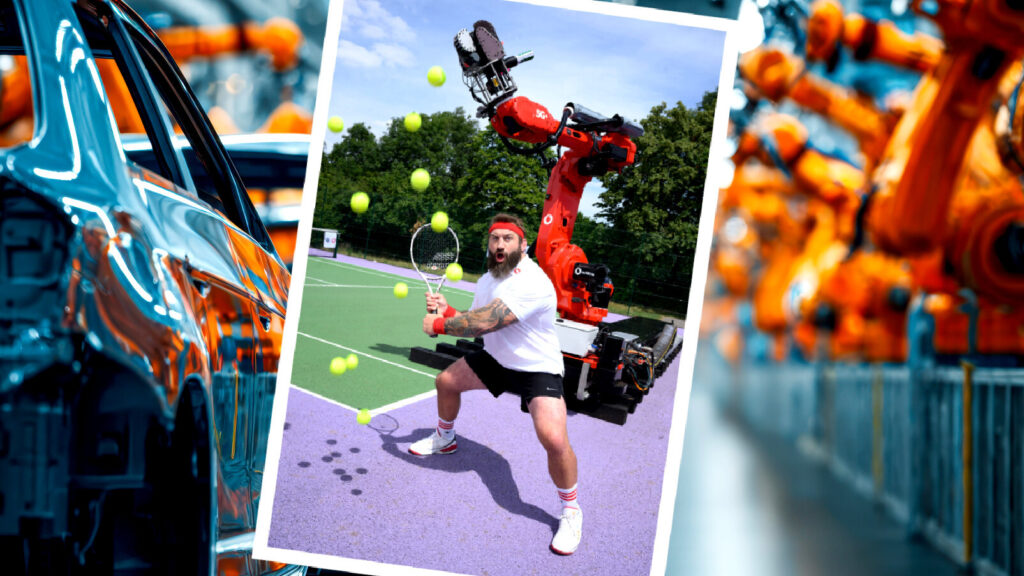
Meanwhile, there is plenty going on to think ECE is still on to a good thing. China Daily reports that China is to build 50,000 private 5G networks to drive the “value-added of the industrial internet core industry” (whatever that means) to $368bn by 2030 – says a plan by eight government departments. The government in New Zealand is to open the 3340-3460 MHz band for private 5G; it has a consultation, to the end of the summer, about use cases and spectrum sharing. All positive, then. Best of all, as the public 5G tech solution for similar ends in different set-ups: Vodafone has a fun demo in the UK. It has sliced its 5G SA network for a Wimbledon tennis app, which gives visitors a chance to return Jannik Sinner’s pro-serves on Centre Court – in ‘real time’. The set-up analyzes the live match feed, including the speed, position, and trajectory of each serve, and sends the data over the 5G slice to a robot arm that recreates the serve “in under a second” – for have-a-go-Henrys (Joe Mahler in the pic) to have a swing at.
How cool is that? But that’s enough from me; there’s a football game to watch.

James Blackman
Executive Editor
RCR Wireless News
RCR Top Stories
Telco conundrum: Anxiety is the dizziness of freedom. So said some Danish thinker; so says Sean Kinney, writing from DTW that telecoms is deterministic and AI is probabilistic, and therein lies the problem. Good food for thought here.
AI control plane: Sean Kinney, again – live from Cisco Live some weeks ago; the points are pertinent: that the network is “more powerful than the node”, where comms, security, identity, observability and cost converge in the AI world.
5G/AI for tourism: Huawei used a media tour in Xi’an to demo how 5G and AI are supporting new cultural tourism services, combining high-capacity connectivity with AI-powered visitor experiences.
6G foundation: The 6G foundation is set; innovation is being applied in a measured way, focused on targeted enhancements – in the uplink, for energy efficiency, and in mid-band capacity. But hardware evolution is required, says Qualcomm.
AN blueprint: AI-augmented networks and autonomous operations are familiar now for telcos, says Cyient. The harder work is to turn ambitions into operational realities – with fragmented OSS/BSS and multi-vendor architectures.

AI-Powered Telecom Infrastructure
Supermicro, in collaboration with NVIDIA, delivers AI-powered infrastructure tailored for telcos, enhancing operational efficiency, network management, and customer experiences. Explore now
Insights and Opinion
Cluster efficiencies: In big GPU clusters, disruptive events happen on a daily basis – which can cost millions of dollars. Clockwork, backed by AMD and Broadcom, works around link failures and hardware crashes so training jobs finish faster.
Qualcomm DC play: Qualcomm is going after AI data centers with its new Dragonfly chips and HBC memory, betting power efficiency wins inference workloads from Nvidia. Meta and Microsoft are on board. More from Christian.
AI proof for IoT: LoRaWAN’s minor charge looks modest next to cellular IoT’s mega count. But the LoRa Alliance says the comparison is false: LoRaWAN growth is driven by private networks, industrial integrations, and physical AI.
Mega telco JV: BT and Verizon are combining their international units in a $4bn 50/50 JV serving 3,000 customers in 180 countries, streamlining global connectivity services while letting both firms sharpen focus on domestic markets.
China’s AI vision: China Mobile outlined its “mobile intelligence” vision at MWC in Shanghai, highlighting AI services, intelligent infrastructure, computing networks and industry applications spanning consumer and enterprise sectors.
What We're Reading
Dish bankruptcy: Dish DBS has filed for Chapter 11 protection, seeking a prepackaged restructuring that includes its mobile network, being decommissioned following the sale of spectrum to AT&T and SpaceX.
Fable ban lifts: Anthropic has restored access to its Fable model, after a more than two-week blackout resulting from US government safety concerns that it could be abused to enable serious cyber-attacks.
Inseego update: Inseego has appointed sales chiefs for APAC and EMEA as it pursues its acquisition of Nokia’s FWA business. It has also reworked its management to address the market in Latin America.
Hybrid NTN IoT: Myriota has added support for terrestrial cellular to its 5G NTN system, and also to its AssetHawk tracker. The hybrid IoT offer enables tracking between cellular coverage and remote, satellite-connected environments.
900k LoRa meters: Connexin, providing the metering network for South East Water, will connect up to 900,000 smart water meters across Kent, Sussex, Surrey, Hampshire and Berkshire by 2035. It has picked LoRaWAN for the comms.
Events
CCA Annual Convention, September 14-16th, New Orleans, Louisiana
Join industry stakeholders and innovative leaders in the communications service provider community this fall at CCA’s 2026 Annual Convention. Register now
RCR Roundtables AI Infrastructure, October 21st, Dallas, Texas
Join 50 senior data center, energy and AI leaders at the Ritz-Carlton Dallas on October 21 for invitation-only roundtables on powering and scaling AI. Request your invitation
