

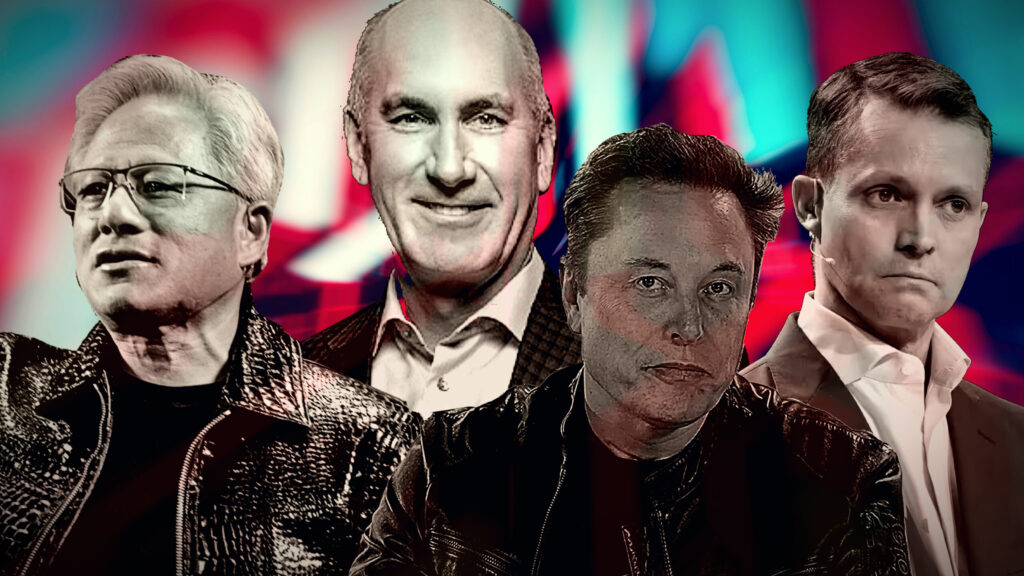
Plenty of AI-RAN stuff from GTC in Berlin today, courtesy of Nvidia and Nokia – live tests with T-Mobile, BT, Deutsche Telekom, Elisa, Orange, plus others. As a show of strength, a year after the US outfit pumped $1 billion into the Finnish firm, it probably worked. RCR attempted to pull together a round-up, but ran out of time; you’ll have to search through their press notes. But most interesting, and the much bigger play, is how telcos might make use the assets they own – their radios, sure; but also their cell sites, fiber networks, switching points, data centers, and other scattered offices and sites – to bring AI closer to the action, in devices, robots, vehicles, machines.
The grand pitch, here, is that telcos can turn their real estate into infrastructure for AI workloads, mostly for enterprises – rather than simply carrying traffic between other people’s training clusters and inference nodes. AI in/on the RAN is part of it, but AI around the RAN seems just as important. Nine operators in the EMEA region are building or expanding Nvidia-powered infrastructure. CRA in Czechia, Etisilat in the UAS, Silknet in Georgia, and TIM in Italy are adding new infrastructure. Deutsche Telekom, Fastweb + Vodafone, Kazakhtelecom, and Serbia-based Orion Telecom are expanding existing deployments.
The announcement offers few details on capacity, investment, workloads – so the scale of the scheme, and the opportunity, remains blurry. But there are some more tangible examples. Deutsche Telekom is to expand its Industrial AI Cloud, apparently, hosting open models including Nemotron and Soofi for customers such as Germany-based Agile Robots. A GTC demo with the robotics firm combines device/robot-edge and network-edge processing for “real-time perception and action” and “fine-tuning and coordination” across a robot fleet, respectively. Larger training workloads stay in a central cloud infrastructure. But it all remains very experimental.
And for all the noise about AI infrastructure, the immediate business for telcos is still about selling connectivity, bundling services, and persuading customers to cough up – as AT&T appears to be doing quite well. Service revenue growth hit a four-year high, with more than a million ‘advanced connectivity’ additions for a second consecutive quarter, as fiber and fixed wireless complemented mobile. AT&T is raising its earnings outlook while lowering longer-term capital investment, even as it pushes fiber beyond 60m locations by 2030. For now, AT&T’s strongest proof point is still the old one: customers, convergence, cash flow. None really are from hosted AI, as yet.
Telcos doing telco things, then, quite successfully, amid all the AI noise. While Elon Musk burns through capital to clarify his AI vision, and makes out like he will bury the old telco set in the process. Starlink has a “clear path” to generate “several hundred billion dollars” a year in connectivity revenue, he says

James Blackman
Executive Editor
RCR Wireless News
RCR Top Stories
Starlink ‘billions’: SpaceX has outlined more plans, almost, for a hybrid Starlink network and claimed a path to hundreds of billions in connectivity revenue besides – as its AI cap-ex surged, along with revenue, and bandwidth demand is going up, up.
DT scales agents: Deutsche Telekom is expanding agentic AI from RAN Guardian’s event-driven network optimization to MINDR, a cross-domain platform designed to diagnose and remediate network issues with human oversight.
Handoff issues: A blunt verdict from RCR‘s NTN Integration Forum: acquisition and attachment are solved, but seamless handoff across to terrestrial networks and across satellite providers still runs on standards, silicon and spectrum.
6G, AI-RAN etc: A new 6G architecture is taking shape, but the business case is elusive. Here: AI-RAN gains, the fight for control of D2D networks, and Industry 4.0’s push from physical AI hype to practical use cases.
6G to the rescue: Ericsson forecasts surging uplink demand as AI shifts mobile traffic patterns, urging operators to avoid 5G’s costly standalone delays. Its 6G vision hinges on spectrum efficiency, reusable infras, and bankable new services.

AI-Powered Telecom Infrastructure
Supermicro, in collaboration with NVIDIA, delivers AI-powered infrastructure tailored for telcos, enhancing operational efficiency, network management, and customer experiences. Explore now
Beyond the Headlines
Core questions: Keysight and Docomo say 6G core development is advancing on a compressed timeline, but AI architecture options remain under study and consensus is still needed.
D2D regulation: Regulators in the UK, US, and Spain are taking different approaches to D2D services, but await WRC-27 for global spectrum rules. Existing deployments risk shutdown under ITU rules if they cause harmful interference.
AI-RAN options: Ericsson has defended its custom ASIC strategy for AI RAN, quite robustly, citing immediate opportunities and 10% spectrum-efficiency gains, and future options for GPU adoption alongside.
What is HBM4E? Samsung and SK hynix have shipped 12-high HBM4E samples with roughly triple HBM3E bandwidth per stack, but no supplier has a confirmed mass production date.
Virginia tops 12GW: Virginia’s operational capacity exceeded 12GW in H1, while Portland and Eastern Oregon reached 3.6GW, as planning pipelines grew and power, infrastructure costs and approvals shaped expansion across both markets.
What We're Reading
AT&T posts gains: AT&T added more than a million ‘advanced’ subs for a second quarter, delivering its strongest service revenue growth in four years. Sales grew 5.3% to $32.3bn; EPS rose to $0.65. It also raised it earnings outlook.
Nokia and Nvidia: Nokia and Nvidia have AI-RAN with T-Mobile, BT, Deutsche Telekom, Elisa, Orange, plus others, combining live trials and telco-side GPUs with agents for autonomy and distributed placements for latency, sovereignty.
AST launch plans: AST SpaceMobile is eyeing D2D coverage in the US, Canada, Japan, UK and Saudi Arabia by year-end, backed by 60-plus operator partners’ gateways and spectrum access, including AT&T, Verizon, Vodafone.
Tosh QSN platform: Toshiba has a quantum-safe networking (QSN) platform for network operators, data center providers, enterprises, and public-sector firms to protect critical data paths as their security and operational requirements evolve.
Telco AI framework: Beyond Now has an AI framework to help mobile operators deploy collaborative AI agents across revenue operations, connecting business context, people, systems and workflows to drive measurable commercial outcomes.
Latest RCRtv Interviews
Events
RCR Roundtables AI Infrastructure, October 21st, Dallas, Texas
Join 50 senior data center, energy and AI leaders at the Ritz-Carlton Dallas on October 21 for invitation-only roundtables on powering and scaling AI. Request your invitation
Industrial Wireless Forum, November 10th, Virtual
From private 5G, Wi-Fi and public cellular to edge AI, spectrum, next-generation IoT and sensing, the forum examines the infrastructure choices and practical challenges shaping the future of industrial operations. Register now
AI Infrastructure Forum, December 8th, Virtual
Join RCRTech’s AI Infrastructure Forum to explore how telcos, hyperscalers and data centres can compete or partner as AI shifts to inference, and who captures the value when every token counts. Register now
Industry Resources
RCRTech Trend
Rise of Non-Terrestrial Networks (NTN)