

I was interested in this news release today about Ericsson’s work with AT&T and MediaTek to field-test something called Layer 1/Layer 2 Triggered Mobility (LTM) for critical IoT, ‘extended reality’ (groan; meaning VR and AR, plus combinations of both), and sundry ‘AI-driven’ (double-groan; anything that might be fairly attached to an analytics tool, which might be usefully marketed as AI) apps. I like the rangy industrial IoT space, as you know; it feels like it matters. I always liked the high-concept 3GPP talk about URLLC, which is really about full-fat IoT (if tractors and glasses, and everything except phones is a ‘thing’), and often about private 5G. This LTM feature looked like a fit.
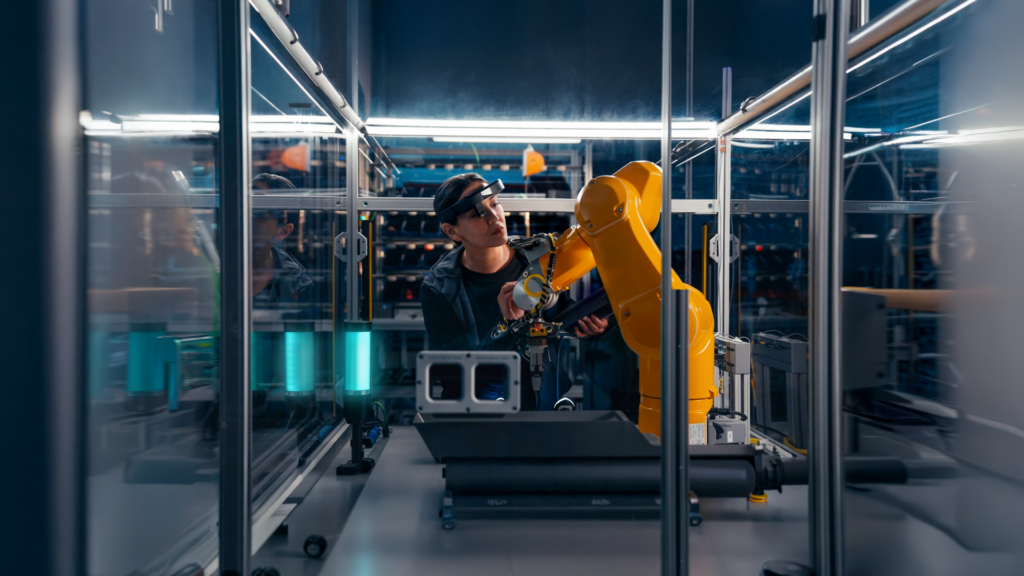
It is not quite; it is an advanced mobility feature, which nevertheless stands to help with handover between sundry 5G macro and edge sites to support low-latency low-jitter apps that might one day be running on URLLC-style slices and such. Continuous connectivity and predictable latency matter, of course, for emerging (AI-driven) applications on distributed infrastructure (AI comms grids) – such as for industrial edge systems, connected vehicles, and whatever XR shenanigans are in demand. Scene processing, say, whether for workers in RealWear (see image) roaming between cells on industrial campuses or punters moping about museums in modish Ray-Ban specs, hinges on good handover.
Disruptions are not going to fly – meaning the industrial fix is missed, and the plant blows a fuse, or the Monet is confused for the Manet. You get the idea. Ericsson says the LTM (nothing to do with LTE-M, for reference) trials have seen handover interruptions reduced by up to 25%, and handover failures, as important as latency reduction for service reliability, might be almost-eliminated. Ericsson explicitly links the tech to ‘physical AI’, of course – describing AI systems operating in the physical world through robots, vehicles, sensors, drones, and industrial equipment – which is stronger language than simply saying it supports woolly AI applications. So it is about all the things I like.
LTM is evolving from a latency optimization feature into a broader mobility enhancement that improves handover speed, reliability, and throughput consistency – capabilities increasingly viewed as prerequisites for critical (!!!) IoT and AI – and private 5G where vendors, operators, and integrators can be arsed to put in the work.

James Blackman
Executive Editor
RCR Wireless News
RCR Top Stories
Nvidia dependence: Nvidia still dominates AI compute, but Microsoft, Google, Amazon, Meta, OpenAI, and Anthropic are all building custom chips to cut their Nvidia dependence, especially for inference workloads.
Protecting 900 MHz: The FCC faces a spectrum balancing act: strengthen GPS resilience without disrupting a thriving 900 MHz ecosystem powering critical IoT, and billions in economic value. Olivier Beaujard at Semtech explains how.
Samsung eyes ’29: Samsung has restarted commercialization of its 1.4nm chip process, now targeting 2029 mass production – two years later than originally planned, as TSMC and Intel push similar advanced nodes.
CUDA GPU designs: Oxmiq Labs is licensing CUDA-compatible GPU and AI chip architectures rather than building chips itself, courting governments and chipmakers who want their own compute without a GPU design team.
Thai AI capacity: True IDC is expanding its data center footprint in Thailand with a seventh facility in northern Bangkok, designed for AI, hyperscale computing, and liquid cooling as regional digital infrastructure demand continues to grow.

AI-Powered Telecom Infrastructure
Supermicro, in collaboration with NVIDIA, delivers AI-powered infrastructure tailored for telcos, enhancing operational efficiency, network management, and customer experiences. Explore now
Insights and Opinion
Private 5G deal: Druid Software has acquired Node-H to simplify the integration of private 4G/5G and broaden the channels through which they are sold – including via operators. The firm says it will help integrators to pair Druid with the best RAN.
Elisa AI results: Elisa tells RCR that AI automation has reduced network incidents by more than 80% as the operator expands 5G monetization through premium services, network slicing, FWA, and private networks.
Anthropic ASIC: Anthropic is reportedly in exploratory talks with Samsung to build a custom AI chip on a cutting-edge 2nm process – a move that would loosen its dependence on Nvidia. Christian has the story.
DC scenarios: NTT models three AI data center growth scenarios through 2030, concluding that power, supply chains, and infrastructure constraints – not demand – will determine whether AI capacity can keep pace.
Telco conundrum: Anxiety is the dizziness of freedom. So said some Danish philosopher – and so says Sean Kinney, writing from DTW that telecoms is deterministic and AI is probabilistic, and therein lies the problem for telco AI
What We're Reading
Telenor buys Bahnof: Telenor is to acquire a controlling stake in Bahnhof, valuing the company at SEK 6.1bn. The deal will make Telenor the second-largest fixed broadband provider in Swden. It will trigger a mandatory offer for shares.
URLLC for AI: Ericsson, AT&T, and MediaTek have tested Ericsson’s URLLC-style trial of Low-Latency Mobility feature, reducing handover interruptions by up to 25% and improving support for XR, critical IoT, and emerging AI-driven apps.
Physical AI is live: NTT Data and HYMH have embedded physical AI on assembly lines at an HYMH factory in Kentucky. The validates assembly steps and detects errors in production of Hyster and Yale lift trucks.
£28m switch failure: Ofcom has fined Virgin Media £28m in the UK for making it difficult to cancel contracts and switch providers. It investigated following customer complaints and concerns that the company discouraged switching.
World Cup record: DE-CIX recorded a traffic peak of 29.5 Tbps during the World Cup last-16 match between Argentina and Egypt. DE-CIX Frankfurt also hit a record 19.6 Tbps, driven by growth in streaming, cloud services, AI, and data exchange.
Events
CCA Annual Convention, September 14-16th, New Orleans, Louisiana
Join industry stakeholders and innovative leaders in the communications service provider community this fall at CCA’s 2026 Annual Convention. Register now
RCR Roundtables AI Infrastructure, October 21st, Dallas, Texas
Join 50 senior data center, energy and AI leaders at the Ritz-Carlton Dallas on October 21 for invitation-only roundtables on powering and scaling AI. Request your invitation